11 minutes ago
Lajcak in Kosovo tomorrow with Schelz and Macron advisers: What Analysts Say
Periskopi(4 years ago)
(4 years ago)There is a growing commitment by the international factor to quickly closing the Kosovo-Serbia dialogue process, say professors and expert on politics and international relations. The appointment of two advisers by German Chancellor Olaf Scholz and French President Emmanuel Macron to help dialogue is seen as a good opportunity for [...]
There is a growing commitment by the international factor to quickly closing the Kosovo-Serbia dialogue process, say professors and expert on politics and international relations. The appointment of two advisers by German Chancellor Olaf Scholz and French President Emmanuel Macron to assist in the dialogue is seen as a good opportunity for intensification and greater seriousness in the process. According to them, Miroslav Lajcak's visit to Kosovo and Serbia on Friday is aimed at increasing pressure on the parties for a solution to the license issue.
Professor Arben Fetos says there is a awareness of the return of international attention to the issue in order for it to be completed as soon as possible.
He says the appointment of two advisers by Chancellor Scholz and French President Macron implies direct involvement of two European leaders.
Also, the warned visit, which is now several times not only of Lajcak, and Mr. Escobar, his coming to Pristina along with two newly appointed people from Berlin and Paris, tells of the growing interest of European powers in this case of the European Union to increase pressure on the parties in order to first create a new solution to the license process because it is already practical that requires solutions, following the implementation of the personal documents, and I am certainly convinced that we have made an increase in international interest to close the issue legally related to the dialogue that needs to be brought about, as long as it is stated in its full-fledged recognition of the constitution, as long as long as it is to be mentioned in the EU-definance.
Even according to political science professor Dritero Arifi, the European Union has been intensively relocked in the dialogue process.
The “will have explosive requirements, especially on the issue of license plates that may perhaps go softer or be required until a solution to final issues is found in Serbia, because I believe these issues will all be left in a legally binding final agreement with mutual recognition, if there is no solution at the moment... The European Union is especially re-keyd by France and Germany in the dialogue, intensively, now directly with the commitment of advisers of both countries, and I expect there will be a new dynamisation, a greater intensity and seriousness in dialogue”, Arifi says.
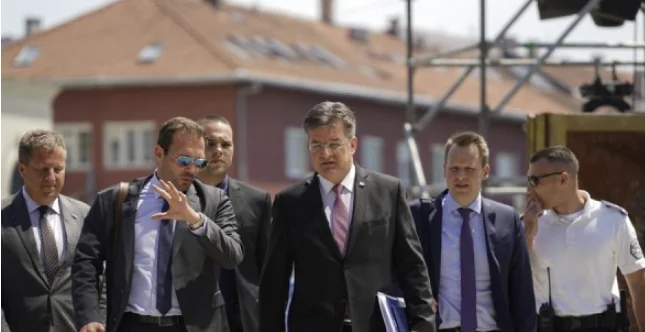
On Friday in Kosovo, the European Union's emissary for the Kosovo-Serbia dialogue, accompanied by advisers Jens Plettner and Emmanuel Beaune, appointed by German Chancellor and French president.
The meeting with Prime Minister Albin Kurti has been confirmed in Kosovo, while the same will visit Belgrade, where Serbian President Alexander Vuciq will be expected.
“They will visit Belgrade and Pristina together and hold separate meetings with President Vuciq and Prime Minister Kurti. The goal is to discuss how to get Dialogue before”, EU Foreign Policy and Security spokesperson Peter Stano has told Kosovo.
On September 4th, French President Emmanuel Macron and German Chancellor Olaf Scholz sent letters to Kosovo Prime Minister and the president of Serbia, where among other things, they called on two leaders to show commitment and maximum readiness to make difficult decisions that, according to them, lead to progress in Kosovo-Serbia dialogue.