11 minutes ago
Kosovo and Serbia increasingly closer “difficult decisions”
Periskopi(4 years ago)
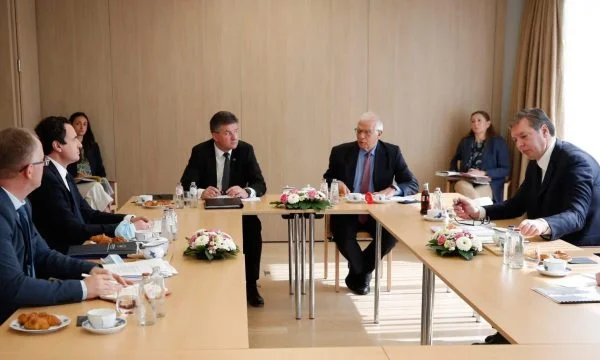
(4 years ago)Not a week has passed since the start of implementing the agreement between Kosovo and Serbia for abolishing the opening/scaling documents, and there is expectations of further progress on the two sides. “Dialogue between Kosovo and Serbia is entering a new level of seriousness”, estimates the connoisseur of political processes in Kosovo, Agon Maliqi. States of [...]
“Dialogue between Kosovo and Serbia is entering a new level of seriousness”, estimates the connoisseur of political processes in Kosovo, Agon Maliqi.
The Quint States Germany, France, Great Britain, Italy and the US are creating a common voice regarding this process, Dusan Janjaq, from the Forum for Ethnic Relations in Belgrade, says.
The sign of such a thing, they say, is German Chancellor Olaf Scholz's decision, and French President Emmanuel Macron, to appoint their advisers for dialogue.
Jens Plettner and Emmanuel Beaune were told they would provide support to the EU envoy for the process, Miroslav Lajcak.
Lajcak and the two new advisers are expected to stay in Kosovo and Serbia on 9 September.
“
Maliqi recalls that the appointment of advisers from Germany and France does not take place for the first time, but the time when it happens until the Russian invasion of Ukraine continues adds seriousness to the move, he says.
“This can also be seen as a sign that important states, such as Germany and France, smell the possibility of moving forward with a comprehensive agreement [between Kosovo and Serbia], but also use the opportunity to stress [this process's]”, Maliqi says of Radio Free Europe.
Diplomats in the West say that Russia's war in Ukraine, starting in late February, has created a new moment for European security, but also for stability in the Western Balkans, where some countries still have open issues.
Maliqi says the “is visible” that Kosovo and Serbia are entering a negotiation process, which may soon end, though not necessarily. He says the EU countries' sensitivity to dialogue has influenced NATO's “almer.
Last month, when tensions between Kosovo and Serbia have increased due to a government decision in Pristina for vehicle plates and travel documents, NATO has warned it will intervene if stability is put at risk.
I see it as the greatest concern [of EU countries], as greater commitment ... but also as the form of pressure on [Kosovo and Serbia] leaders not to repeat cases of escalation that occurred late, and to use the opportunity to move towards a” agreement, Malqi says.
Janjiq, on the other hand, says Quint may be preparing an international conference for Kosovo and Serbia.
“... so that this conference helps the parties bring about bold decisions. It is necessary just what Scholz and Macron have told Kurt and Vuciq themselves to start making bold decisions”, Janjic says.
When Scholz and Macron announced on September 4th the appointment of their advisers, they sent a letter to Kosovo Prime Minister Albin Kurti and Serbia's president, Aleksandar Vuciq, calling on them to show willingness to make difficult decisions, which, as it was said, would bring progress in the dialogue.
What those decisions might involve was not elaborate.
EU aid in finding compromise
EU spokesman Peter Stano suggests Lajcak and the new advisers will meet on 9 September Kurti in Pristina and Vucinqi in Belgrade.
We really want to do as much as we can to help both sides find all necessary compromises and reconciliation to move the dialogue forward, to close all open issues and, ultimately, reach comprehensive agreements on normalisation of relations, mutually and legally acceptable”, Stano tells Radio Free Europe.
Asked if the dialogue is entering a new phase, Stano explains:
The time benefits and results in dialogue between Belgrade and Pristina, mediated by the European Union, always depend on the ability, will and willingness of the two sides to find the necessary compromise. The EU, as a facilitator of this dialogue, is trying to help both sides find this compromise. Everything that is happening now is part of this” activity.
What do citizens say?
For some citizens surveyed by REL in Pristina, there is still question whether a comprehensive agreement between Kosovo and Serbia is near.
Artan Behluli, professor of architecture, says international pressure for reaching an agreement is more focused on Serbia. But, he says he does not expect results which Kosovo would like.
Serbia, on several strategic lines, does not change politics. She's so patient. Maybe she has a historical memory that makes her realize that Europe is what changes, not Serbia”, says Beluli.
Ramadan Ahmeti, a bank worker, estimates that Kosovo's Western partners are increasing the pressure to reach an agreement that would resolve disputes between Kosovo and Serbia.
I believe there will be a deal. I believe it's closer than it was. But I still wonder if it will be a satisfactory agreement for us, and not talk about them [Serbian side]”, Ahmeti says.
Dedicated, Both Says
From the Kosovo government, free Europe Radio says they welcome “the additional dedication of two important European Union states” Germany and France ʹ in reaching the legally binding agreement for full normalisation of relations between Kosovo and Serbia, with “mutual recognition at the centre”.
“Prime Minister [The Kurti] also shares the opinion that normalising relations between Kosovo and Serbia is of particular importance for the Western Balkan region and that the Government is committed to principled dialogue”, said in a statement issued by the Kosovo Prime Minister's Office.
Authorities in Serbia did not publicly comment on the additional commitment of Germany and France in the dialogue. But, during a visit to Kosovo on 5 September, Serbian Prime Minister Ana Brnabiq stressed that her country is “always ready for dialogue”.
“ [Negotiation of relations] we need, not because of European integration, but because of ourselves, because of what we sincerely want, which is peace and long-term stability”, Brnabiq said in North Mitrovica.
With the European Union's mediation and US support, Kosovo and Serbia have started talks on normalising relations since 2011.
The sides have reached dozens of agreements, but their implementation on the ground has stalled, and for that, they blame each other.
Last month, tensions between them have increased, as a result of a Kosovo Government decision on reregistering cars with license plates that leaves Serbia in the RKS (Republishment of Kosovo), as well as on separate entry/scaling documents for citizens of Serbia.
In recognition, some Serbs in northern Kosovo have rebelled and set up barricades.
With the international community's suggestion, Kosovo has postponed implementing the decision for 30 days, until September 1st, respectively.
But, meanwhile, with the mediation of Western diplomats, the parties have reached agreement on the removal of the opening/speed documents on both sides, which has entered into force on September 1st.
The challenge now remains to reregister vehicles. Serbia wants negotiations, proposing neutral plates on Kosovo's status, but the Kosovo government does not give up its decision. The reregistment process, which is said to last two months, has started on September 1st.
During the visit to Kosovo, Serbia's prime minister, Ana Brnabiq, also said that “is the time” to form the Association of Serb majority municipalities in Kosovo.
Even though the parties have reached agreement on this Association, Prime Minister Kurti says Kosovo cannot accept forming a “single-ethnic organisation”.
The international community, on the other hand, repeatedly reiterates that the agreements reached must be implemented, including for Association.
What would be the difficult “decisions of the parties to normalise relations, remains to be seen.
Kosovo has made it clear that the comprehensive agreement should include mutual recognition with Serbia, which Serbia, for the time being, says it will not.