17 minutes ago
Corona: China is closing down again
Periskopi(4 years ago)
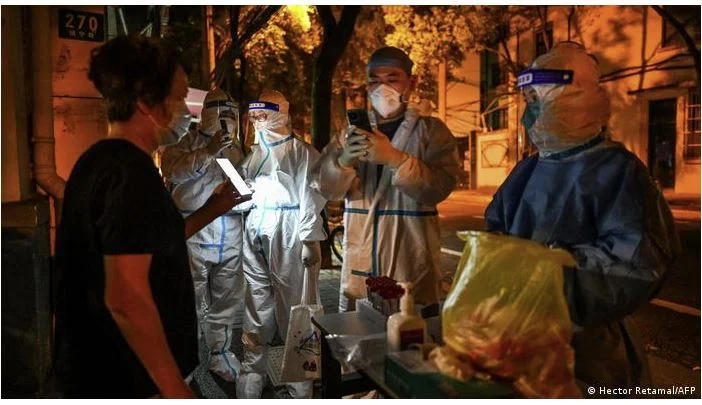
(4 years ago)Some large Chinese cities have tightened their measures against spreading the Corona pandemic. Several major industrial centers have also been affected. The Shenzhen technology centre, the port city of Dalian and the Guangzhou economic metropolis. This is the list of major Chinese cities affected by restrictions due to the Corona pandemic, and this list is becoming [...]
The Shenzhen technology centre, the port city of Dalian and the Guangzhou economic metropolis. This is the list of major Chinese cities affected by restrictions because of the Corona pandemic, and this list is getting longer. The Center for Analysis Capital Economics counted 41 Chinese cities under measures Wednesday, which account for 32 per cent of China's economic output.
“At the moment the injuries that are causing these measures are modest, but the risk of damage is increasing”, warned economist Julian Evans-Waitard of Capital Economics. “But even if the damage is avoided, we expect economic growth to be lower in the future. ”
Guangzhou near Hong Kong, which has almost 19 million inhabitants, reported only five infections Wednesday. However, authorities ordered that restaurants be closed until Saturday in certain areas and that events within the facilities be cancelled. Closed gardens should stay, as well as elementary, high and high schools, while autumn semesters at universities will be postponed. Bus and subway connections have also been reduced.
The Shenzhen technology centre has already ordered the closure of entertainment and cultural sites at least four counties with a total of about nine million people. Restaurants will also not be able to open or open to a limited extent for several days. The economic production of Shenzhen and Guangzhou together reached 5,89 trillion yene (about 850 billion euros) last year. By comparison: This corresponds to about half the gross domestic production of South Korea.
Effects on German Economy
According to the Kiel Institute for Economic Studies ( IfW), municipal jams are already worsening barriers to global supply chains. However, current restrictions in Shenzhen and other cities are not yet comparable to the drastic impasse in Shanghai in the spring. If the cases of Covid-19 continue to grow, an even stricter impasse, especially in Shenzhen and around it, could burden the supply chains and the Christmas business”, warned IfW trade expert Vincent Stamer. “Because the province of Guangdong around the Guangzhou metropolises and Shenzhen in the Pearl River Delta is China's province with the largest exports. Many consumer goods for the German market are produced there. ”
China actually wanted to achieve a 5.5 per cent economic growth this year, which seems less and less real. Experts expect only four per cent due to Covid's restrictions and problems on the real estate market.
The Chinese industry contracted again in August, according to the Statistics Office survey. The acquisition index has dropped by 0.4 points, and now it's 49.0 points. Economic growth is possible only if the consumption index exceeds 50 points. The economy is affected not only by Corona's measures but also by the worst wave of heat and droughts there that are not remembered for decades, as well as the crisis in the real estate market.
Therefore, banking economists have reduced their forecast for the second largest economy in the world after the United States. Experts from the ANZ, for example, expect in China only an increase of gross domestic output of three per cent this year, and had previously been expected four per cent. /dw