31 minutes ago
Albanian Post: Controversial Agreement next year, final after 10 years -Serbia benefits massive aid, but what does Kosovo get?
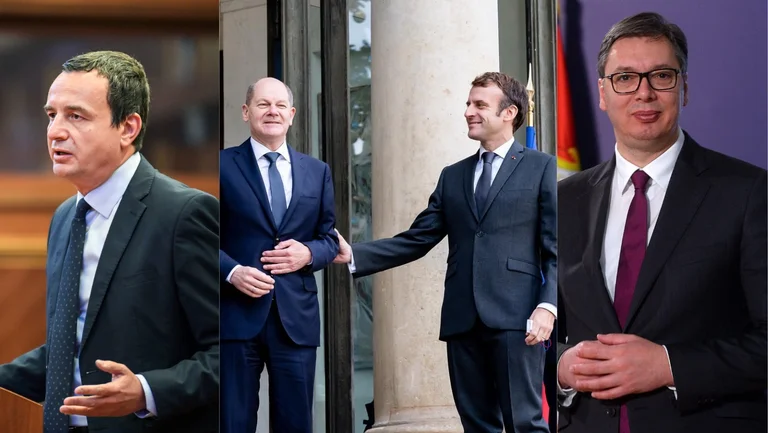
Periskopi(4 years ago)
(4 years ago)In 2023, the second agreement on normalisation of relations should be signed, following that in 2013, with which Serbia actually accepts Kosovo's reality independent state, but does not formally recognise. In a later phase, hypothetically after 10 years, when the EU is ready to expand and [...]
This is the plan presented in the new framework for agreement between Kosovo and Serbia, compiled after the commitment of President Emmanuel Macron's advisers and Chancellor Olaf Scholz.
With next year's deal (if the proposal is accepted) Kosovo also accepts five states that have not yet recognised the European Union, while Serbia will benefit massive financial assistance, economic assistance and will be recognised as the power of the region.
The new “Cornosis which Albian Post owns is the new proposal coming directly from Scholz's involvement in the dialogue process, because, as stated in the document “Kosovo and Serbia in themselves will never solve the matter”.
The four-page document, which explains the logic behind the new framework, contains the 10-year-old vision of the problem's solution and provides a “macro-perspective”.
The document consists of entry and is later divided into three segments along with three sub-titutes containing 13 points.
All segments explain the so-called “new corsage”, which was introduced to Alexander Vucic's Albin Kurti. This framework, publicly, has been accepted only by Serbian President Vucic following the two advisers' visit to Belgrade.
The proposal at the end also envisions how to keep going if Kosovo and Serbia do not accept this proposal.
Dialogue vision, a marko-perspective
This section shows at three points what is envisioned in the next 10 years if the agreement is accepted. Current developments are seen as the continuation of the EU's engagement, in the dialogue launched a decade ago.
“2013, first agreement on normalisation of reports. 2023, the second agreement on normalisation of the reports (the actual acceptance of Kosovo's independence towards a formal act of recognition). 2023, the third agreement on normalisation of the reports -- bilateral recognition -- shortly before the six Western Balkan states join the EU” -- is written in the documents.
The first point is that “A substantial normalization of the reports must be achieved by the middle of 202318x1>.
Then it goes on with the second point.
Kosovo and Serbia are the two separate legal and political realities that should be recognised as such by all sides in the dialogue process. All parties are Pristina (Kosovo), Belgrade (Serbia) and Brussels ( The EU, meaning all EU states, including non-concilators)”.
The next point explains Serbia's position.
Serbia will not be ready to join the EU without a complete normalisation of political, legal and diplomatic reports with Kosovo. However, given that Serbia's EU accession is still far apart, at this stage Serbia will not be required legally to recognise Kosovo”. According to AP sources, this position is a consequence of the fact that, currently, the EU is not even willing to consider a accelerated membership for Serbia, therefore the other Western Balkan countries.
Therefore, at the fourth point is determined that “for now, instead of recognition, Serbia must accept Kosovo's reality as a particular political and legal reality”. This point, during the conference in Belgrade, has been publicly accepted by President Vucic when he declared: “they insist there (so in Kosovo) there is a reality that we should accept as such”.
Before passing on to explain “practical settings”, a remark is given.
Document explains “Esence here is the correct use of semantics: Kosovo's independence (apceptance) towards recognition (recognition) of Kosovo independence”.
Explaining what recognition (acceptance) of independence divided into three points implies.
“In actual terms, Kosovo and Serbia must completely normalise reports, enabling the bilateral movement of people and goods. ”, says first point.
This normalisation must also reflect on regional reports. In other words, interconnection, socioeconomic development, good neighborhood, and digital data. The Joint Regional Market promoted by the Regional Council for Co-operation, based on four EU freedoms and the leading region towards the EU's Single Common Market”, is said at second point.
According to Albanian Post sources, Germany and France insist on this point. These two powerful states, pillars of the EU, have harmonised their policy towards the Western Balkans. France stands firmly behind Germany in its quest for the full vitalisation and success of the Berlin Process, while Germany stands firmly behind France in its vision of a cautious policy of enlargement towards the Western Balkans. France and Germany have made it clear to Kosovo and Serbia that within 2022 they want practical agreements, between the two sides, and that they enable the successful revival of the Berlin Process.
The third point says that “accepting Kosovo as a divided political and legal reality, Serbia will take a passive position and will no longer oppose Kosovo's membership in the international organisation”. According to portal sources, the non-active rejection of Kosovo's membership in international organisations is a specific and very powerful requirement towards Serbia.
After explaining these document points, the position of the EU as a whole and states separately in relation to Kosovo's status is clarified.
After the second agreement on normalisation of the reports, the five non-connocident countries in the EU will join 22 other EU nations and recognise Kosovo. This union enables Brussels to address the membership of six Western Balkan states as a single bloc”, the document says.
It also envisions Kosovo's membership in international organisations and this journey runs through four phases, but it is previously found that Serbia's passive “position does not permanently solve the problem”.
Kosovo's “Membership in the United Nations Organisation depends on Russia's veto of the Security Council. However, until the EU and the United States resolve their issues with Russia, following the second agreement on normalisation of the reports, Kosovo's membership in international organisations will go through these” stages.
Under the proposal, the first phase is “Kosovo becomes a member of the Council of Europe”. Second phase “Membership in Interpol and U NCO” The third “Faza, the start of NATO accession talks, EU membership application” and the fourth “Faza: UN membership”
All in the end, it explains what the two countries benefit from if they sign the agreement and what the consequences will be if the accord is not reached.
As for Kosovo, it takes on the recognition of five EU states, unblocking the prospect of membership in NATO and the EU”, and “Serbia receives a massive financial aid and economic assistance, as well as will be recognised as the force leading economically and politically the” region.
Since Kosovo has neither visa liberalisation currently and is virtually isolated, the consequences of not signing have to do with the government rather than with the state itself. The document highlights the complete isolation of Kurti's government as a form of pressure that would affect government life expectancy.
While, if Belgrade does not accept it, then succeeds “economic and financial isolation” and also emphasises that “Five non-connouncil states will eventually abandon Serbia and join other states that have recognised Kosovo. Despite the result, the EU will speak with a voice of”.
After developments in Ukraine, the issue of EU unity, opposite Kosovo and Serbia, has returned to Achilles' heel for the EU itself, so France and Germany are committed to practical, political and legal demonstrations of European unity.
So Serbia is set before a position where it becomes clear that, in the event of opposition, it will lose both the much needed economic and political assistance of the EU and the support of five non-recognisive states.
The document, as explained at the outset, is a perspective macro, drafted as a draft explanatory of key dynamics, and does not deal with specific elements, nor with agreements one by one reached so far in Brussels -- one of the most problematic, the Association of Serb Majorities.
What has been seen so far, the EU and other Western diplomats want all signed agreements implemented, including the Association, which the Kosovo government opposes.
Albanian Post sources, which have direct knowledge of the current process, state that, without a willingness of Serbia to formally recognise Kosovo's independence, it is very difficult to reach an agreement about association, which would ensure a higher degree of autonomy for Kosovo Serbs. In other words, easily, discussions on association can be shifted for the third phase of dialogue, when the European perspective for Serbia and Kosovo becomes tangible.
/Albanianpost. com