23 minutes ago
“The truth is taught in Prekaz”
Periskopi(4 years ago)
(4 years ago)The visits of the citizens of Serbian ethnicity to the Memorial complex “Adem Jashari” to Prekaz would have to be seen as something positive, because the truth of what happened in Kosovo can be learned, says Bekim Blakaj, from the Fund for Humanitarian Law in Pristina. Visits of Serbian students' academic and researcher nature [...]
Visits of the Serbian students' academic and researchist nature to this memorial should not be hindered, estimates Ismail Hasani, professor of Sociology.
But, unlike them, Squirew officials from the municipality where Prekaz village is located and representatives of the Kosovo Liberation Army Veterans' Organisation say that Serb visits there would create sensitive situations.
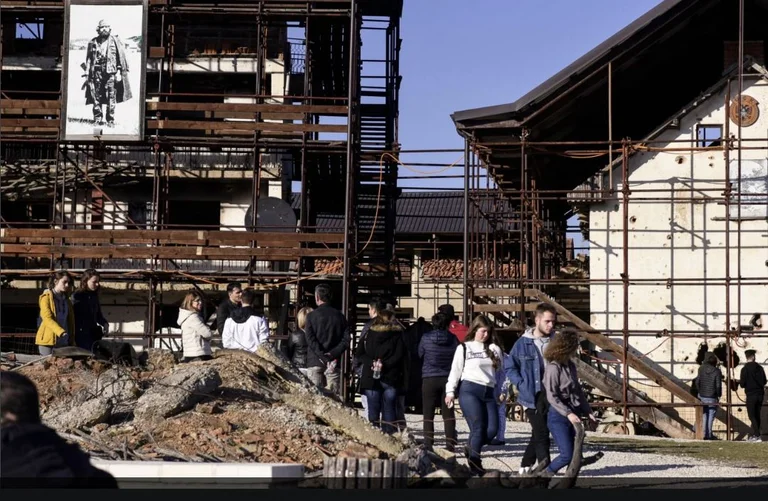
The “Adem Jashari” complex is a monument to cultural heritage, which commemorates events of 5, 6 and 7 March 1998, when forces of then Yugoslav President Slobodan Milosevic's regime killed 20 members of Adem Jashar's immediate family and over 30 relatives and relatives.
A failed visit by about 60 students, who are participating in the International Summer Academy in Pristina, was filed for debate over Serb visits there.
Their journey towards this memorial on 17 July was prevented by a group of football club fans “Drenica”, dubbed “Black Eagles”, with claims that there are Serbs among the students. Fans were joined by several members of the KLA War Veterans Organisation of the Skyright municipality.
Despite the presence of Kosovo Police members at the scene, the bus with students was forced to stop traveling to Prekaz and return to Pristina.
Labinot Hajdari, from the International Summer Academy, said in a Facebook text on July 17th that in the group traveling to Prekaz, “all were international”. According to him, their visit was canceled “not to provoke the” situation.
Nura: Visits That Create Sensitive Situations
The head of the Skyeraj municipality, Fadil Nura, says order and security institutions have been dealt with in case of rejection manifested on the street by fans “Black Eagles”
Whether or not those young men warned the protest, I don't know. There have also been some asambistists. I had communication with the police station commander [in Skenderaj]. I have confirmed that they can [trest] on their own behalf, but they cannot be called either on behalf of the municipality or on behalf of the [political] subject for such protests. So we, as a municipality, have nothing to do with this case”, Nura says Radio Free Europe.
He adds that it is not against the eventual visits of Serbian students to the “Adem Jashari”, but, according to him, circumstances should be set for such visits.
“ ... but it's been a while since peace was achieved and then visits have become completely normal”, he points out.
As long as there are still uncut wounds in this country, unfortunately... I don't mind anyone's visit... But it's a little sensitive”, Nura adds.
Lati: Serbs should apologise, students are not to blame
Emin Lati, representative of the KLA veterans' organisation in Skenderaj, says he was present at the scene when “The Black Eagles have blocked the students' route to Prekaz.
The Serb, without apologizing, is my opinion. Now, come their children and visit places where their ancestors committed crimes, that's not right. At least not without a moral apology. Students are not to blame. They are young men and young women who are not to blame. They, perhaps, were not even born at the time”, says Latty of Radio Free Europe.
Police don't give an explanation
Radio Free Europe turned to the Kosovo Police for the South Mitrovica region, which also covers the Skokyright municipality, with the question of whether the fan protests “were warned. Black Eagles”
This police spokeswoman, Fajrije Plana, said it was not a protest and that police have their official version.
However, Plana interrupted the telephone link, without clarifying what the official police version of the case is. Then she wasn't available.
Radio Free Europe also addressed the Government of Kosovo with the question of whether an evental visit of Serbs, as individuals or as organized groups, to the Memorial “Adem Jashari” in Prekaz can be seen as problematic, but until the publication of this text it did not respond.
Despite the effort, REL failed to contact even members of the fan group “Black Eagles”
Not rarely, students from Serbia attend the various summer universities that are organised in Kosovo.
Such is the case this year at the University of Pristina International Summer University. This university has scheduled a visit to the memorial in Prekaz on 16 July, but it has not been realised. From the university they haven't given details about why or whether one will be realised in the coming days.
Blake: Serbs Must Listen to the Truth
Bekim Blakaj, from the Fund for Humanitarian Law in Pristina, says that justice has not been established for the majority of war victims in Kosovo.
According to him, there is no formal acceptance of the truth by the state of Serbia for crimes committed in Kosovo.
But, in spite of that, Blakaj says, the visits of any Kosovo community to countries where crimes have occurred, in principle, should not be problematic.
Instead, this should be viewed as something positive, because I'm sure those young people would hear the truth there and then agree with the victims. Then the truth would be conveyed further to their families, to their society, and so on to”, Blakay tells Radio Free Europe.
Hasani: academic and working visits must not be stopped
Sociologist Ismaile Hasani says the ban on visiting students of any ethnicity or any community in the Memorial “Adem Jashari” is totally unreasonable.
I don't think it's fair to stop realising an activity, which has been fully academic. The visit to the Memorial BARdem Jasharı in Prekaz, in this form, not only should it not be stopped, but it is welcome”, Hasani says.
As for individual visits of Serbs, he adds, they are not only early but also impossible.
“... to the fact that there has been a tragedy of unprecedented proportions in human history. It means, it has almost disappeared that a whole family”, Hasani says.
In this context, it singles out individuals of Serbian nationalism, coming from space outside Kosovo.
“While those [Serbs] living in Kosovo who accept the state of Kosovo and who do not have their hands washed with blood can visit the memorial in Prekaz, either for curiosity or to convince themselves what Milosevic's regime has done”, Hasani says.
The former head of the Skywright municipality, Bekim Jashari, a member of the family for which the memorial was established, said he understands the “reaction. The Black Eagles”, but, in a Facebook post, he expressed concern about the images where, as he said, “allegedly were prevented from visiting the Memorial complex ledem Jasharım several international students, guests in Kosovo”.
He said “the selection” of fans, except for “, is contrary to Albanian tradition in relation to guest, also conflicts with our family positions as a family”.
Kosovo has emerged from the 1998/99 war with over 13,000 people killed and thousands missing.
Even 23 years after the war are not yet known for the fate of over 1,600 people, most of whom are of Albanian national affiliation.
Kosovo leaders repeatedly reiterate that the future cannot be built by denying past crimes, while urging Serbia to accept responsibility and apologise for war crimes.
Officials in Serbia often deny the crimes of Serbian forces committed during the war in Kosovo.