24 minutes ago
My mouth is all upset
Periskopi(4 years ago)
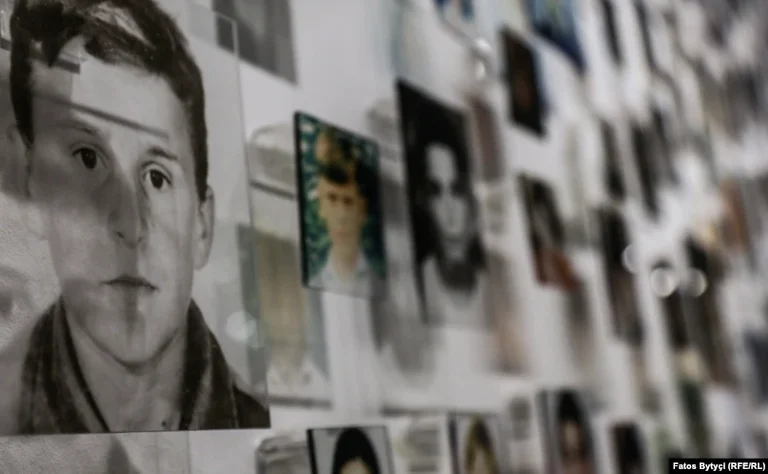
(4 years ago)Alemshahe Krasniqi, 65, from Fushe Kosova, finds it difficult to wait for April 1st and recall the same date of 1999. She, 23 years ago, Serb forces killed five members of her immediate family, her husband, daughter, her father-in-law, her brother-in-law, and eight other members of the immediate family. [...]
She, 23 years ago, Serb forces killed five members of her immediate family, her husband, daughter, her father-in-law, her brother-in-law, and eight other members of the immediate family.
After the start of the NATO forces bombing on Serbian targets, members of the Krasniqi family had initially tried to flee their homes, but Serb forces had turned them back.
“M) killed five family members”
To avoid the danger of total annihilation, men had separated themselves from women, taking refuge in their two homes. But when her daughter, Blerta, had gone to bring bread to the men, along with her close companion and two other women, all had found death there along with the men, executed by Serb forces.
My husband's mother and father, two chips, my husband and brother-in-law, that's six. Agron the seventh, Hamdi the eighth, Zymber the fourth, is making 12 and Miftar, the thirteenth. There's been another couple of buckets, two or three. My daughter was named Blerta. I had the only thing simple. Agron, Arben was young. My eyes are blind... but how come? I feel like it's blacker... Now, speaking, I'm getting my mouth-blown”, Alemshah relates.
At the same time, a group of women from Pristina, who had been sheltered in houses near the Krasniqi family home, had been deported under the arms barrels of Serbian forces, towards the train station.
And they brought some women and girls over to our backyard and took them to the train station. Same cops, two, masks. Of the women of the neighbours who were deported, one of the girls mentioned a policeman named Peja”, says Alemshaya.
Six years after the plow against the Krasniqi family, the lifeless bodies of this family members were found in The mass cemetery in Batajnica, in Serbia's capital, Belgrade.
My brother - in - law and my mother - in - law, six years later, at the morgue in Rahovez. The husband and father - in - law and one of our neighbors have been bringing them seven years later. We buried them. Tomorrow (April 1st) we have the anniversary, 23 years old tomorrow. Heavy enough. But better than those bones in there than not to let them know their graves at the bottom of”, Alemshah says.
But not more than two decades later, she says, murderers were never found, nor were justice brought to her dead loved ones. She says her hopes of ever being brought to justice have waned. However, she does not believe Kosovo institutions lack the will for such a thing, but, as she puts it, “so we have power”.
“Plaxation softens when the perpetrators receive sentence”
The same fate separates Olgica Kostiq Boziniq from the village of Opteriusa, near Rahovec, who lost 15 members of her close family in June 1998, including two brothers, Lazarus and Todor.
Neither does she have high expectations of war crimes trials in Kosovo.
She tells Radio Free Europe that the remains of her killed family were found in a mass grave -- Volljaka, near Kline in 2005. But it stresses that the grief and pain he has experienced, for more than 20 years, will be softened only when the authors receive due punishment.

Mass graveyards identified throughout Kosovo
Hopes are based on the processes under Kosovo's Specialised Chambers in The Hague, which are mandated to investigate alleged crimes against humanity, war crimes and other criminal acts, which have been committed in the period from January 1998 to December 2000.
For the perpetrators to be punished, so that crimes do not repeat in the following period, there will be no such thing as”, says Olga Kostiq Bozinic.
She also believes that if all the authors are found and punished, reconciliation in Kosovo will be achieved and then return to Rahovec, about 60km southwest of Pristina.
During War in Kosovo About 14,000 people were killed.
Peci: Trauma - A Psychological Burden of Family Members
Faithful Peci, psychologist and sociologist, in a conversation with Radio Free Europe, points out that the traumatic situations experienced by the families of the victims of the recent war in Kosovo are the trauma that will accompany them throughout life. But, as he says, in times when Justice Set in Place The burden of psychological weight is eased in family members, although it does not disappear completely.
“On the psychological level, every television scene, every anniversary, every talk in the function of war and function of the traumas of that situation, directly affects the psychological, mental well-being of the family who are faced with the latest”, says Peci.
He adds that in most cases, people have personally faced post-traumatic stress, suffering, and the consequences of the war they have experienced.
There's a pre-traumatic pressure 20 years after the war. Thus, it is not too late to be involved in starting initiatives that would treat family members who have lost loved ones are traumatized and have burdens of gravity on their shoulders, which they are now carrying for more than 20 years”, Peci noted.
Is there justice for war victims?
“Justice For war victims where is it stuck? ”, is the title of the report published by the Kosovar Fund for Humanitarian Law, supported by the European Union, the United Kingdom and Switzerland, which was released in Pristina on Thursday, March 31st.

Mass cemetery locations identified in Serbia
Fund for Humanitarian Law In Kosovo, it monitors and analyses war crimes judgments committed against civilians before courts in Kosovo.
As reported in 2021, the Fund for Humanitarian Law in Kosovo has monitored a total of 50 court hearings on eight cases related to war crimes charges against civilians.
According to this fund report, during 2021, Kosovo's justice institutions have filed only one indictment for War crimes carried out in 1998-99, meanwhile since the end of the war so far, 72 people have been sentenced to domestic courts.
FDDK project co-ordinator Amer Alija, during the report's presentation, said that last year two people were arrested under suspicion of being arrested. Criminal Work War crimes cases of five war crimes were prosecuted against the civilian population for six defendants.
“There are delays in war crimes cases”, Alija said, and added that Kosovo institutions and competent authorities must take some steps to avoid delays.
Also, it was found that there are still major challenges in prosecuting war criminals, even though more than 20 years have passed since the war in Kosovo ended.
Heidi: Judgment in Lack When All Legal Options Run Out
Commenting on the FDDK's findings, Kosovo Special Prosecutor Drita Hajdari's head of war crimes, argued the establishment of only one indictment during 2021 with the inability to arrest the perpetrators of these criminal acts.
The prosecutor handled the cases and filed charges in cases where we secured the defendant's physical presence. It means, we cannot file charges in cases where we do not have the presence of the leaders of those criminal acts”, Hajdari said.
She added that even though Kosovo has one A law of judgment in want, According to her, that law is almost inexplicable.
This option (indiscretion judgment) should be applied in cases when we exhausted all legal opportunities for apprehending the head of criminal work”, Hajdari said.
According to her, there are currently more than 1,000 war crimes cases.
Hajdari said that the arrest of the defendants is problematic, because most are located outside Kosovo, and that depends on INTERPOL and the state will in which the defendant is found. According to her, there have been cases when defendants have been extradited, but even when extradition has been refused.
Miftarian: Old Reasons About Prosecutor's Failures
Ehat Miftaraj, executive director of the Kosovo Institute for Justice in a conversation with Radio Free Europe, says that according to the institute's reports, Kosovo has clearly had no clear vision and strategy on how to approach investigations, prosecutions and war crimes trials in Kosovo.
He says that Kosovo's Special Prosecutor, as authority with exclusive competence for investigating and prosecuting war crimes criminal acts since 2015, when he also received competencies from EULEX, for seven years has failed to prove concrete, investigation, prosecution and trial of war crimes cases.
Unfortunately, this prosecutor, for years, argued that applicable legislation does not allow judgment in absentia, and this is presented as an obstacle to the investigation, the prosecution of the perpetrators of these war crimes acts that They've happened in Kosovo. The moment this law, the Code (Penal), has been met, changed, and entered into force, the old reasonings are restored that the physical presence of those who committed war crimes in Kosovo is in some way hindering them from exercising their competencies and responsibilities”, Miftaraj points out.
He adds that Kosovo prosecutors' reasonings about, as he calls their “failures” can be broken by taking example prosecutors in the Republic of Serbia.
Serbia's Republic also has no access to the persons allegedly committed crimes in Kosovo, but the same hold investigations. The applicable legislation in Kosovo allows it to be issued in any case when there are doubts that someone has committed war crimes in Kosovo, to issue a decision to start investigations, then investigates will then be conducted, and in these cases the international arrest warrants against persons who cannot be brought to Kosovo”, Miftaraj says.
From 2000 to 2008, war crimes in Kosovo have been investigated by the United Nations Mission (UNMIK), and since 2008 The European Union's Mission for Rule of Law (EULEX) is responsible for investigating war crimes.
In 2018 this mission has delivered documents to the Kosovo Prosecution and to local courts. / REL