4 hours ago
Russia letter to Albania: Tell us whether you are for or against Ukraine's NATO membership
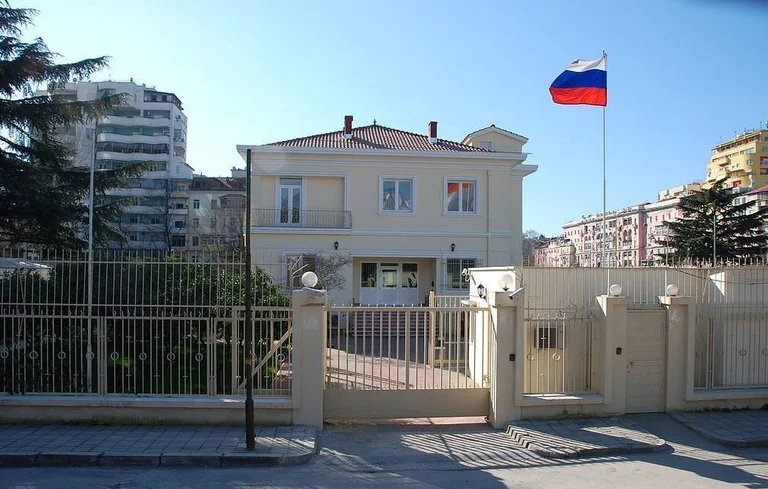
Periskopi(4 years ago)
(4 years ago)Russia's Foreign Ministry has sent Albania a letter in which it is directly questioned whether it is pro or against Ukraine's membership in NATO. The letter, rare in its kind, is published on the face of the Russian Federation Foreign Affairs Ministry and has all [...] address.
Russia's Foreign Ministry has sent Albania a letter in which it is directly questioned whether it is pro or against Ukraine's membership in NATO.
The letter, rare in its kind, is published on the face of the Russian Federation Foreign Affairs Ministry and addresses all NATO countries, which according to the Russians must give their individual positions on related security issues.
The move has been read as Russia's diversion to NATO states to understand whether there are cracks in the organisation's position and whether there are states that will veto Ukraine's membership in it, abcnews writes.
Full letter:
You know well that Russia is seriously concerned about increasing political-military tensions near its western borders. Aiming to avoid any further escalation, the Russian side presented on December 15th 2021 the drafts of the two interlocked international legal documents a treaty between the Russian Federation and the United States of America for Security Guarantees and an agreement on measures to ensure security. The Russian Federation and the North Atlantic Treaty Organisation member states.
The US and NATO's answers to our proposals taken on January 26th 2022 demonstrate serious differences in the sense of the principle of equal and inseparable security, which is essential for all European security architecture.
We believe it is necessary to clarify this issue immediately, as it will determine the prospects for future dialogue.
The European Security Charter signed at the OSCE Summit in Istanbul in November 1999 formulated the main rights and obligations of O participating states The SEU's about security instability.
He underlined the right of any participating state to be free to choose or change its security agreements, including alliance treaties, as they develop, as well as the right of any state to neutrality.
The same paragraph of the Charter directly conditions these rights with the obligation of each country not to strengthen its security at the expense of the security of other states. He says further that no state, state groups or organisation can have any key responsibility for preserving peace and stability in the O area SB or can't consider any part of O area The SB as his realm of influence.
At the OSCE Summit in Astana in December 2010, leaders of our nations adopted a declaration reaffirming this comprehensive package of related obligations.
However, Western countries continue to extract only those elements that fit them, and specifically the right of states to be free to choose alliances to guarantee their security exclusively.
The words “as they evolve” have been shamed, because this provision was also an integral part of understanding the intrepid “security”, and especially in the sense that military alliances must abandon their initial preventative function and integrate into all-European architecture.
Based on collective approach, not as close groups. The principle of inherent security is selectively interpreted as an excuse for continuing course towards the irresponsible enlargement of NATO.
Western representatives have been found, while expressing their willingness to engage in dialogue for European security architecture, deliberately avoid reference to the European Security Charter and the Astana Declaration in their comments.
They mention only previous OSCE documents, especially often the 1990 Paris Charter for a New Europe that does not contain the increasingly inadequate obligation to not strengthen its security at the expense of the security of other states.
Western capitals also try to ignore a key O document The SBE's Code of Conduct on the Political-Usitary Security Aspects of 1994, which clearly says that the United States will choose their own security agreements, including membership in the alliance, given the legitimate security concerns of other states. This is not gonna work. The very essence of mutual security agreements is that there is either security for everyone or no security for anyone.
Istanbul Charter predicts every participating state of O The SEU has an equal right to security, and not only do NATO countries interpret this right as an extraordinary privilege of membership in the North Atlantic Club ?
I will not comment on NATO's instructions and other actions reflecting the bloc's aspirations for military primacy and force use by bypassing UN Security Council preparations.
It is enough to say that such actions conflict with fundamental all-European obligations, including commitments under the above-mentioned documents to maintain only such military capabilities that are in proportion to the individual or collective needs of security, taking into account obligations under international law, as well as the legitimate security interests of other states.
Discussing the current situation in Europe, our colleagues from the United States, NATO and the European Union continue to call for “de-terradition” and call on Russia for “to choose the path of diplomacy”.
We want to remember: we've walked that way for decades. The main points, such as Istanbul and Astana summit documents, are precisely the direct result of diplomacy.
The very fact that the West now tries to review in its behalf these diplomatic achievements of leaders of all countries The SEU raises serious concern.
The situation calls for genuine clarification.