 17 minutes ago
Tensions in the north, experts: Russia seeks Balkan unrest for its interests
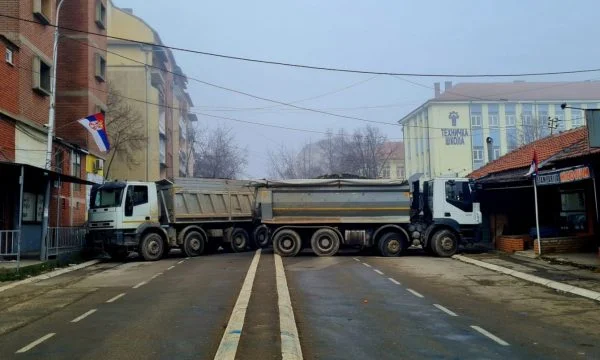
Periskopi(3 years ago)
(3 years ago)Tensions in the Serb-run northern Kosovo have sparked discussions about possible Russian involvement in their promotion, as well as discussions about fears of the outbreak of violence that has increased since the beginning of Russia's aggression in Ukraine. Serbia is the only European country that has not imposed sanctions [...]
Serbia is the only European country that has not imposed sanctions on Moscow and accounts on its support for claims on Kosovo, whose citizenship have recognised the United States and the main countries of the European Union. But, Serbia also aspires to integration into the European Union, a process conditioned by normalising relations with Kosovo.
Russian experts say Moscow, which openly supports Belgrade and does not recognise Kosovo's independence, makes harmful statements that disturb even Serbia's leadership.
So, days ago, the first deputy chairman of the State Wedding Committee for International Affairs, Alexei Chepa, on radio “Moscow Specax” invited Serbia to “become part of Russia” in the event of a complication of the geopolitical situation in the region. He even demanded that any <x4 call from (Aleksandar) Vucic” be expected in this regard.
After that, Russian Foreign Ministry spokeswoman Maria Zakharova said Moscow is waiting for Belgrade's reaction to the Kremlin's proposal for normalising the situation around Kosovo. It seemed very vague.
This is just another evidence of methods, including provocative dezinformation and planting, which the Kremlin is directed to achieve its goals, said Central and Eastern Europe expert Ivan Preobrrazensky, regarding the absurd proposal that Serbia joins the Russian Federation. According to him, there is a feeling that all representatives of Russian authorities are more participants in some propagandistic shows in federal television channels than serious politicians and diplomats.
The official “Declarations on foreign policy themes coming from Moscow are often the freest propaganda of landscapes with a clear mix of irresponsability and top state officials are no exception here”, he said. “Just read the posts of former president of the country Dmitry Medvedev. So you can not only argue with all Western capitals, which has already happened, but with the same Belgrade, which sometimes, apparently, just doesn't know how to react to Russian statements”.
Earlier, Dmitry Medvedev, among other things, in his post defined the nature of war in Ukraine as confronting Moscow with the West devoted to “satanism”.
At the same time, the Kremlin shows a clear interest in promoting a new conflict, rather than stability in the Balkans, says Ivan Preobr Drazensky. According to him, this is the goal of the efforts of numerous information channels, which widely spread dezinforms in each case.
The “seems to have no problem in promoting a hot “ <x1-2> in the form of an armed crash between Serbia and Kosovo. And any instability between the two countries echoes throughout the Balkans. However, so far the Kremlin has nothing to boast about in this regard... His efforts to achieve that goal are futile. This is mainly due to the fact that all of Belgrade and Pristina's goals are related to membership in the European Union”, he stressed.
The particular relationship between Moscow and Belgrade rests on several factors, political analyst Andrei Okara thinks. According to him, it is first of all an Orthodox cultural heritage and a <x0 preference” general to the West.
“in both countries, the idea is widespread that the West, led by the United States, allegedly seeks to destroy them”, he said in an interview for the Russian voice service of America. “This is a totally unstable idea but it exists that Serbia and Russia are close to both their mentality and their historic path”.
In addition, some imperial complexes are still alive in Belgrade, as well as in Moscow”, Oara politician believes.
At the same time, in reality, Serbia is a country aspiring to membership in the European Union, does not picture itself without Europe and does not want to clash with the West, Andrei Okara stressed.
And Russia now badly needs some, if not friends and allies, then at least kind partners to him, though in words. Such countries now virtually do not exist, except in North Korea, Iran, Eritrea and similar isolated countries. That is why Belgrade is so valuable to Moscow”, he said.
Of course, the politician Okara points out, the Kremlin would now take a clear advantage of whether another “hotpot” would be created in Europe. According to him, this could, to some extent, re-evaluate the issue of Ukraine” and distract some public opinion attention.
“However, we see that efforts to promote conflict between Serbs and Albanians in Kosovo have not yet succeeded. There is a feeling that there are forces in Russia that are trying to power this conflict. However, despite the complexity of the situation between Kosovo and Belgrade, there are always compromises. And Serbia now clearly does not like the fact that it can be positioned as an ally or an associate of the Kremlin. This is a very strange and specific friendship”, politicologist Andrei Okara concluded.












