7 minutes ago
Can the world be supplied with energy from melting atoms?
Periskopi(3 years ago)
(3 years ago)With the energy generated by the melting of atoms, harmless energy can be produced for the environment. But the amount of energy is insufficient. After decades of U.S. studies, a significant success was now achieved. The American Foreign Ministry announced the achievement of a major success in atomic smelting technology. National Ignition Scientists [...]
The American Foreign Ministry announced the achievement of a major success in atomic smelting technology. Scientists at National Ignition Facility (NIF), the laser-rayed atoms facility in California laboratory, Lawrence National Laboratory have managed to produce energy in the laboratory with the aid of atomic smelting.
“This is an important success for researchers and collaborators of National Ignition Facility, who have dedicated their career to the smelting of atoms, and this success will surely be followed by other findings,” said US Energy Minister Jennifer M. Granholm. “Simply put, this is one of the most impressive scientific achievements of the 21st century. ”
Decades of scientists have spent more energy on experimental atomic smelter than they have gained new energy from the entire process in general. These losses have caused not the unification of atoms but the sharing of atoms to become standard process for producing unlimited and harmless energy for the environment, although this process is linked to health and security risks.
On December 5, 2022, NIF scientists developed for the first time in history the experiment controlled by which the melting of atoms is gained more energy than it is spent to get there. Thus, large - scale energy - generation researchers have taken an important step toward achieving their goal.
“The future of energy “
Whoever works in the atomic energy sector knows for sure: The production of an atom melting current is 30 years away, and that was worth it to researchers both ten years ago and today. Despite the complexity of this technology, those who work with it are very convinced that the effort is worth it.
But why? Eliminating atoms has greater energy potential than all other known energy sources. It can produce four million times as much energy as the energy produced by chemical reactions, such as burning coal, oil, or gas, and four times as energy produced by the sharing of atoms, the process currently used in all the world's atomic plants.
Atomic collapse, discovered at the end of the 20th century, is seen by many political decisionmakers especially in Europe as energy of the future.
But is the atomic melting really a green “ ” alternative to our current methods and how far we have been able to go for electricity by this method?
Like “fire wood burning”
To get back to that question, the international thermofuel reactor, I TER, a major joint nuclear experts project from 35 countries, offers opportunities to visit.
ITER is located several hours off France's southern coast in the middle of an idyllic landscape. The project's territory is full of metal halls, workshops, and equipment. Researchers, technicians, and technicians circulate in this area with protective helmets, rubber boots, and neon - colored vests.
In the midst of this industrial landscape, Pietro Barbashi, the ITER General Director says the future of the energy melting of atoms is very hopeful. He compares energy production to atomic melting to burning firewood. The fire that warms wood starts with a chemical reaction. This reaction is enough to burn the rest of the wood. ”
Energy gains from atomic melting
The atoms consist of a nucleus (of proton and neutron) and electrons. During the melting of atoms, two atoms melt, producing an atom through the impact of their nucleus. High energy is produced by melting, and scientists want to turn this energy into electricity. This energy will one day light our homes.
From a technical point of view, we already use energy from the flying neutrons of atomic power plants. Why don't we just stay here and ask for more?
Melting in the Face of Breakup
Unlike the melting of atoms, the divide does not melt two light atoms into each other, but a heavy atom is divided into two or more atoms. All of the world's atomic plants use sharing reactors to produce electricity.
France, in which I is located TER, produces 70 per cent of its energy from the split of atoms. In most parts of the world, atoms are not a satisfying source of energy, because the public is afraid of harmful radiation, fear fed by incidents like Chernobyl disaster, Fukushima atomic melting and partial atomic melting in the American atomic plant,”Thre Mile Island (4)x1>.
The main difference between the separation of atoms and their unification is in the radioactive fuel produced during the two processes, explains Akko Maas, an ITER employee. He's part of the team since ITEL started research.
“During the atomic division like the uranium used and the reproduced Platini are radioactive. Even when energy is extracted, radioactive material remains. Of the first two materials seen as the most effective for energy produced by the melting of atoms, deuterium is not radioactive, and the tritium is. However, radiation is relatively weak and short - lived.
If the materials are properly selected, the radioactivity created by the melting of atoms, even if it becomes industrial production, can be limited to 100 to 200 years, which is much less than 40 thousand years, which we observe in the sharing of atoms,” says Maas.
Use “gebra”
Atomic energy supporters claim not only that this energy is very efficient but also that it reduces our lot from fossil - based fuels. Atomic energy itself is seen as another way to produce energy, in addition to the fossil - based fuel produced, because in its production it does not produce carbon diocsod but is produced as a secondary helium product, a nontoxic gas that does not cause reactions.
In addition, deuterium is in large quantities in marine waters, and researchers demand that they produce the tritium in the country with the help of lithium.
The resources of renewable energy such as solar energy and wind energy cannot cover the world's energy needs. Atomic decay, if successful, can produce more energy than need. It all sounds beautiful, however, it has been so far an impossible dream. In order for atomic melting to become reality, technological progress in plasma physics must be achieved. It is technically difficult to achieve an atomic meltdown, to be sustainable and stable,” says Barbashi.
Plasma “rescind”
The rays of the sun and the warmth we feel on earth are the result of an atomic melting reaction. This process develops in the core of the sun under high temperatures and intense pressure. The challenge is to reproduce these processes that develop in the heart of the sun, but without the pressure produced by the force of the mass of the sun.
To achieve atomic melting on earth, gas must be heated at very high temperatures of 150 million degrees Fahrenheit [150 million ° C], which is tenfold the temperature of the core of the sun. When this dot reaches, gas is turned into plasma, which is a million times easier than the air we breathe.
Atomic smelter researchers have found that plasma production through the heat of a deuterium mixture and tritium is the simplest way to create an environment where atomic melting can develop and energy can be produced.
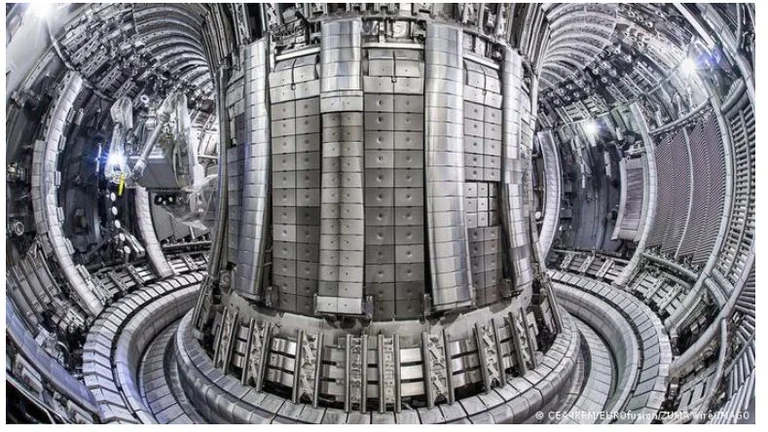
The fluid used by ITER for atomic smelting experiments is held in an facility called Tomonmac, being restricted by a strong magnetic field. Under these extreme conditions, plasma particles quickly crash into heating. But paradoxically, when temperatures rise, the level of impact declines, along with it the heat effect. So it's the plasma that, after a specified moment, dies down,” says Barbashi.
If we go back to analogy with the firewood: It is as if the fire was not known to keep it steady “plasm burning”. This is the biggest challenge facing the experimentation of atoms worldwide.
Security in Melting
What is a curse to someone else can be a blessing to someone else. “The terminal” of plasma when conditions are unfavourable also means that the reaction stops when there is a lack of stability. This makes smelting of atoms safer than sharing atoms, experts say.
A nuclear meltdown like Fukushima is impossible to happen, says Gilles Perrier, director of the security and quality sector in ITER. In a dividing reactor, we have a radioactive core that should cool off in case the reactor goes off.
“During the separation of atoms risks for incidents are much greater. During the atomic meltdown, they are very small,” says Perrier. In his opinion, the safety of an atom smelting facility consists of three parts: Plasma, radiation reduction, and the avoidance of tritium contamination. Plasma is kept in a vacuum container. “Even in the worst case if plasma appears outside, the consequences do not spread more than to the place it happened,” says.
From Experiment to Electricity
Atomic melting researchers have thus far produced the maximum energy output of 54 megajuli in five seconds. This is equal to the current needed to keep a lamp on for two months. The challenge facing researchers now is how to produce electricity in large quantities.
Barbashi says moving from an atom smelting experiment to the power generation reactor is like moving from burning wood to the coal power plant. Although the challenge is great, he is optimistic that the ITER's experimental reactor will become operational by the end of the decade and contribute to a demonstration plant being established within the next 30 years.
After all, atoms melt technology needs time, but according to some scientists we don't have time. The energy of atomic melting cannot solve this winter's energy crisis, and it will not contribute to lowering carbon dioxide emissions in the near future.
In his book “ (The tale of atomic smelting) nuclear scientist LJ Reinders says the energy of atomic melting will arrive late to solve our acute climate problems. Barbashi, on the other hand, feels that investments in the melting of atoms are made, not to cover today's energy needs, but to those of the second half of our century. / DW