7 minutes ago
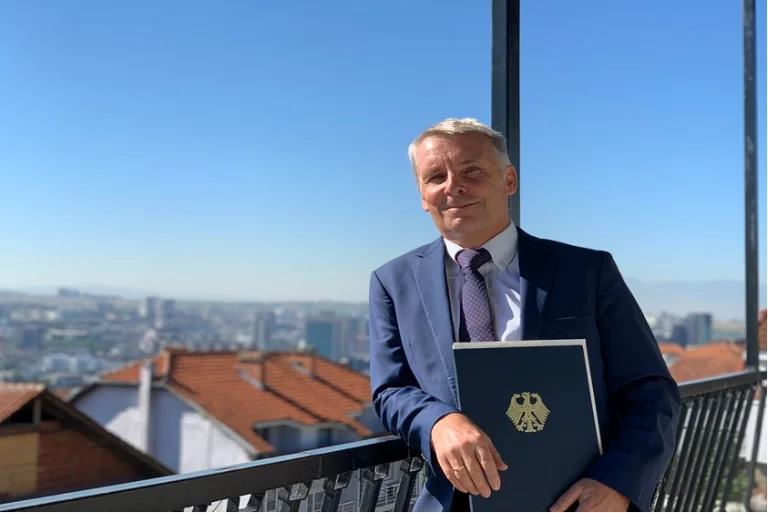
Rohde: Association does not threaten Kosovo's sovereignty
Periskopi(3 years ago)
(3 years ago)All who express concerns that the Association of Serb majority municipalities is entities for an ethnicity in a multiethnic state are eligible, as if no agreements had been signed offering its creation, German Ambassador to Kosovo Jorn Rohde has said. In the interview given, the interactive “” of KTV, Rohde [...]
In the interview given to KTV's interactive “ ”, Rohde said that to move forward, the agreements must be respected. He has confirmed Germany's position, but also of states that have recognised the state of Kosovo that there will be no Bosnia and Herzegovina, nor will Republika Srpska. He has also turned over the Franco-German plan.
A German NGO, along with the European Institute for Peace recently, has published a proposal for Association, which is very clearly designed to be in line with the Constitutional Court's act by 2015, which also envisions certain competencies in the field of health and education and perhaps even planning. And it's all in harmony with Kosovo laws”, Rohde has said.
Asked whether association means self-rule, Rohde has said that “is a kind of autonomy in some areas that does not threaten Kosovo's territorial integrity or sovereignty.
COMMHA: Let's start this interview with what we already record 10 days since the barricades on the road are located in the north of the country by Serbs. What is the German stance when we see barricades set up, when we see that police cannot carry out their functions, when journalists are attacked, unfortunately today there was an attack on Kosovo's journalists in northern Kosovo, and so, when we see the free movement stumbling. What attitude do you have for these Mr. Ambadador?
ROHDE: Responding to your questions about attacks on journalists, I just criticised him last Friday. It is unacceptable, absurd and shameful to people who are doing their job in a democratic state. As for the barricades, our position is clear. They are illegal and must leave as soon as possible from those who established them.
COMMHA: Prime Minister Kurti said today they are waiting for KFOR to remove the barricades, but will not tolerate this situation for a long time. Do you fear that the situation could escalate?
ROHDE: KFOR is there and it offers a safe environment and free movement. So I'm optimistic that it will come true, I hope as soon as possible, because the last one we need is a further escalation of the situation. The Kosovo government has escalated the situation. As you know, elections had to be held. And now I ask that in the north people call upon the mind of especially leadership.
COMMHA: But this is not happening, including your foreign minister, Annalena Barboeck, who on December 11th said Kosovo has lowered tensions with the election delay decision. She also added that Serbia's rhetoric did the opposite... As the situation continues to be the same after 10 days...
ROHDE: You're right. How can I say it? People living there are suffering because border points are closed, schools are closed. You have roadblocks and you can't move that much. There are people in the north and I would underline that they are suffering most and that they have become a political hit ball. So, especially now, since Christmas is coming, these barricades must be removed as soon as possible. We need dialogue, not confrontation.
COMMHA: As you see, why is all this happening? When we see that the Kosovo government has postponed elections in the north, as requested by the international community, while the situation is worse, it has deteriorated with some barricades that have been added since the Kosovo government has postponed the elections to leave dialogue...
ROHDE: It's hard for me to speculate, but it wasn't just internationals, but the Government itself realized that the conditions for elections in the north were not ripe. Without candidates, without voters, security issues, access to the polls was at risk. So it was a fair decision to postpone elections, as you put off the elections for other reasons, when we had the Devud-19 crisis. I can only speculate that people, some forces, are interested in escalating the situation. My government certainly stands with the Government of Kosovo to escalate the situation. Those responsible for the barricades should think that they are making their populations suffer.
COMMHA: When you mention that there are people in the north who are facing their daily plight: we are also seeing that their political representation that has been dominated for more than a decade by the Serbian List is standing firm with what is happening in the north. What views do you have on the fact that the political representation of Kosovo Serbs is so strongly supporting the equalisation of roads in northern Kosovo?
ROHDE: Look, I demand from each political force the escalation of the situation and rational behavior. Whenever someone is arrested, as is the case of last week in the case of a former Kosovo Police member, of Serbian origin, who woke up a great echo for pressure on Serbs, but when a Serb politician from Kosovo last week, Mrs. Trajkovovic was being held by Serbian police at the border, there was an absolute calm from the same politicians. So it is up to political experience or to criticize someone. And I don't find this as a money route by applying double standards. So this was just a look that questions many issues. I even saw many civil society members from the Serbian community criticising the way Mrs. Trajkovic was held at the border and saw reports that her daughter had also been questioned at Belgrade Airport. So, please, if you criticize something, please don't apply double standards...
COMMHA: So according to this, all opponents of Mr. Vucinac here in Kosovo are being threatened?
ROHDE: Looks like it. Ten days ago, the Government of Kosovo charged Mr Nenad Rassic as minister. The rhetoric we heard about him from Serbia is also as my German minister, rhetoric and escalation and unacceptable.
COMMHA: As we speak, KFOR is considering Aleksandar Vuciqi's government's request for the return of nearly 1,000 Serb soldiers to Kosovo, based on what Vuciqi quoted, Resolution 1244. What is the German attitude in this matter?
ROHDE: As you know, my minister has clearly stated, it is an unacceptable request. It's simply stated: an absurd request. We have Resolution 1244. There are some paragraphs that were applied in the state of the day. For us as Germany and all those countries that have recognised independent Kosovo, we recognise Kosovo as an independent country. It is unimaginable that in an independent country we would do something against the desire of an independent country. So we consider that request unacceptable.
COMMHA: That's why it won't go forward, because NATO needs consensus on such a decision...
ROHDE: Yeah. This is our clear attitude, not just our attitude. I think the U.S. has a similar attitude.
COMMHA: What is questioned here in Pristina as regards the situation in the north. We're seeing some people wedge the streets. KFOR in the past has demonstrated that it is capable of managing such crises. Why don't we get rid of the barricades when we see only a few people standing in front of them?
RHODE: This question should be addressed to KFOR, it is not my job to speculate, but I am sure KFOR will do an analysis, because it is his mandate to offer free movement.
Sometimes it's good to wait for the right time. As he said. KFOR, we ask political activists to find solutions, and sometimes I regret that it is the lack of political dialogue, even in Kosovo among various acts. Sometimes by not opening the phone here to talk directly to Belgrade. We need more dialogue and we need to open the phone and make things clear.
COMMHA: Are you suggesting this has happened recently, that the Government of Kosovo has not opened the phone?
ROHDE: I don't know. I didn't see any evidence there was a direct call. I think that especially political leaders have responsibility for the population and need direct communication channels. We are in the 21st century and it should be possible to speak directly to each other. So who's suffering: there's people in the north again, mostly they can't send kids to school. Of course, there are forces that are not interested in escalating the situation, but we have to strengthen those processes that break down the situation.
COMMHA: We have government officials who, even in this studio, constantly tell us that when we speak to Kosovo Serb representatives, besides the Serbian List, they feel afraid, examined by criminal groups operating in northern Kosovo, but in other parts of the country. As well as what more Kosovo authorities can do to communicate more directly with Kosovo Serbs, as you say, Mr. Ambassador?
ROHDE: The best way to do so is to build trust. You hear the sorrows of the minority population. I remember that when the new minister for Kthim and Community was appointed, one of his first positions was: Please postpone the election! And, the government listened to Minister Rassic's proposal. So it should be. You hear a lot of their voices and then make a special judgment in a toxic environment where it's very difficult to communicate. Where there are people who know what's happening in the minority population and that's why we need to communicate with them. This is important.
COMMHA: But, in northern Kosovo, it has now become very difficult what we now see. Nearly 10 years after the start of the Serb integration in security institutions, the judicial, prosecutorial system, through a determined political decision, suddenly, these officials have resigned, prompted by political influence. Now, on a daily basis, we talk about how to maintain independence in the judiciary, security institutions, and how these institutions should maintain independence from policy interference. Do you think that deal has already fallen to the ground following the resignations we've seen in the north?
ROHDE: Yeah. Your description of the current situation is correct. We have a new status quo, which is very unfavourable, because 10 years of reintegration are threatened. And I don't know how you can replace them, especially judges and prosecutors. So my call is to reach a deal as soon as we can. I also agree with you that not all these resignations have taken place voluntarily. There seems to be a coordinated pressure as well.
COMMHA: From who?
ROHDE: Pressure coming from Serbia. Therefore, we need dialogue and for the Government to reach the Serbs and as soon as possible and oppose this step.
COMMHA: When we are honest about principles, honestly, the rule of law, the return of all who resigned under a political decision, would it not conflict with the rule of law itself, or do you think it should be compromised this time?
ROHDE: You know, again. That's a hypothetical question. What's the main purpose. The main goal is to have a peaceful and prosperous Kosovo development. Kosovo as a full multiethnic and sovereign state. That's the grand goal. How you achieve it, the Government of Kosovo must decide that. But the rule of law that you mentioned should specifically be applied so that minorities feel they are in their home in this country. Still, 90 percent in Kosovo belong to an ethnicity and the remaining ethnic minorities. So, you're given a feeling they're home. And yet the internationals, including ourselves, in various events, with QUINT statements, have sought implementation of the Decani Monastery's decision. That is the decision of the Kosovo court. We've constantly requested its implementation. Five successive governments have done nothing. This decision, of course, has remained from past governments, but if you do not respect a court decision, you undermine your credibility when you speak of rule of law. And especially that decision, which is a test for minority communities, how sincere the government is with laws that are not partyly pleasing to the majority.
COMMHA: On the other hand, we see that 2/3 of Kosovo Serbs living in the southern part of the country have not resigned and live in a quiet environment. How do you see this?
ROHDE: That shows... A survey that Germany has funded, where different communities live last week, such as Camenica, Gracanica, and although the results have not surprised me at the macro level, it had a lot of similar meaning among communities. But I've also seen that minority communities have a sense that their demands are not being fully addressed. So it's not entirely bad. So the positive is that you can be together very well, that's Europe's main idea. Most or few, it doesn't matter. Europe has open limits, and the concept that an ethnic group must live in a state is a 19th century concept. The state-national is a multidivers entity, a very ethnic and multi-language entity. This is the reality of Europe and we need to cultivate it in this region.
COMMHA: Our prime minister is saying almost the same when he expresses his opposition to the Association of Serb-run municipalities. He's basically saying we don't need an entity for just one ethnicity. Kosovo is a multiethnic state, and therefore, the creation of a new entity would only strengthen divisions. What look do you have on this?
ROHDE: My look at this wouldn't matter. I'd say he's right if we didn't sign agreements that offer the creation of the Serb Major Community Association. You have the dowry so sun sevanda or agreements must be held, and that's a reality. And where I come from, in Germany, we have a minority group of Danish people. They have their share. They have hospitals and everything. They get money from Denmark. And many Germans send their children to their schools, who are better equipped than German schools..
COMMHA: This is a pleasant example, Mr Ambassador, but at the same time, Germany and Denmark respect each other's territorial integrity. They respect each other's independence and they know each other. Meanwhile, as we discussed in the first part of the interview, Serbia not only does not recognise Kosovo's independence but causes trouble on Kosovo territory. The concerns are that if you create such an association, out of four municipalities, for which we have long failed to exercise full sovereignty, the Government of Kosovo could create a new entity, as our prime minister calls it, a new Bosnia or the Kosovo presidency. Do you not fear that implementing such an agreement would create an entity that would further jeopardise Kosovo's sovereignty, Mr Ambassador?
ROHDE: You're right, situations are totally different. But we've been negotiating with Denmark for four years after we've been through it since World War II. So we have a long history of wars and now, of course, it's all right. Yet, we need to respect agreements so that we can move forward. Categorically, I reject Bosnia and Herzegovina, or this Serbian republic..., how many times have I and colleagues from other embassies said that, obviously, this is not Republika Srpska. And a German NGO, along with the European Institute for Peace recently, has published a proposal for Association, which is very clearly designed to be in line with the Constitutional Court's act of justice from 2015, which also envisions certain competencies in the field of health and education and perhaps even planning. And this is all in harmony with Kosovo laws. This is the first and second...
COMMHA: Is this self-government, Mr. Ambassador?
ROHDE: It is a kind of autonomy in some areas that does not threaten Kosovo's territorial integrity or sovereignty. And it improves a situation where you now have the reality of parallel structures, which are not always controlled by the Government of Kosovo, and then you have a structure that is fully with Kosovo regulations. I can only say, what's the problem here?
COMMHA: That means that the situation we have right now in the north is related to this, because Serbia wants them to push something, saying we can threaten a part of your territory so that something long required by Serbia can be won.
ROHDE: Our whole discussion here is to fulfil past agreements, in search of innovative solutions. You've seen the European proposal inspired by Germany and France, you know... that tried to bring things forward. All these proposals include agreements from the past, the Association of Serb-run municipalities. They provide a way forward for Kosovo and you know... We want, especially Germany... you've had visits from Germany. We had the summit in Berlin for the Berlin Process. You've already had this proposal for an association statute... all of this, say, is driven by Germany, or are German ideas to push Kosovo closer to Euro-Atlantic structures.
COMMHA: Is this proposal involved in the Franco-German plan?
ROHDE: This is not a German proposal. A German NGO, the Ebert Foundation that published it together with the European Institute for Peace... as I understand it, is a tool that the Government of Kosovo, that is, a sovereign government, can use as an idea project to resolve the situation and always respecting the Constitution of Kosovo.
COMMHA: The Kosovo government has said the Franco-German plan presents a good basis for agreement. How do you see the future of this plan and why is it so nontransparent? We talk about transparency every day... I know diplomacy doesn't always reveal all the pieces of negotiations. But there have been weeks when large numbers of projects are circulated in the media and we see no transparency in this regard.
ROHDE: I am not commenting on either status or projects I can only say that the two parties interested plus the European Union that practically facilitated the talks on this proposal have agreed to maintain privacy. And I respect that. My problem, in this part of the world, is words without owners. And I'd rather like a lack of transparency at first, because if there's agreement on these proposals, then you can talk about them, because we have a basic agreement between the interest parties.
Most of the time, we face the situation when we have completely opposing views, and it is our intention to push both sides toward the agreement that benefits both sides, especially the people.
COMMHA: When you say one of the issues about the agreement with Serbia to benefit both sides, it's the AKS issue. Last week, for a visit to Kosovo, were American diplomats, and Mr. Escobar said that if the Government doesn't apply the AKS issue, “would be found alternative partners, civil society, business community, etc.”, I'm paraphrasing, maybe you'd hear his statement.
ROHDE: Yeah.
COMMHA: What is the position of the German Embassy in Kosovo? Can you implement an agreement with alternative partners if the Kosovo government does not implement it?
ROHDE: It's a German NGO, a foundation, which has already drafted a proposal. So, this comes from civil society and as I said before, this is the choice of the Government whether you accept it or not, because you have to solve a problem. You have a contract! Your best friends tell you you have to do something in that direction...
COMMHA: What if the government chooses not to act in harmony with this?
ROHDE: To put it straight: I don't see any solution that doesn't address this proposal... even the Government, just a few weeks ago, joined the European Declaration in Brussels, saying that all preliminary agreements should be respected... all of them.
COMMHA: The only regret in this direction is that are we talking about the rights of Kosovo Serbs or Serbia's rights in Kosovo?
ROHDE: No, we're talking about the rights of Kosovo Serbs. For us, Kosovo is a sovereign state.
COMMHA: But on the basis of what resulted from the so-called Franco-German plan, Kosovo and Serbia do not recognise each other as explosives. Serbia in fact does not recognise Kosovo in the form of explosives.
ROHDE: Let me answer by comparison: when both Germanys existed, we, West Germany, never knew the Eastern Germany, but the big step forward when we reached the first basic agreement was that we had bilateralised our problem. So it was more of a third party issue. As soon as this basic agreement was reached, third states established diplomatic relations with East Germany, as it did not matter anymore.
COMMHA: Do you have confidence that the agreement between Kosovo and Serbia will be reached? Is it real to expect this to happen in the spring since March of next year to have a deal reached?
ROHDE: If I had a glass or something, I didn't... I hope it will be achieved. I'm part of the profession looking at half-filled glasses and I see there's a lot of political capital, invested by Kosovo's best friends to postpone a deal. What we need is for the two main sides of interest -- Serbia and Kosovo -- to agree to something. We're trying to help as much as we can... I mentioned regional integration earlier through the Berlin Process. We want you in Europe, but you, Serbia or Kosovo must do something to move there. We can offer you advice and tools, but the entire Western Balkans... you know my Chancellor... the sooner the better... this has been a crucial year for Kosovo, application for EU membership... we will have visa liberalisation within a year. Applications are not yet in practice, but, as the prime minister said yesterday, the train has left the station and invited everyone to board it... and the Government of Kosovo to do its best to speed up the train with decisions that bring progress.
COMMHA: The prime minister also said, when Kosovo submitted the EU membership application, that it is real to believe that within 10 years we will be part of the EU. What do you think?
ROHDE: Too many hypothetical questions. We recently had a poll for potential EU membership... and at the actual pace of reforms could take between 15 and 55 years. Governments in various states must speed up reforms on various issues. So progress is based on merits and there are tasks the EU must perform. We too need to reform ourselves. We have to reform the right to vote... six new members... if the right to veto remains in force on certain issues, this could maim the EU.
COMMHA: Thank you very much, Mr. President. Ambassador.