40 minutes ago
Montenegro's parliament approves amendment of Law to President, protesters react violently
Periskopi(4 years ago)
(4 years ago)Montenegro's parliament, by majority of votes, approved on Monday the amendment of the Law to the President, with which the current parliamentary majority will take part of the president's competencies in the election of the new government. The purpose of the amendments proposed by the pro-rus Democratic Front is for their candidate, Miodrag Lekiq, to be resolved [...]
The purpose of the changes proposed by the pro-rus Democratic Front is for their candidate, Miodrag Lekiq, to be elected candidate for prime minister of the new Montenegrin government.
Similarly today, Montenegro's parliament failed to elect members of the Constitutional Court, because none of the four candidates received enough votes.
The elections voted 42 MPs, while 49 votes from 81 deputies holding the Montenegrin parliament were needed.
Opposition MPs did not attend the session.
The adoption of the Law for the President conflicts with the Venice Commission's recommendation, which on Friday said that <x0-do not adopt changes in the Law for the President of Montenegro, as they would essentially represent a change of the Constitution, with a smaller parliamentary majority than projected”.
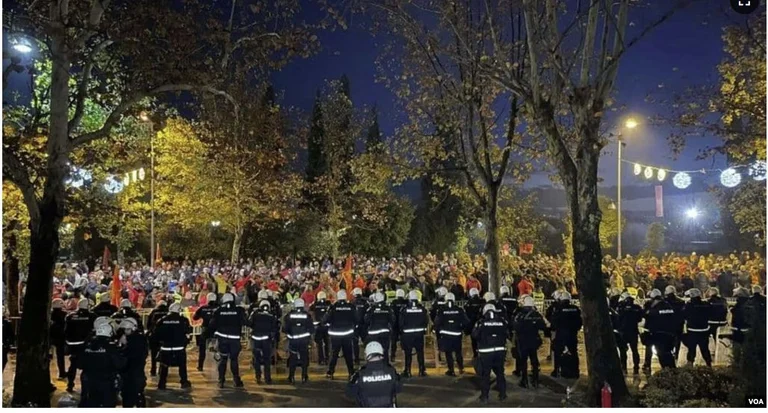
Following the adoption of amendments to the Law to the president, protesters since the morning stood before the parliament headquarters reacted sharply against the action of majority deputies. In that case, parliament headquarters was hit with solids, breaking the glass and doors of parliament, after which police have thrown tear gas.
Citizens continue to stand before the police cordon and sing the national anthem.
One of the police leaders tried to address the protesters, but they received him with calls of discontent and refused to leave.
Montenegro's power crisis culminated with Light government's fall Abazovic, after unilaterally signing the agreement with the Serbian Orthodox Church, which President Milo Djukanovic's Socialist Democratic Party and a part of the opposition considered contrary to national interests.
Adoption of controversial amendments to the Law to President followed after President Djukanovic rejected the majority proposal their candidate Miodrag rejected Lekiq is mandated and submitted the proposal for the parliament's distribution and to go to the new parliamentary elections.
The European Union voiced concern several times about the political situation in Montenegro and called for the immediate break of the institutional blockade and normalisation of the situation in the country.
The EU urged political forces not to further strain the situation and work towards reaching an interparty consensus as top priorities. They They remembered that Montenegro's continued progress in membership requires all political actors to support the functioning of democratic institutions. /Vosa