9 minutes ago
Harsh Kosovo-Serbia relations: How did it get here?
Periskopi(3 years ago)
(3 years ago)For a long time it seemed very possible to draw close to Kosovo and Serbia. But now the fronts have hardened, the Serbian Army has even been placed on high alert. How did it get here? Serbian Defence Minister Milos Vucevic's words sounded threatening, as if Serbia's conflict with Kosovo was nearly before the military explosion. “5000 [...]
Serbian Defence Minister Milos Vucevic's words sounded threatening, as if Serbia's conflict with Kosovo was nearly before the military explosion. The Serbian Army's <x0000 Special Forces are being deployed to combat. By the end of 2023 they will all be ready for war. They will be our most powerful handful and destroy the bad intentions of those who do not love our country”, Vucevic said during the visit of Serbian troops to the border with Kosovo.
This is the strongest escalation of the situation in Kosovo for years and yet it is still very impossible that the Serb war forces will try to enter Kosovo. There are 3,500 NATO soldiers stationed in the KFOR mission that care for security in the country. Even Serbian President Aleksandar Vuciq avoids the word “attack” so far. He's talking instead of a defensive mass. “We do everything, to maintain peace and stability. But after Albanians are armed and act against our people, we will do everything to protect the Serbs in northern Kosovo.” So said the Serbian president in a video clip on his profile in the Instagram.
Serbian president presents himself angry
The Serbian president currently leaves no case without addressing his angry people by appearing as a politician who guarantees the protection of Kosovo Serbs. Vuciq presents himself on television with persons who, according to him, are ruled by the Albanian-dominated government in Pristina. He came out together with the head of the Serbian Orthodox Church, Patriarch Porfirije, who is also the archbishop of the Pec Patriarchate. Porfirije wanted to visit Pec this week but was not allowed by Kosovo border police. Furthermore, Vuciq appeared with a family of Kosovo Serb vinedressors whose wine was confiscated and destroyed. Because this family had untainted taxes, Kosovo police took the wine, mixed grapes, making wine useless.
Barricades
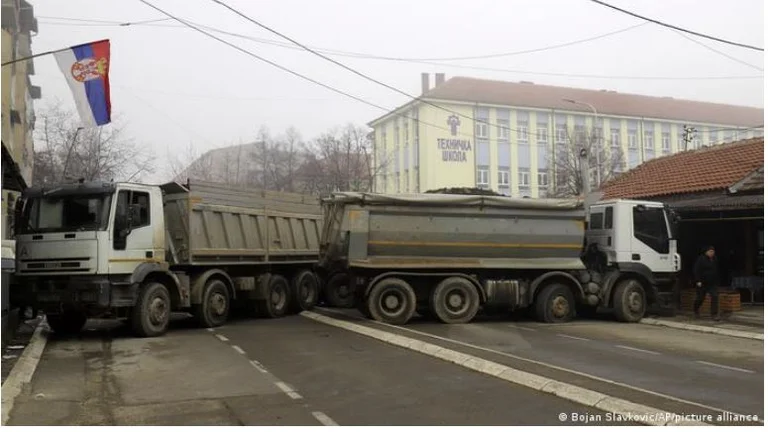
Tensions are also due to the establishment of barricades. Two new barricades were set up in divided Mitrovica. For more than two weeks, other barricades block roads in important road axes in the north. Squeaks and stones are also thrown against journalists. Kosovo police have closed border crossings with Serbia and northern Kosovo, meanwhile. Reports were also on fire. Belgrade accuses Pristina of breaking the law, while Pristina rejects the charge that the arrests committed by the former Serb police officer and another Serb because of attacks on police officers are addressed to Serbian ethnicity. For his part, Prime Minister Kurti accused Vuciqi of committing <x0 criminal gangs” and is promoting the Serb population in the north to destabilise the situation.
How did the situation escalate so quickly?
It all started with a car license fight. The Kosovo government demanded that Kosovo Serbs exchange their Serbian plates with Kosovo's ones by implementing reciprocity. The goal was to establish control over traffic in Kosovo's state space and to obtain registration taxes. After a solution to the dispute was found, the next apple of conflict was exposed. Serbs demand the establishment of the Serbian Communists Association, set out with the Brussels Agreement about 10 years ago. So far there is no co-ordination among particular Serbian municipalities. Pristina's government rejects this, citing constitutional decisions as reasons. After that, Pristina's fears -- that Serbs would take too much power -- would block politics in the country and thus create a kind of Republic of second Srpska, as in Bosnia and Herzegovina. In Kosovo there are four Serb municipalities in the north and six enclaves in the south, where the situation is calm.
Kosovo to become EU candidate country
Only in November did the situation seem hopeful. After ironing out the row for the license plates, it was for further talks with the chance of success Kosovo will become an EU candidate country, while Serbia, which has been a candidate for 10 years, will hold the option of approaching the open EU despite its proximity to Russia. The EU has presented the so-called “German-French proposal” for normalisation of relations. This proposal reveals that Serbia is not obliged to recognise Kosovo as an independent state. But it must admit, that Kosovo on its state territory will autonomously exercise its power. Now these rapprochement efforts have been postponed away after the last few weeks with many incidents. / DW