4 minutes ago
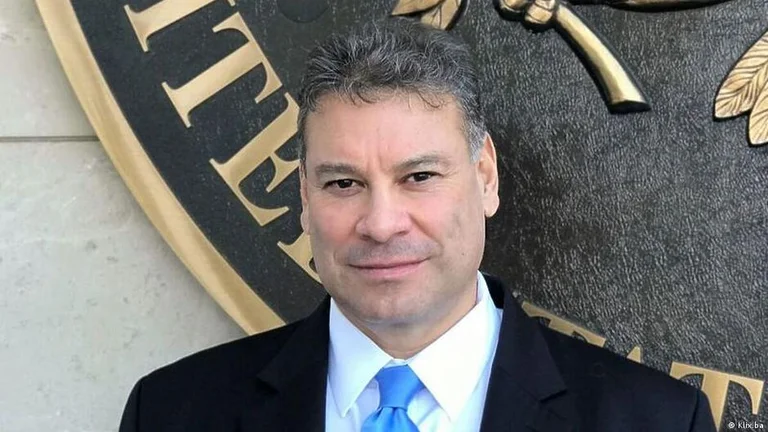
Escobar: Association is duty, Kosovo has full US guarantee
Periskopi(4 years ago)
(4 years ago)The US special envoy for the Western Balkans, Gabriel Escobar, says Kosovo has very strong security guarantees from the United States. The US, he says, flatly rejects and rejects Serbia's demand for its forces' return to Kosovo. Speaking of Radio Free Europe in Pristina, [...]
The US, he says, flatly rejects and rejects Serbia's demand for its forces' return to Kosovo.
Speaking to Radio Free Europe in Pristina, Escobar says the barricades in northern Kosovo must be removed from people who have established them, but wants the Government of Kosovo to find ways to address the concerns of the Serb community in the north.
Escobar, as well, says forming the Association of Serbian municipalities in Kosovo is a duty, both for Kosovo and Serbia, and for the EU, which has between its negotiations.
“We will have Association, we will be part of the process, and that process should include the Government of Kosovo. If not, we can conduct that discussion with alternative partners, with civil society, with youth groups, with the business community, with all who would like to see Serbia and Kosovo emerge from this cycle of instability”, Escobar says.
REL: Mr. Escobar, thank you for the interview on Radio Free Europe in Pristina. How has your visit so far been to Kosovo?
Gabriel Escobar: Like all my visits to Kosovo, it has been very productive. I want to start by saying something I said in one of my last interviews. We consider Kosovo and the Western Balkans part of the transatlantic community. You are simply not part of formal structures, but in every way, we consider you to be important partners and productive members of the community.
Every time I come here, I meet business leaders, I meet civil society, I meet with young leaders. That's what I've done this time. They have indeed reinforced my and our Government's opinion that the Western Balkans is more of an opportunity for Europe and the United States than a danger. We just have to make this aspirin happen.
REL: I want to start with the current situation in northern Kosovo. Who do you see responsible for the barricades?
Gabriel Escobar: What I mean is less about blaming and more about the way forward. The reality is that we need all to contribute to the process and all contribute to resolving this current crisis. I really believe the barricades should be removed from the people who put them.
But we also need to offer them a diplomatic route to address complaints through political channels and through diplomatic channels. So we're seeing it in the current crisis. And beyond the crisis, we need to start thinking about a more stable framework in which communities in this country can work together.
REL: [Kosovo Prime Minister Albin Kurti] has said the barricades are influenced by Belgrade. Do you share that opinion?
Gabriel Escobar: I share some of that thought. However, starting with my discussions with the community [Serbian] there, they have some complaints that need to be heard. I don't think boycotting and barricades are a way to do this. But, I think open communication, dialogue and accession that there is a lack of trust between the two communities are important for successfully moving forward.
REL: Do you think there is not enough dialogue with the local community from official Pristina?
Gabriel Escobar: I heard that from them. I have heard from members of civil society and other people who are not politically bound, that in many cases they feel isolated from the central government. Now, in some cases, they feel afraid even of some people who are related to Belgrade. So we have to find a way out of this trap. And the road ahead is through careful co-ordination, open dialogue and full engagement in dialogue that facilitates the EU.
REL: After Kosovo Serbs left the institutions, do you think it is possible to re-integrating Kosovo's north into the institutional system of Kosovo?
Gabriel Escobar: Of course, I hope so, and I hope that when we reach a solution that I hope will soon happen to my counterpart Miroslav Lajcak is here today we will see the barricades removed and we will see a way ahead for reintegration. I call on the Government of Kosovo to accept the people who will return, those who have the right to return, let them return. And then we move forward in discussions on normalisation.
You have met with representatives of the Serbian List...
Gabriel Escobar: Yeah, I've met.
REL: Do you think they will support the return of Kosovo Serbs to Kosovo institutions?
Gabriel Escobar: I think they want to come back. I don't think anyone benefits from the boycott. I think we all have to engage in the reconciliation process and I think they might be part of this process.
REL: Is Belgrade exploiting the barricades as an excuse to improve its negotiating position in the dialogue?
Gabriel Escobar: That remains to be seen. But I have to say, there are still elements of the lack of trust between that community and the central government. And, whatever happens, whatever we do, we have to have confidence between communities, before we have a successful solution.
REL: If locals do not remove the barricades, the prime minister [the verdict] has called on KFOR to do so. Do you expect KFOR to remove the barricades?
Gabriel Escobar: We expect the people who raised them to leave. But we also expect them to be offered a way forward to address certain issues. Now, there are so many issues that we have to be determined about. Some cases related to rule of law, with legitimate warrants... they must be tried in courts and not in the streets. However, in issues dealing with administrative procedures, such as license plates, their voice [Serbian community] must be heard. We have encouraged Government to hear their voice in this matter. We will continue to try to draw both sides together and focus their attention on the EU-attensive dialogue.
REL: Serbia's president, Aleksandar Vuciq, has said that, on December 15th, Serbia will call for KFOR to return its forces to Kosovo. How do you see this?
Gabriel Escobar: We disagree. We flatly reject it. We don't support him at all. And, also, I mean that Kosovo has very strong security guarantees from the United States.
REL: What would be the US's response if Belgrade made an armed withdrawal?
Gabriel Escobar: First of all, I don't expect this. But, second, I will re-increase that Kosovo has strong security guarantees from the United States, manifested with their participation in KFOR.
How can the United States, or you personally, contribute to the reduction of tensions?
Gabriel Escobar: I have told the community [serb] that I am open to listen to their concerns. They have some legitimate concerns. We are also looking for ways to help this government strengthen its position in many things. But the most important thing the US wants is to see the establishment of the Association of Serbian municipalities. I've told people that the United States will help this government implement this. From our position, it is an international obligation, legally binding.
It is a duty for Serbia, it is a duty for Kosovo, it is a duty for the EU that has helped negotiate it [the association]. And since we support dialogue, it's also our commitment. Now, a single politician in a single political party cannot leave this obligation. So we'll work for Association. This will be our contribution to the dialogue process.
REL: Should Association be formed before reaching the final agreement?
Gabriel Escobar: To be honest, I think it should work immediately for Association. He must be on the agenda for the next discussion. We have to think about how to use it to build trust between the Government and the minority community. This has nothing to do with Serbia. This concerns the relationship between the Government and the minority community, within the framework of Kosovo's constitutional structure and fully according to Kosovo laws.
I see this as an opportunity to improve the relations between groups, and not as the possibility of another state interfering with Kosovo's internal affairs.
REL: Kosovo Prime Minister Albin Kurti, a certain way, believes this issue should be part of the final agreement and should not be discussed before the final agreement.
Gabriel Escobar: It already exists. We believe that all existing obligations should be implemented as soon as possible.
REL: You share the same concern with Kosovo leaders that association could be a copy of Republika Srpska?
Gabriel Escobar: No, absolutely not. It is not the mechanism to impose on Kosovo. It is an issue for which Kosovo can work with the international community, as well as with the affected community, to find solutions that constitute victory for the two sides, enabling the protection of collective rights, enabling the preservation of the functionality and constitutionality of this independent and sovereign state.
I'd like to talk to you about the Franco-German plan. The plan itself does not mention mutual recognition, does not mention Kosovo's membership in the United Nations, nor does it mention association in an exclusive way. Can this be a level of concession for both sides for eventual reaching the agreement?
Gabriel Escobar: The talks on that proposal, which we fully support, are in very sensitive phase. We're at very preliminary stage of discussion. [EU envoy for dialogue] Miroslav Lajcak will be here today [December 13th] to start discussions on how to move forward on this proposal. But, again, we support him. We think it represents victory for both states and provides opportunities for them to discuss conflict resolution, protection of minority communities, protection of religious and cultural sites, and many things that will help them deepen in European integration.
REL: The Kosovo government has not fully accepted this plan, but has said it provides good grounds for future negotiations. The focus of the Government of Kosovo, as it says, is for mutual recognition to be at the heart of the agreement, until for Serbia it seems to be the Association. What should be the center of the final agreement?
Gabriel Escobar: European integrations for all Western Balkan states should be at the centre. In this context, a good relationship, lasting relations among all countries of the region. And finally, full recognition of the right of all states to exist, of their independence and sovereignty. Our position has never changed in this regard, that knowledge should occur.
However, the sequence of steps and the way we get there is something that needs to be discussed within the dialogue. Our position is that the countries of this region have to have equal, respectful and peaceful relations with each other so that the whole region can move forward.
REL: Even mutual recognition?
Gabriel Escobar: Yeah, absolutely.
REL: I wish we could go back to the north case. Kosovo has postponed the elections until April. What do you expect to change by then?
Gabriel Escobar: What I expect to change is first to start urgently discussions on normalisation. I hope they started by then. Second, until April, only the others have started discussions on Association. I have to be clear, we will have the Association, we will be part of the process, and that process should include the Government of Kosovo. If not, we can conduct that discussion with alternative partners, with civil society, with youth groups, with the business community, with all who would like to see Serbia and Kosovo emerge from this cycle of instability. It's hurting business, it's damaging the future of young people, everyone wants to see these two countries move forward.
When do you expect the final agreement to be reached?
Gabriel Escobar: I won't talk with deadlines and we can't predict it, but urgently.
REL: In recent months, the United States has asked Kosovo Prime Minister Albin Kurti, in some cases, to withdraw from his decisions in order to prevent escalation of the situation on the ground. Prime Minister Kurti has done so, although he has endured for a while. Do you consider the US as a credit partner who wants to negotiate with confidence?
Gabriel Escobar: I have to be very clear about this. Relations between the United States and Kosovo are stable. They're strong. These relations are with Kosovo people, not a concrete person or one party. We're open for partnership with Government here. This does not mean that we will have no tactical differences. People have to expect this. However, that does not mean that the US is abandoning strong support for Kosovo.
REL: On the other hand, Serbia's president, Aleksandar Vuciq, is strengthening his nationalist rhetoric to the Kosovo issue. But he has not faced public criticism from the EU or the US. What's your look at this?
Gabriel Escobar: He hasn't faced...?
Has he faced?
Gabriel Escobar: Absolutely faced, absolutely faced. And those criticisms have produced results. You have seen Serbia vote twice against Russia in the United Nations, once at the European Council for Human Rights and voted to suspend Russia from the EURZH.
So they're facing criticism and, by the way, the same way we've asked your government to adapt your policies and actions to create regional stability, so we have asked Serbia. And we've achieved results. The solution to ID has been a unilateral concession from Serbia. And, in many other ways, we've got concessions for the way to create regional stability. So I want to stress that we are not unilateral in this matter and we are looking for a solution from which the two states win.
REL: However, Serbia still refuses to impose sanctions on Russia.
Gabriel Escobar: I think they should [set sanctions]. I think they have some obligations that come up from the membership process to adapt to the European Union, and that's the discussion they're holding with Europe. I encourage them to do so.
REL: Will you open this discussion with President Vuciq if you visit Belgrade?
Gabriel Escobar: Yes, we have an ongoing discussion with President Vuciq about regional initiatives, world stability and European territorial integrity. And, I have to say, we don't have very different attitudes about what's happening in Ukraine.
REL: To what extent is the Russian impact on the Balkans, especially in Serbia, which is the reason for instability in at least three Balkan states?
Gabriel Escobar: I have to say, it's an important factor. There are clear allies of Russia working in the political systems of at least three states. There are large Russian deninforms in the information sphere throughout the region. I have to say that Russia must not make solutions, it just has to create problems to advance its agenda. Therefore, we must be vigilant about this, and we fight this mountain influence everywhere and whenever we see it.
REL: How do you evaluate the region's response to this behavior of Russia?
Gabriel Escobar: The region, largely, has responded positively. Every state in the Western Balkans has voted to condemn Russian aggression in Ukraine. Every single one of them. Each has offered a kind of help to Ukrainians who flee violence. And every state [of the Western Balkans] knows them, and at least respects them in Russia's case ʹ the measures Europe has set.
REL: I want to talk about Montenegro. Do you support Montenegrin Prime Minister Dritan Abazovic, in signing Montenegro's membership in the Balkans open in the coming days?
Gabriel Escobar: Our attitude towards the Balkans is very clear, we support all initiatives for regional economic integration, with two conditions. The first, for them to bring you closer to Europe and not to conflict with your European obligations, whether the Berlin Process or any EU-led initiative. And secondly, all Western Balkan states are allowed to join the [enisms] as full-fledged members. So far, the Open Balkans qualify in these two categories. Now, if it fails to respect any of these two conditions, we absolutely will withdraw support for the Open Balkans.
REL: It seems that in Montenegro's Parliament, there is no support for the issue. Do you think that this could affect the further destabilising of this country?
Gabriel Escobar: No, I don't think, because to be clear, the Open Balkans initiative is benefiting from existing regional integration trains. And COVIED has accelerated this integration into the region, because people couldn't travel through air transport, they drove in cars, they traveled more cars to the region.
You have seen Serbs going to the Albanian coast, you have seen Albanian businessmen doing more business in Belgrade, going there to vaccinate. You have seen very important ties of energy and transport between Northern Macedonia and the rest of the region. So this is just happening. The question is how best to create the moment to remove barriers to free trade. Therefore, whether the Berlin Process, the Open Balkans, CEFTA, the Council for Regional Co-operation or the joint regional market, we support it all.