30 minutes ago
Ambassador Havenier: Association is an option, it has to become a north part of Kosovo, and that's how we treat it.
Periskopi(3 years ago)
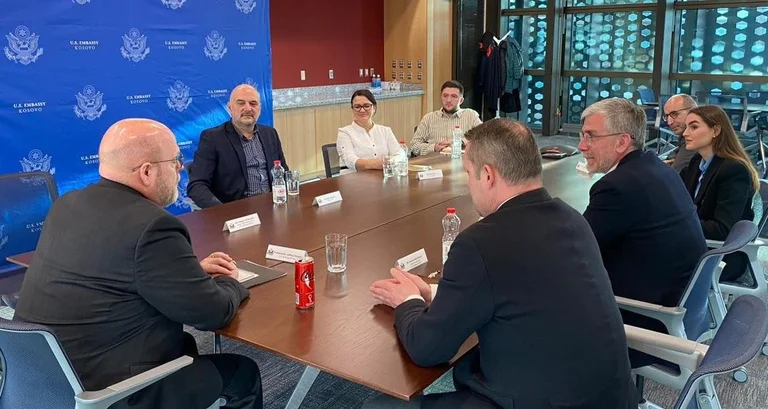
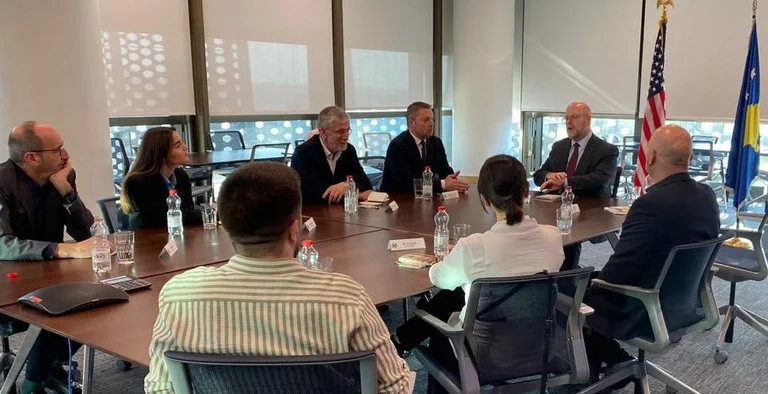
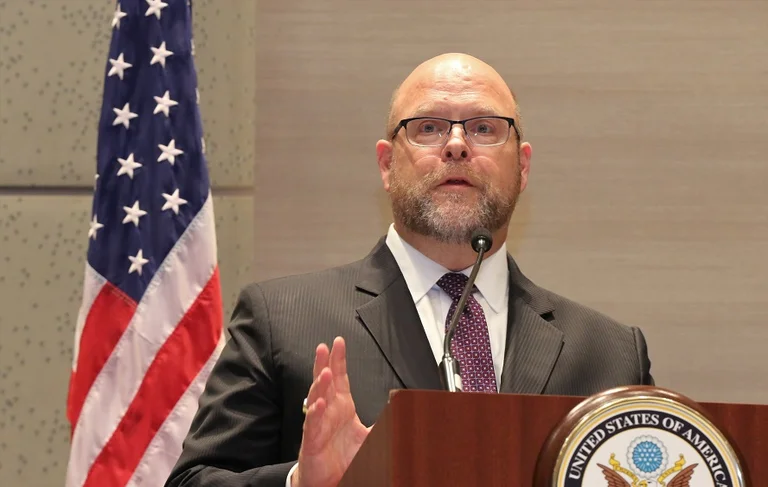
(3 years ago)US Ambassador to Pristina Jeff Hovenier in an interview with journalists' colleagues, where Periscope was present, has spoken of many issues Kosovo has been through in recent months, focusing on the situation in the north and the requirements for forming association. Hüvenier thinks that association has no option and as [...]
US Ambassador to Pristina Jeff Hovenier in an interview with journalists' colleagues, where Periscope was present, has spoken of many issues Kosovo has been through in recent months, focusing on the situation in the north and the requirements for forming association.
Horvenier thinks that association has no option and that it should be done.
The ambassador has also been asked for the release of terrorists in the north, Dejan Pantic, and the international demand not to arrest the barricaders.
He first said to reporters: The only vows or guarantees that we have made are publicly known. I am assuming that President Vuciq has directly referred to the US and EU statement on December 28th, which spoke of the excusing of tensions in northern Kosovo and of our prospects for the situation. A call we made for all to hold to the maximum and de-empt the situation, which repeats some of the consensus we have had with the Kosovo leadership on issues of the Serb community in Kosovo and also our call for Kosovo and Serbia to return to ensuring environment towards reconciliation and regional co-operation and stability. You are as familiar as I am with whatever vows we have made for any party.
Total interview:
Do you believe this will accelerate the negotiation process after the new year?
Havenier: I sincerely believe in that and that is our goal and the EU. None of us have hoped to see a number of the emergency issues that have occurred, which, according to our perspective, have narrowed the road to important things. We are committed to working towards a comprehensive agreement on the rating of relations that has mutual recognition at the centre. We believe the best way forward is to urgently discuss the EU proposal, which is supported by France and Germany, which the US fully supports. This contributes directly to reaching an agreement on several issues of importance between the two states. But what Miroslav Lajcak has recently talked about in an interview is that there are some recent crises that have made it difficult to focus on this broader strategic goal, but we hope very much that in the new year there will be continuing these talks and we will work towards the comprehensive agreement.
We have recently heard many disappointments from the US to Kosovo institutions, mainly the way the situation is managed in the north. Has this report in any form damaged the United States of Kosovo and what it was like to negotiate with Kurt to withdraw from the Targa decision? In this regard, you may be aware that he said that you had more information than he has so that you agree?
Havenier: There were specific statements by American officials not in recent weeks but earlier expressing concern for the positions of the Government of Kosovo. We share the same strategic goals, we want to see Kosovo in the European Union and Euro-Atlantic organisations, we want to see progress in normalising reports between Kosovo and Serbia. In some cases, we didn't agree, not on strategic goals, but on tactics to get there and I think the license plate issue was a clear example of that. We have acknowledged Kosovo's right that people living in Kosovo will have Kosovo signs. But we didn't deal in the way and in time to implement this, and that resulted in a disappointment because we found ourselves in a situation where things, according to the prospect of American government and our partners, that should not become lighting points, became potentially such. Has this damaged our reports? I don't believe that, neither institutionally nor privately. I have co-operative reports and believe mutual respect with both Prime Minister Albin Kurti and President Osmani. The US is a supporter of Kosovo's long-term goals as it has always been. We will certainly still have some differences in tactical ways on how to achieve the same results. I have to underline that our priority and I believe that the Government of Kosovo is to work in an environment where we don't have crisis or dashing points that create a situation where it becomes an agenda instead of an agenda of importance and strategic normalisation of reports with Sebria, and we will work hard to postpone it early in the new year.
Based on all of Kurti's actions about the situation in the north, have you advised him not to be hasty with those actions, including license plates or elections?
Havenier: I would say that my advice to the Government of Kosovo is a public matter. We don't have secret messages for them that differ from what we publicly say. It's no secret that we've wanted more time in implementing the fine decision for people who haven't changed the plates. But we're beyond that right now. I need to state some steps the Government of Kosovo has taken. While we had another view of the deadline for the license plates, ultimately the Government of Kosovo, even later, but agreed with it. At this point, the government does not fine people who have not changed the plates, nor does it give a warning, and this was an attempt to de-excedent the situation. When the barricades happened, that was a very difficult thing and the US issued an extremely powerful statement, referring to what they are, that those who have put illegal barricades on the road should immediately withdraw them. We were clear about that. We have also told the Government in private and publicly that we want patience, that moving very fast and unilaterally would complicate the situation more than improve it. The government heard that. From our perspective, Prime Minister Kurti and Government told of the patience we have been looking for while we were resolving this. We wanted a political solution to that. My colleague in Belgrade, Ambassador Hill was clear on this and he's right. And eventually a political solution was found. It took patience, hard work but it was achieved and I think we can all agree that the way the barricades were removed, with some exceptions today, is much more preferable than the use of force that could result in hurt or far from being killed. Thus, I will say there have been answers from the Government of Kosovo to some of our concerns, and there have also been some moments that we have had very different attitudes for some of these issues.
Mr. Ambassador, if I do not err two weeks ago special representative Gabriel Escobar in N1 said that if Kosovo refuses to establish the Association of Serb-run municipalities will find a way to create it without the Government of Kosovo. How would that be possible?
Havenier: Let me get back to him that he (Escobar) said something very clearly and that I said very clearly. A clear political stance remains The United States. The founding of the Serb-run municipality Association has no option. It is a legally binding agreement Kosovo has taken over. A legally binding agreement that has been confirmed by the Kosovo Assembly. The states cannot decide what legally binding agreements they implement or implement. They are legally binding agreements. Kosovo is a state that follows law enforcement. So our expectation is that Kosovo implements the Association of Serb-run municipalities. We also strongly believe that it is also in Kosovo's interest to do so. This is an important element of this widespread effort to accelerate the normalisation of reports between Kosovo and Serbia. But regardless of Serbia, this is a very important thing for Kosovo. Kosovo Serbs are citizens of Kosovo, residents of Kosovo, they enjoy the rights in Kosovo, they have to take the rights and protection from the state like all citizens of Kosovo. They have expressed their concerns that they believe the state is not fully responding to their concerns, or is not addressing their concerns. They have spoken of the importance of the Association of Serb-run municipalities as an indicator of the willingness of institutions to respond to them. By implementing this, moving forward with this, the state is not only fulfilling a commitment it has, but also helping the country to be stronger and better. A multiethnic Kosovo where all citizens feel they receive protection and rights. We Americans are much stronger as a result of our diversity. Back to what colleague Gabriel Escobar said. We're too serious to see this issue moving forward. We'll talk to everyone about this with all the Heedars about it, that certainly includes Government. But other Heeders also, there are opposition parties, NGOs. There are interested individuals. Everyone who has something to say. The last thing I want to say is that people need to be reassured.
We are also aware of concerns that association can be misused in various ways or create a third level of governance to create defunctionalization. We don't support something like that and this is new in the U.S. position. What we've told the government very clearly is that we believe that association should move forward. But it should not be done in a way that is contrary to the current Constitution of Kosovo, or should not be in conflict with the Constitutional Court's 2015 ruling. We believe that under these provisions there is much space for association to be made and functioning and to address all the concerns of ethnic Serbs in Kosovo. In health and education specifically. That's what my colleague said. I repeat it. But I want to be very clear that this is a very important priority for the United States of America.
Have you received any informal guarantees from any of the Kosovo institutions that will create association to get something else in dialogue?
Havenier: What I can say is that association remains an active part of our dialogue with the Government of Kosovo. I can say that within the ideas for normalisation is a need to discuss what I would call obligations and guarantees for non-provision communities and that is part of our talks with Government.
In the common stance you have had with the EU, you are welcomed the fact that Kosovo has no list that have been at the barricades. Meanwhile in the next paragraph you've asked to respect order and law. Why shouldn't anyone who has somehow blocked 10 %s of the territory and put the lives of people in the north at risk?
Havenier: The question of what to pursue for criminal investigations and action is the decision of the Kosovo authorities. What we have said in the stance, that we welcome the securitys of Kosovo leaders who confirm, and will let the words speak on their own, that lists of Serbian citizens will be arrested or prosecuted for peaceful protest/the existence of barricades. And the next sentence at the same time says order and law should be respected. And any form of violence is unacceptable and will not be tolerated. Let me give you a script. Someone is protesting, a big protest at the Rudare barricades. Our understanding is that the Government of Kosovo does not consider that action a crime. And no one will be followed for protest and why it is present.
Give another example. Someone's protesting at the barricades and firing guns at the cops and hitting something like that with friends. This is a crime. We have clearly said that the law must be respected and any form of violence is unacceptable. I think we've given a huge difference to what a peaceful protest and criminal activity is.
We were going back to the Association. I want to ask you that we are entering a new crisis in Kosovo with the Association issue, seeing what has happened in the past six months when it comes to some technical agreements. Will we see a resistance of the Government of Kosovo again, have you been clear with them?
Havenier: I can't talk about what the government's attitude will be about this. It's a decision they have to make. I can express our expectations are and our partners are doing their best to support Kosovo in the trajectory to continue to take its place in European and Euro-Atlantic structures and reach an agreement on normalisation with Serbia. What I'd say is we're looking towards the future. This is an important part of the agenda. The US will make efforts to support the achievement of these strategic goals, as well as our partners and EU mediators, but will depend heavily on negotiators as well. We hope there will be political will. We believe that these issues can be resolved through this political process and we want that to happen.
Do you want the Association to be resolved within the comprehensive agreement, or will there be separate negotiations that the issue of Association is resolved?
Havenier: All our positions have been that this is discussed within the EU-mediated dialogue. That's what we actually say and I think we'll keep saying.
There's a deadline. Because it is said that Mars 2023 will be an agreement between Kosovo and Serbia. Does the United States have any deadlines for the deal?
Havenier: One thing we need to remember is that we don't lead in these negotiations, we don't participate in these negotiations, and we're not middlemen. It's a dialogue mediated by the EU and has our strong support and I think that anyone who has paid attention to recent developments has been able to see how strong our support has been, including many hours from my personal time in recent months. But the question of deadlines goes to EU mediators. Lajcak has made some comments expressing his hope for Mars 2023. I have something more to say. What I can say is that the U.S. believes that this is an urgent and very important issue and we will do everything to make this work progress the most effective way. I want to say one more important thing that is relevant in the context of your questions. This is a new U.S. position. When we recognised Kosovo as an independent state in 2008 we have done it with the existing borders. And I want to repeat this. I want to make sure people understand that from our perspective, the north of Kosovo has more special consideration, is part of the Republic of Kosovo, and we treat it like that. I want to stress this because there are numerous questions for the north of Kosovo. I want to assure you that the US position is very clear, it is part of the territory of the Republic of Kosovo, we consider it that way and treat it that way. Acknowledging that we work very closely with international partners, KFOR and EULEX and others for the need of attention and dedication and taking special action to ensure that Kosovo citizens and those living in northern Kosovo together receive guarantees and protection from the state. But it is part of the Republic of Kosovo.