8 minutes ago
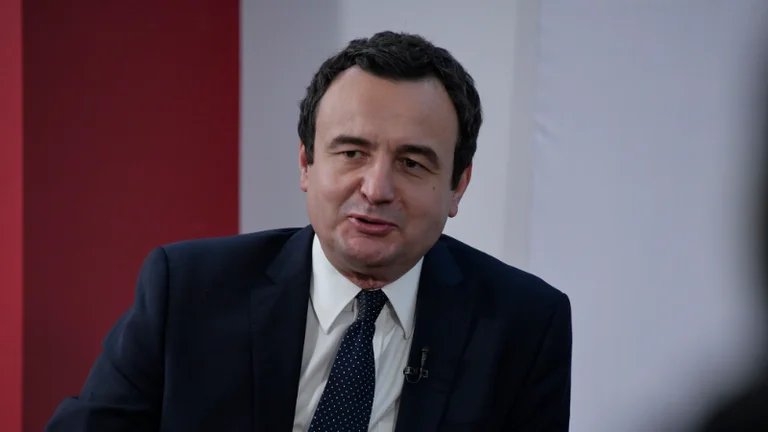
Prime Minister Kurti shows what keeps him most at Vucinqi
Periskopi(4 years ago)
(4 years ago)The prime minister's office submitted a full interview with FAZ journalist Michael Martnes on Wednesday. What the journalist himself had heard on Saturday was that Ambassador Havenier had more information about the north about the situation in the north has been erased from the interview. Martens said the reason [...]
Following an Albanian interview by Prime Minister Kurti sent by his office today
K R EU KOSOVA CEVICE, WHENTI: “in December we will submit our EU membership application”
FAZ: Prime Minister, thanks to American and European mediation, “Targisza” in Kosovo appears to have softened, at least at the moment. What is the essence of compromise?
Prime Minister Kurti: We have agreed not to comply with our decision to fine drivers with illegal Serbian license plates. Serbia has agreed to stop issuing plates inherited from Slobodan Milosevic's regime. We did so not only to avoid escalation of the situation, but also to create an opportunity for the quick start of talks on a full normalisation of relations between Kosovo and Serbia. These must be completed before spring 2023. That was the real purpose of compromise.
FAZ: EU foreign policy chief Josep Borrell was criticised in an extremely clear way for failing to find a compromise at the beginning. Are you a stubborn person or was Borrell wrong?
Prime Minister Kurti: I'm not stubborn, I'm a professor. There are principles and values that I maintain and that I do not negotiate in Brussels. We do not go to Brussels to negotiate for police officers, prosecutors, customs officers and cadastral leaders. We are there as representatives of the two states negotiating the normalisation of their relations. It's a dialogue on a principle agreement, not just a crisis management dialogue. We do not need dialogue for the sake of dialogue or to show that Brussels is active. I wouldn't have gone to Brussels if it was just about license plates. I will go to Brussels to conclude a comprehensive agreement. However, Mr. Borrell insisted that we sign only one declaration on the license plate and present this as a great success. That was the main dispute I had with him.
FAZ: You were a political prisoner in Serbia when incumbent President Aleksandar Vuciq was Minister of Propaganda in the Milosevic regime. Does that weigh your conversations, or do you keep your feelings?
Prime Minister Kurti: I never try to contain my feelings. Emotions are an important part of what we are and what we do. But I also have enough experience to let reason decide what I say or not. I was not released from Serbian custody last year, but more than 20 years ago. The main problem for me is not what Mr. Vuchy, but he has not regretted what he was today. Instead of repenting of being Milosevic's minister of information, he regrets that I was released from prison more than a year after Milosevic's fall. That's what he said a couple of times, and that irritates me. It's not about what I went through in prison, it's about the fact that Serbia has changed so little.
FAZ: Much has been said about a French-German initiative to resolve the conflict between Serbia and Kosovo. What does this plan foresee?
Prime Minister Kurti: On 9 September, EU special envoy Lajčák and Jens Plötner and Emmanuel Bonne, foreign policy adviser to German Chancellor and French president, visited me. What they introduced seemed to be a very serious initiative. They brought me a list of models and ideas that we discussed long before we were taking them to Belgrade. I told them I thought this would be a good basis for further talks.
FAZ: Why should Alexander Vuciq be interested in a compromise with Kosovo when the reward he once hoped for -- Serbia's EU membership -- is no longer realistic?
Prime Minister Kurti: More than nine months have passed since the Russian invasion of Ukraine, and Serbia has gone far on Russia's side. Whoever finds that Serbia will not join the EU in a predictable future will not forget that not only Brussels does not love Belgrade, but also that Serbia prefers Moscow.
FAZ: However, the agreement is not failing solely because of Serbia. Your ancestors have promised that Serb enclaves and settlements in Kosovo will be allowed to join an association of municipalities. You're blocking this, why?
Prime Minister Kurti: Serbia continues to say it will never recognise Kosovo. They say Kosovo is an artificial state. But in this supposedly artificial state, they want a real community of municipalities. The Serbian solution is: “You don't exist but we want something from you.” This is not gonna work. Second, when you ask for something, always remember that the same request can be made to you. Minorities make up about eight percent of the population in Kosovo and about 20 percent in Serbia. Serbia must think about the principle. Also, our constitutional court has ruled that the Serbian community of municipalities is not in line with Kosovo's constitution.
FAZ: A key principle of your policy towards Serbia is reciprocity. Can you imagine a model in which the Serb minority in Kosovo gets exactly the same rights as the Albanian minority in southwestern Serbia?
Prime Minister Kurti: I am for reciprocity of the rights of all minorities throughout the Balkans. This is the formula for peace. Minority rights are important to combat nationalist domination. But Belgrade no longer has the rights of Serbs. Serbia wants these rights to be territorialised, and this is something entirely different. Belgrade wants Serb communities to form a union, but I don't know how to have any Serbs in Kosovo looking for it. Every week I receive dozens of letters from Serbian citizens of our country. It's all kinds of things, jobs, legal function, and so on. Nobody writes: We need a community society. Only Mr. Vuchy says that.
FAZ: However, the EU and Washington appear to insist on establishing community association. Is its prevention more important to you than risking relations with Western allies?
Prime Minister Kurti: 33 agreements have been reached in Brussels over the past decade. Two-thirds of them have not been implemented by Serbia. I admit that these 33 agreements exist and I'm ready to consider all of them when formal talks begin to normalise our relations on the basis of the Franco-German proposal in Brussels. But Serbia would like to isolate an agreement and ignore the remaining 32, as well as the Franco-German proposal. But I'm not for that. When we talk about normalising our relations, I am willing to talk about the communities and rights of the Serb minority, not as the precondition for talks, but as part of them.
FAZ: Where is Kosovo on membership application to the Council of Europe?
Prime Minister Kurti: We are counting on supporting our partners and friends so that the vote for our admission to the Council of Europe can be made as soon as possible. In addition, we will officially submit our application for EU membership in December. Of course, we know that membership will not come soon. But it is important that we express our will to join the EU formally, formally and publicly.