15 minutes ago
Kurti: Agreement with Serbia expected next spring, with mutual recognition
Periskopi(4 years ago)
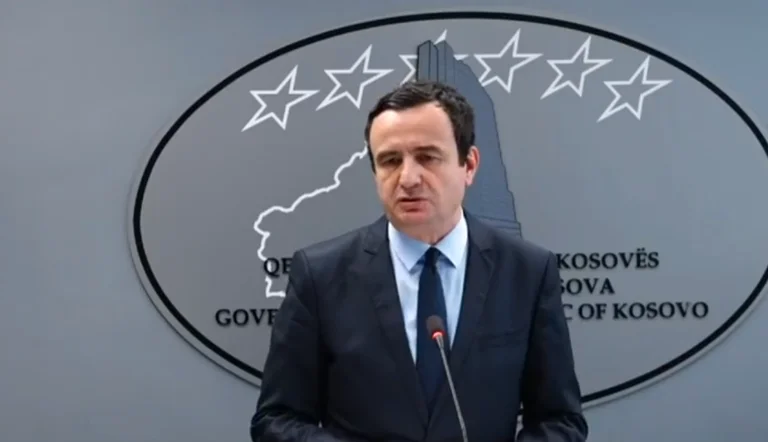
(4 years ago)Kosovo Prime Minister Albin Kurti continues not to give interviews in Kosovo, nor disclose what the Franco-German proposal contains, but much more the confidential has been shown in an interview for Montenegrin television “Gradska” on the “Aritia” show with author Tamara Nikcevic. The agreement between Kosovo and Serbia reminds him of two Germanys [...]
The agreement between Kosovo and Serbia, reminding him between the two Germanys after World War II, should enable Kosovo's integration into international institutions, including the United Nations, Kurti said in this interview.
“Since September 9th of this year, we have a model on which we will rely during our next negotiations, which should start immediately”, he confirmed, adding that the agreement awaits him within the spring of next year.
“actually said that within a few days (will start talks) and by next spring, we should have an agreement on the full normalisation of relations”, the prime minister said.
The agreement said that “is very important, not only for Kosovo and Serbia, but also for our entire region”.
“The normalisation of relations means that in the end we have an agreement, an agreement that is legally binding internationally and in which we have mutual recognition in focus. You know that Kosovo does not recognise Serbia, Serbia does not recognise Kosovo and now we have a deadline for that mutual recognition to be implemented sometime in the spring of next year. This is the deal that was reached last night and that Serbia has accepted”, Kurti has said.
The plan, Kurti said, is to organise a meeting in Brussels next week or next, where negotiations on normalising relations will begin.
The problem, according to Kurti, is to believe that Aleksandar Vucic will respect the agreement.
“From 33 agreements reached by Kosovo and Serbia in Brussels, Serbia has not implemented two-thirds of those agreements. We have bitter experience with Serbia in the sense that signing and implementing agreements are two things completely different. I will work on signing the agreement and implementing it coming in the same context”, Kurti points out.
He believes that it will not be easy but also impossible.
We now have Brussels, Paris, Berlin and Washington as guarantees. So we see this statement as a positive, progressive step in the right direction”, Kurti stated.
However, given the situation with China and Russia, which are not democratic countries and are in great tension with the democratic West and have veto rights, it is not very rational to expect them to change their opinion in a few months”, Kurti believes.
In addition to agreements between the two states, he adds, facing the past is necessary.
So Willy Brandt didn't start Ostpolic in the early 1970s with an agreement and negotiations, but going to Warsaw. I think that in Serbia it is very important that such a confrontation occur with the past. This is good for our present, but also for future generations”, Kurti said.
Asked if there is anyone in Serbia today who would make a gesture like then German Chancellor Willy Brandt who kneeled down before the monument of the Jewish Holocaust victims, Kurti says: “in Serbia certainly has people like that, but they are individuals and have no room for action”.
“They don't have the power and power to come with power, so they're in opposition and they're in the opposition extraparliamentary. It may take some time now, but we are living in difficult and strange times”, the Kosovo prime minister has stressed.
The bilateral agreement on recognition and normalisation of relations implies that Serbia will not oppose Kosovo's membership in international institutions, but also that it will not support a seat in the United Nations. However, he adds, things are still open because negotiations will begin.
I am convinced that Serbia would want these negotiations to last a couple of years, until world conditions change, and that I am not only talking about in the US, but also about Europe. This is an extreme right-wing view of life and the world, and I think that in Serbia, President Aleksandar Vucic does not have the main role here, but the Serbian Orthodox Church, which is closely linked to Moscow, Belgrade University and the media, which are more connected to Church and Russia than to political power. I think they control the disk of Serbia”.
Though optimistic, Kurti stresses that full normalisation must include transitional justice, without which, he adds, cannot be reconciled. And justice, it says, is not only in court.
This is happening in public opinion and in the fact that politicians, intellectuals and civil society are talking about it. And that way they distance themselves from the Milosevic regime and the crimes he has committed during the Kosovo war, and not only in Kosovo”, Kurti explains.
As a memorial of Ivan Stambolic's political murders, Zoran Djindjic and Oliver Ivanovic, Kurti says Serbia has no European future without being distanced from Milosevic, but also from official Russia, so as he points out, despotic President Putin. /albanian mail