8 minutes ago
The KSF Guard honoured Serbian soldiers who committed genocide against Albanians in World War I: Why?
Periskopi(4 years ago)
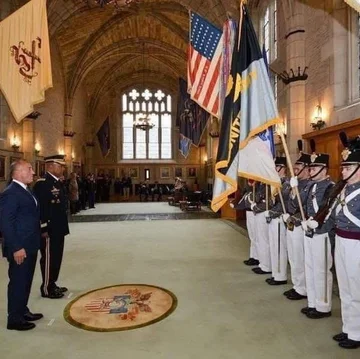
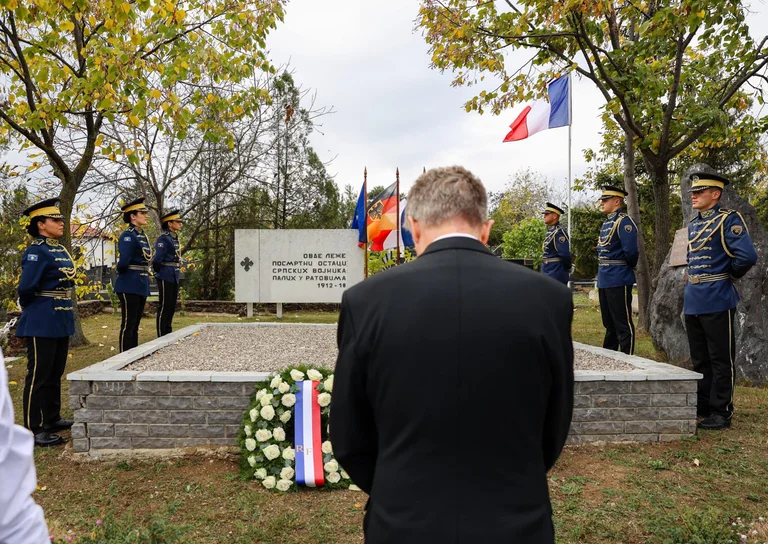
(4 years ago)On November 11th, with the organisation of the embassy of Germany and France, at the Christian cemetery in Arberi, the 104th anniversary of the end of World War I was held, by which all the fallen ones of this war in Kosovo and the Balkans were commemorated. Problem from that day on, getting ready [...]
On November 11th, with the organisation of the embassy of Germany and France, at the Christian cemetery in Arberi, the 104th anniversary of the end of World War I was held, by which all the fallen ones of this war in Kosovo and the Balkans were commemorated.
Problem from that day, it is emerging to be ready for the Kosovo Army soldiers, in front of the plaque dedicated to Serb soldiers during the 1912 -1918 wars. In those years, terrible crimes had occurred against Albanians everywhere.
Periscope has asked KSF spokesman, Mr. Ibrahim Shala for this case, but the same one told us that He will answer us later And the moment he answers us, we'll publish his answer, but first we're bringing back a story of those days.
Adri Nurellari, I bring a report of Leon Trockett, who wrote as a witness from the site of the event of what had happened in those days. He had written the article on December 23, 1912, and Nurellari brings this piece back to memory.
To understand the extent of genocide against Albanians, the then Carnegie Foundation report or this following report by Leon Trocket, published in the Russian newspaper “Kievska Misl” and written as a witness from the site
Leon Trocki “Kievska Misl” 23 December 1912.
I have had the chance, luckily or unfortunately, to visit Skopje, a few days after the Battle of Kumanovo. From the start, I was irritated by the Belgrade authorities over the permit of circulation. Because of the obstacles that the Ministry of War made to me, I began to think that people who led the war had no clear conscience and that down there, they were performing actions quite differently than they were shown in the official press.
This impression or feeling strengthened after meeting an officer who had been in Skopje with the soldiers of the General Staff.
The officer I had known for a long time was an honest man.
However, as soon as he learned that I was going to Skopje, since I had actually received permission to go there, with an open hostile attitude he told me that I should not go and that he did not understand why Belgrade was acting that way, according to him, allowing the “foreigners to go to Skopje.
In Vranje, at the border with Serbia, when he realized that I would not change my decision, the Serbian officer changed his voice and started preparing me for the images I would see when I arrived in Skopje. These are unpleasant things, but unfortunately, they're inevitable...”, he told me.
That, I have to admit, makes me even more suspicious. This means that the evil deeds, which were heard of as far as Belgrade, were not random, were not separate and isolated cases, while an officer treated them as “nevoja of the state”. Someone had to have information on this. Who? Army or government?
I received the answer to these questions as soon as I arrived in Skopje. My sadness began but we just crossed the border. At 5 pm, we approached Kumanovo. The sun was setting, and darkness had already gained ground. The more dark it became, the more the flames of fire went up. They were burning everything around us.
All Albanian villages, near and far away, had been turned into fires of fire to the railway. It was this particular example of a terrible war that I saw in combat zones. At one point, the wealth of those people, inherited from their ancestors ' grandparents and hard earned, was turning into flames. This fiery monotonous drove us all the way to Skopje.
I got off the wagon I drove.
The whole city was silent, there was no one alive on the street, just in front of the train station there was a group of soldiers from whom drunk voices arrived. Each one went his own way, while I was left alone at the station. I went to the band of soldiers. Four soldiers kept the dungonettes on standby.
Among the group of soldiers stood two young Albanians, with white heels. A soldier who was drunk, had his knife in his hand, and in his other hand was the bottle of raki. Centik ordered Albanians to lie down. They, half dead in fear, sat on their knees. After the next order, they stood up. He repeated this several times...
Then the centiary, insulting and threatening, led the tip of the knife to other victims. He forced them to drink brandy, then... he kissed them. Drunk with power, rakia, and blood, he had fun playing with them like a rabid cat with rats.
Same actions, same psychology. The three other soldiers, even those drunks, stayed on guard that Albanians were running away or opposed until the centium was entertained. These are “annautes”, a soldier tells me, “tas will slaughter them!” I left the group for fear. There was no point in trying to protect Albanians.
They could be rescued from only one other armed force. The whole scene was played at the train station. As soon as the next train arrived, I left to not hear the terrible screams and calls by Albanians for help...
The streets of the city and the city itself were so quiet that it seemed to be deserted. All the doors were closed since six p.m. When night fell on, the Cheentians started their jobs.
They broke into the homes of Albanians and Turks, killing and robbing. Skopje had 600,000 inhabitants, half of whom were Albanians and Turks. Some of them had certainly fled, but most were left.
Now, at night, crimes were committed against them. Two days after my arrival in Skopje, the first thing I faced in the morning was the mass of Albanian corpses with broken heads under the Vardar Bridge, right in the city centre. Some said they were Albanians who had been strangled by the Chetniks, others said they had brought water from the river. One thing was, those people weren't killed in combat...
Skopje had returned to a common military camp. Populations, especially Albanians and Muslims, were hiding in the streets from being seen by Serbian soldiers. Among the soldiers' mass are Serb villagers who have come here from different parts of Serbia.
Justifying that they have come to find their sons and brothers, they go through Kosovo robbing. I talked to three of those “editors”. The youngest, a short man, of “trima type”, was praised for killing two Albanians with his rifle, while two others had escaped. His fellow villagers, old villagers, confirmed his confession.
One thing is not good, they complain we don't have any money.
Here you can get as many horses as you want.
The soldier's salary is two denarii. The soldier goes to the first Albanian village and takes the first horse he finds. You can obtain a feather for 20 denarii through soldiers. Serbs from the Vranje suburb are massively heading towards Albanian villages in order to grab everything they find.
Serbian women have also loaded doors and windows on their backs, which they have taken to Albanian villages.
Meanwhile, two soldiers arrived. They are part of the Cetres, which disarm Albanians.
A soldier asks where he can exchange a lira. I asked him to show me the lira, since I had not seen Turkish coin. The soldier first looks at the side, then pulls the gold out of the bag, confessing that there are others, but he doesn't want to confess the amount.
A Turkish lira trades 23 francs. More soldiers came. I was listening to their conversations. I don't know how many Albanians I killed! But I haven't found anything worth taking. And when I took a new bride's head off, I found 10 lire in her!” Their exploits, they speak quite freely. This is common to them.
People do not realize how many internal changes they have brought about only a few days of war. It can be seen how far one goes from the circumstances. Under the barbarous organization of war, people soon become brutalized, and they may not even understand it. A platoon of soldiers was marching Skopje's main road.
A drunk, in all likelihood, a foolish Turk began to curse. The soldiers stopped. They supported the Turk to the nearest wall and shot him on the spot. The platoon went on, just like the population on the street.
Conversation with the officer I knew:
We're cooking birds and killing arnautes. We're tired already! ”
In the evening at a restaurant, I met an officer whom I knew. His unit had been stationed in Ferizaj, in the centre of Albanians, Serbia's old “”. With his men, the sergeant had pulled a large dangerous ball during the march from Kocan to Skopje. The ball would be sent to the army that had surrounded Edrene.
- What duties do you now have at Ferizaj among Albanians? I ask him.
We're cooking birds and killing arnautes. We're tired already! ”,- he says, by making grates and opening his mouth from fatigue. Then it continues: “There are lots of rich people among them. Near Ferizaj, we entered a wealthy village with castle houses. The owner was a wealthy man who had three sons. There were four males and many women. And We brought them forth from their houses all together, and We set them in ranks, and We slaughtered the men before their eyes. Women did not cry for fear. They begged us to let them in and take their clothes. We let them. They then gave us a gift. Then we set the whole country on fire...! ”
How can you act so brutally? I ask him terrified of his confession.
I don't even know, man's taught. At another time, I would not have been able to kill an innocent elder or child. In times of war, as you know, the commander orders and you must follow the order. A lot like this has happened. During the ride of that ball to Skopje, we met a cart along the way, in which four men were lying up to the belt. I immediately smelled the iodine. Something was suspicious, I thought.
I stopped the cart and asked who they were and where they went. They were silent, justifying that they did not know Serbian. With them was only the charioteer, a Roma man, who told us that the four injured had participated in the fighting in Merdare. They were injured and were now returning home. I figured out who they were. - Get out! I ordered.
They understood what I was saying, but they hesitated. What can you do? I put the shit on the rifle and I stabbed the four...
I knew this man. He had been a waiter in Kraguyevc. Man with no quality. Not by nature, waiters, like all waiters in other countries. There was also one time at the Camera Union. He was even a secretary, but he left... And now look what he's back on!
Why do you act like bandits, you're killing and robbing, no difference! I screamed, feeling an abomination for the man I had talked to.
The superior found himself in a difficult situation. Something seemed to come to mind. Then, trying to justify himself, obedient and serious, he uttered a phrase that had even more black than I had seen and heard.
No. It's not like that. We, the regular army, strictly respect the rules, never kill anyone younger than 12. I'm not sure I'm telling you anything about Centiles. They're all on their own. I can assure the soldiers! ”
The sergeant didn't provide for the centiles. And they did not really accept any restrictions. Rescripted from among the unemployed, the disabled, the wicked and the worthless, from the lower crowd, they engaged in their savagery with crime, robbery, and violence.
Acts were a great witness against them. Even the State army felt inadequate by such bloody banaliats of degraded Cets. They were forced to take measures and still without the end of the war, disarmed them, and returned them to their homes.
Return
I was unable to endure that atmosphere further, I had no stomach to endure. Political interest and moral awareness, to look at how such things are done, sank. I already had only one wish: Back as soon as possible. I found myself on the train again. I was looking at the vast fields around Skopje. What beauty, what breadth! People could live well here. What good it is to speak when you know these ideas yourself, but those in that country sounded ten times harder.
Fifteen minutes from the train's departure, I looked out and saw a corpse with a face on the ground and hands stretched out at a distance of 200 yards from the station. About 50 yards from the railway were standing two Serbian guards, part of the forces guarding the railway. Surely this was their work. Get, away, just get out of this place first.
Not far from Kumanovo, in a meadow near the railway, soldiers were digging a large hole.
I asked him what that hole was digging for. I was told that the hole is opening for rotten meat, located in ten or 15 trucks parked by the side of the road. The soldiers had not taken the meat they had met. All their food needs, even more than they needed, were taken from Albanian homes - cheese, milk, honey. I ate more honey at the time, which we took from Albanians than I had eaten my whole life!
For every day, Serbian soldiers slaughtered oxen, sheep, pigs, chickens, which they ate by throwing away. We don't need meat. How many times have we written to those in Belgrade not to send us meat, but they do it according to certain rules!”. This is how things stand when viewed closely. Meat is breaking down, both human and animal meat, villages are burned to the ground, people are being cast out, “people over the age of 12”... all are barbarized, losing their human face...
War is coming to the surface as the top and most importantly, you'll see the crimes if you reveal a little curtain, which hangs in front of the actions of the soldiers “
From “Kievska Misl”, No. 355, December 23, 1912.
November 11, 2022: World War I's Falles in Kosovo and the Balkans / Ambassador Messages That Day
Ambassador Guérot at this memorial ceremony stated that Kosovo and Serbia should follow the example of Germany and France, to reconcile and continue co-operation in the future.
The location of these graves before which we are gathered today testifies that French soldiers who fought all these years in the Balkans fell to Kosovo perhaps at the end of the war in the fall of 1918, supporting the Allied soldiers of the Kingdom of Serbia. It also enables us to appreciate the path of devotion since then. By sticking firmly to the path of reconciliation, France and Germany have been able to find the way of brotherhood and peace. Our ties, our deep friendship, have made possible the creation of a new Europe built on a foundation of shared ambitions. A strong, free and independent Europe committed to solidarity and human rights protection”, he said.
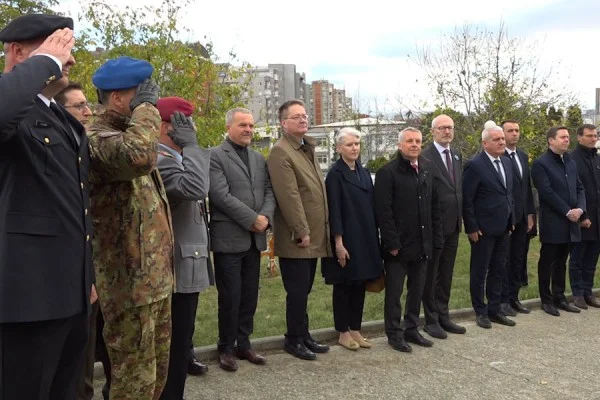
He showed what Germany and France have accomplished may be an inspiration to the region. Guérot said that although he has been long and difficult to dialogue is necessary for the good of the country. According to him, this is the way Kosovo and Serbia should follow.
What Germany and France have achieved can be a source of inspiration for the entire region. Dialogue, though long and difficult, is a necessity that needs to be developed in a constructive and open spirit. This is the way Kosovo and Serbia, Albanians and Serbs must now follow to achieve reconciliation and build a common future...18 French soldiers lost their lives during KFOR service. I want to connect them to our ceremony. It should be looked to the future, instead of returning the old demons and manipulating ideologies that led to war in the past and who claim to justify Russian aggression in Ukraine”, he said.
And German Ambassador Jörn Rohde said the consequences of the war have been terrible, he indicated that 9 million soldiers and 17 million people lost their lives. After the war disaster, he also mentioned November as a holiday day where the history of Franco-German relations was formed, Rohde considers it historic achievements where Germany and France have become friends and allies.
The humanitarian consequences of that terrible war were devastating, more than 9 million soldiers lost their lives, not to mention millions of civilian victims throughout the continent, totaling 17 million people dead. Ladies and gentlemen, it's important to remember, it's important to remember because history repeats itself, so we're here today. World War is often mentioned as the first disaster of the 21st century, and we should rightly never forget it and never forget it. But despite the mourning and grief that we have gathered here today, November 11 is also a holiday, the history of Franco-German relations has been difficult for centuries, marked by fear, endless wars and countless deaths dating back to 1918. But today, the Germans and the French are gathering here not only as the closest allies, but now both our countries and our people have become friends and allies. This historic achievement is a masterpiece of diplomacy and truly amazing reconciliation today, but it also feels pride and hope”, he said.
He also said that Franco-German friendship is a success story, in which according to him is the best example for the possibility of reconciliation of the two enemy countries, leaving the past behind for the country's future.
“The French-German friendship is a unique history of historical success, shows that reconciliation is possible even among former enemies, proves that past conflicts can be overcome if there is sufficient political will. I hope that it can also serve as an example for reconciliation in the Western Balkans, there are many shares in Europe these days, Russia's terrible invasion of Ukraine, and the empirial thought behind it shows us brutally that some of us see violence and murder as a legitimate continuation of politics, that shows memories of war horrors in the past seem to be fading. We must not allow this to happen, remembering our past is an integral part of our commitment to support and protect the global order of peace that we managed to establish after 1945. We should remember, we should never forget”, he said.
World War I began on July 28, 1914, and ended on November 11, 1918, with the victory of the Antanta Block, which belonged to Great Britain, France, and Russia, to the Trilateral Alliance, which included: Germany, Austro-Hungary and Italy. /Periscopi