13 minutes ago
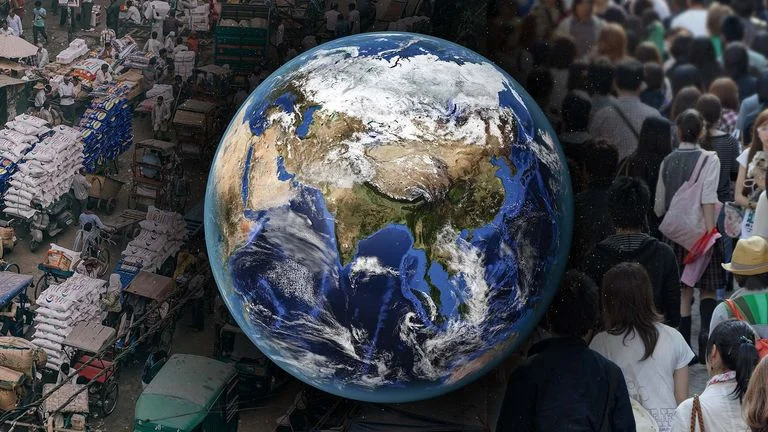
Can Earth Maintain Eight Billion People?
Periskopi(4 years ago)
(4 years ago)The world's population has again passed record numbers, which continue to burden natural resources. The real problem is consumption over the measure, experts say. How can we separate the world properly? This November the number of people on Earth will have passed the record of eight billion people, marking an increase [...]
This November the number of people on Earth will have passed the record of eight billion people, marking an increase of another billion within just over a decade.
The growth of the world's population is a success story worth telling,” says Sara Hertog, a population expert at the United Nations (KB) in New York. Since 1950, the average life expectancy has increased by 25 years. At the same time, birth levels have dropped, accompanied by better access to health care and family planning, as well as greater educational opportunities for girls and women.
But this success has its own price: Every single person added to the world weighs the planet's biological limits and resources. In a current UN report, population growth is described as one of the main reasons for environmental destruction and increased carbon dioxide emissions.
“Loss of biological diversity, climate change, environmental pollution, forest cutting, limited amount of water and food, are all problems that are even more severely exacerbated by the growing and continuing population of”, says Popular Matters, a nongovernmental organisation based in the United Kingdom.
World's richest countries consume more
It's very easy to blame the enormous population growth, especially in developing countries in the South of the globe, says the Hertog population expert, in conversation with Deutsche Welle. It's “misspelled” to expect the slowdown in population growth to be the only solution to the dangers before which our basis of life lies.
“More crucial than population growth is increased income, which stimulates increased consumption and environmental pollution caused by it,” explains Hertog. It recalls that the world's richest countries spend most of their resources breathing, even if population growth slows down or returns. Developing countries in Africa, southern Sahara and parts of Asia, low-income countries expected to have major growth in the coming decades, are responsible only for a small portion of carbon dioxide emissions and resource consumption.
If the people of the world lived today as the U.S. citizens live, then we would need the resources of five globes every year, says the environmental organisation Global Footprint Network. And Nigeria's inhabitants use only 70 percent of the existing natural resources, and India, with 1.3 billion inhabitants, spends only 80 percent of its resources.
We have lived beyond our means
Experts insist on seeking other solutions because the world's population continues to grow: The United Nations estimates that by 2050 the world's population will reach 9.7 billion people, while by 2100 it may reach 11 billion.
The world has enough resources to feed eight billion people, says Vanessa Pérez-Cirera, director of the international economy sector at the World Resources Institute. It can feed another eight billion, provided the current forms of land exploitation are re-organized from the front and adjust, says Pérez-Cirera.
“
The thing is how we share resources together, says Sylvia Lorek, professor of consumer economy at Helsinki University and director of the German think tank for a sustainable Europe (Sustainable Europe Research Institute). That's why we have to question the current consumption model, especially in the north of Globe.
We have long lived beyond our reach,” says Lorek for Deutsche Welle. The professor feels that we will not be able to maintain our current way of life for a long time.
The more people seek to live in the western style of high - consumption living, the harder it will be for the earth to regenerate the essential biological resources of life, flora, wildlife, water, and clean soil. To meet the needs of the world's population, we currently need 175 percent of the world's ecological resources without letup every year, estimates Global Footprint Networks.
We must learn to live well by consuming less
Lorek also stresses that much of the excessive consumption is not the choice itself, but comes from the way society is built and the values that follow us. In the media, advertising, movies and television people are given the impression that financial well-being is the most important thing in life”.
Over the past few years, Lorek and other researchers have observed how people who enjoy a relatively comfortable living standard can learn “live with less” without giving up their quality of life. During these surveys they are focused on three areas, which are responsible for most of the carbon dioxide and resource waste emissions: the way we eat, how we live, and how we move.
The advice they give sounds familiar to all who follow the climate debate: less animal consumption and increased plant-based food, as well as fewer air travel and individual transport by motor vehicles. Restruction of cities must also be done. The main issue here is to build buildings with efficient energy and buildings to offer other opportunities for family villas and single-member household economies, because these consume more surfaces per capita and more energy, causing more carbon dioxide emissions to increase this social way of life.
But only the numbers and facts they speak for themselves are not enough to convince political decisionmakers and society of changes that must definitely be made in our way of life, the professor says. Doing only what science says is like living in “ecological program”, Lorek thinks. We need “to build together as society a balanced way of life”, so that only more justice can be established in the consumption of resources between poor and rich nations.
Thus, it can be achieved to ensure that everyone has a minimum quality of living and that the opportunity can be removed simultaneously so that only a few people can consume the world's most limited resources. Because this, would be a dangerous “for social cohesion”, Lorke's conviction.
Pérez-Cirera says, it's not about everyone having a lifestyle, but the important thing is to show that the standard “hopeful and attractive” of life is possible, even if you limit excessive consumption.
I think claims should change”, she says. “is not realistic at all, giving the message that anything we now value will be able to taste even in the future”. But political decisionmakers need to understand that economic development is possible, but concentration should not be done in quantity but in quality. “We must surely show that you can lead a life of pleasure with even less things.” / DW