15 minutes ago
Hard to document war crimes: Experts demand that the institute be autonomous
Periskopi(4 years ago)
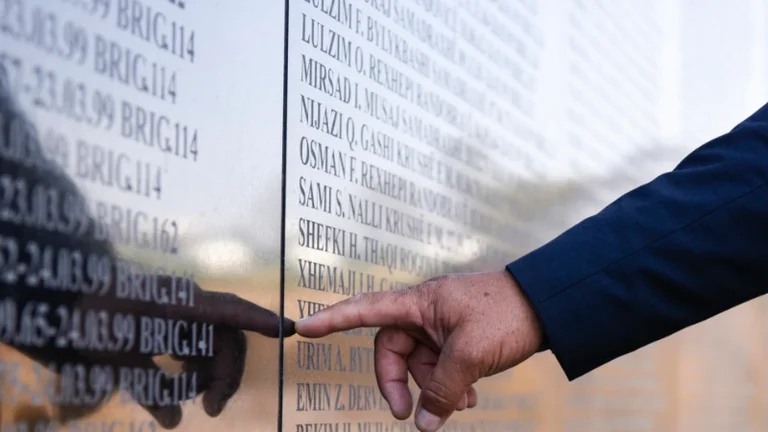
(4 years ago)Twenty-three years after the end of the war in Kosovo, the actual documentation and evidence of crimes committed by Serbs to the Albanian population are seen as a difficult process. Experts have named this issue as stepping aside from institutions for a long time. And on the other hand, they welcome creation by law [...]
Twenty-three years after the end of the war in Kosovo, the actual documentation and evidence of crimes committed by Serbs to the Albanian population are seen as a difficult process.
Experts have named this issue as stepping aside from institutions for a long time. And on the other hand, they welcome the establishment by the Law of the Institute for Investigation of War Crimes.
Criminal Law Professor Ismet Salihu had led such an institution years ago, but was closed with government decisions.
But he said he said that from the creation of this institute he expects a lot considering the work that will be done there. However, he added that this Institute must have a special status and be autonomous.
Kosovo's “Opinion expects much of this institution. Numerous crimes were committed in Kosovo by Serbian forces, even more serious than those committed after World War II. This institute, soon, must be established and the sooner the proper staff is recruited and the optimum conditions” created.
This institute must have a special status, not near the prime minister's office, but be autonomous such as the Institute of History, Albanology. He must have his autonomy and create the optimum conditions. This Institute in the next five years has to work intensively, collect all evidence, evidence of murder, torture, destruction of cultural heritage, and of the most painful and sensitive crime for violations”, he said.
He added that Kosovo has been delayed in establishing the Institute because it has spent a long time after the war and much evidence has faded, and some have even been lost.
We've been delayed to establish this institute, then we're too late because of the neglect of our powers, so it should be as soon as this institute is established. It's been a relatively long time, now about 23 years since the end of the war, a lot of evidence has faded, a lot of evidence has been lost”.
While Bekim Blakaj, director of the Fund for Humanitarian Law in Kosovo, said that in time, the investigation and prosecution before war crimes courts has become even more difficult.
In fact, according to him, most of the evidence has disappeared and the key in these court processes remains the will of witnesses.
Now 23 years have passed since those terrible crimes were committed, most of the evidence has disappeared. We can't talk about forensic evidence anymore, but unfortunately the documentation hasn't been collected, the archives haven't been traced many of the documents that could be used have disappeared”.
So in most cases the major burden in these court processes is remaining on witness testimony. The survivors are the main evidence in these processes. In time, even the memory of these witnesses fades and unfortunately, most of them have already changed their lives”, he said.
As for the establishment of the Institute for Crimes in the War, by the government of Kosovo by law, Blakaj said it is time to try to document all crimes committed during the war.
It's in the process of establishing the Institute for Crime During the War, which is being founded by a special law, and I'm hoping, since it's being created, as such, the agency under the Government, but with a special law”.
It's time to try to document all crimes committed during the war. I'm hoping, since there's a political will from this government, that will empower the insulin with all resources necessary”.