32 minutes ago
Albania: Energy in times of crisis from floating thermal power plant
Periskopi(4 years ago)
(4 years ago)Albania also faces unusual energy supply difficulties. Two floating thermal power plants are expected to produce lower-cost energy. Two floating thermal power plants, which have already thrown their anchors into Vlora Bay in the Ionian Sea, will begin producing on January 1, 2023, 15 per cent of the amount of energy [...]
Two floating thermal power plants, which have already thrown their anchors into Vlora Bay in the Ionian Sea, will begin producing on January 1st, 2023, 15 per cent of the annual energy needs of the economy and households in Albania. According to local experts, the energy produced by two floating thermal power plants, rented for two years by the American company “Excerate Energy,” will have a cost three times the same amount imported.
The war in Ukraine, the energy crisis from Russia's drastic reduction of Europe's natural gas supply, forecasts for a winter with low rainfall and snow, stratospheric growth and energy growth in European and global markets are also clear signals for Albania, predicting unusual energy supply difficulties. In this context, the Rama government decided earlier this month that the increase in electricity prices for household consumers for the last three months of this year -- starting this Saturday (01.10) they will pay 4, 5 times more for 1 KW/h if they consume more than 800 KW/hh per month. But on Friday (30.09) Prime Minister Rama announced that the government decided that the decision to increase the price of energy on consumption of 800 KW/hours per month should not go into effect “made up of rainfall and energy savings”.
Arber Avrami, Executive Director of Alubgaz, tells DW that “with two power plants Albania has enabled ensuring an extremely valuable solution in meeting the international challenges that the energy crisis has created. With a 110MW/h capacity and potential to produce no less than 867 GW per year, these floating terminals provide a good opportunity to cope with the global energy crisis that is expected to migrate during the coming winter. ”
Germany and floating thermal power plants
According to official sources from the Energy and Infrastructure Ministry, the number of floating ship-termocentrals - is limited to a global level. The American company “Excerate Energy” has only 10, two of which have reached Vlora Bay. In terms of the global energy crisis, demand for floating thermal power plants is increasing.
Even developed countries like Germany are considering these floating ships, generating energy as a means of overcoming emergency problems as much as a suitable way to balance energy shortages from Germany's willful withdrawal from nuclear energy use. Germany is viewing navigational thermal power plants as a preferred, timely, flexible alternative to geographical dislocation where more and with reduced environmental risk of”, Arber Avram says of the DW.
Environmental impact within international standards
The production of electricity from two floating thermocommeters after three months is “conform domestic legislation, international conservation standards and has received the respective environmental certificate”, explains for DW, Arber Avrami. “Platforms will hold their activity in an area that has industrial use destination. They are within the Triport industrial complex in Vlora, where the Vlora thermal power plant, the Petrolifera hydrofuel processing area, as well as other activities with similar character”, he points out.
In terms of fuel that will use floating thermal power plants “will be the ones that meet the world standard and are used in floating tools and industrial activities, with gas emissions according to local and international norms for industrial emissions”, says Arber Avram. The “Technology that will be used in these plants guarantees that the environmental impact stays in the World Bank's international manuals, the agreements that Albania is part of, the rules for environmental permits in the Republic of Albania”, he stresses for DW.
Environmentalists - Winters in Darkness or Environments free of risk?
But environmentalists and environmental organizations think differently. The risk of lack of energy and a winter in the dark have divided their opinions about the effects of environmental pollution and those on the Ionian Sea flora and wildlife, in Vlora Bay, from the production of energy from two floating thermal power plants using an oil type. Environmentalist Xhemal Mato says about the DW, that “in terms of power shortages and a winter darkness the benefits of electricity production from two floating thermal power plants are greater than environmental damage, which I think will not be irreversible and very severe. ”
But environmental organisation “Alliance for the protection of Vlora Bay” and another group of environmentalists along with Vlora citizens have protested the deployment of two vessels expected to produce electricity in Vlora. Environmentalist Saban Guri says about DW, that the use of oil as fuel will cause great damage “because it doesn't happen on Earth, which has generation skills but in the sea that does not have these capabilities, which risks causing major environmental damage. ” “The floating thermocentrics have no cooling. The water that will emerge from them will be over 40-45 degrees, which means that wildlife and flora at sea will be destroyed because it does not endure this temperature. Pollution of seawater and air will bring great environmental damage”, says environmentalist Sazan Guri.
Developing gas infrastructure
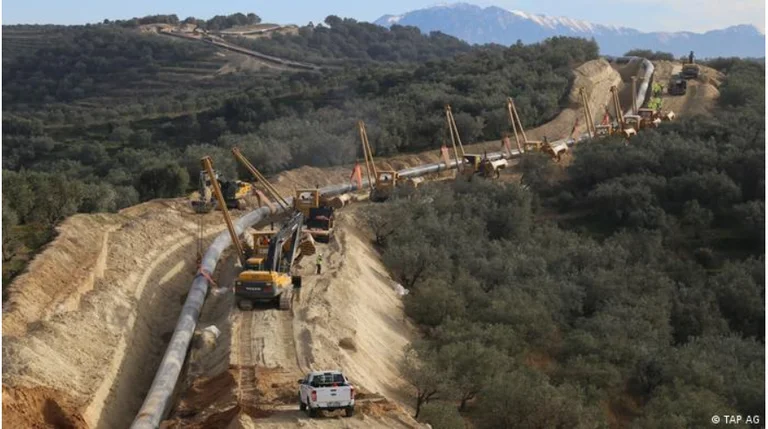
The environmentalist movement's opposition to the location of floating thermal power plants and their temporary operation with oil appears to be unable to produce immediate results. For now, natural gas is not possible as fuel to produce electricity and there are lower emissions of harmful gases than hydrocarbons. In Albania the gas infrastructure is under way and limited only to the TAP pipeline, which carries gas to Italy”, Albgaz Executive Director Arber Avrami tells DW.
However, steps are being taken. „In collaboration with the strategic partners of American companies, “Excerate Energy” and „Exon Mobil” is building the infrastructure of a new terminal for the floating liquid gas port (LNG) at the port of Vlora and LNG transmission to the existing TEC in Vlora. Later, through the Fier-Vlore pipeline, connection will be made with the TAP gas pipeline,” stresses for DW, Arber Avram. When the gas supply begins through this terminal, floating power plants will be converted to use natural gas as the first fuel to produce electricity.
Regional Energy Security Projects
Albania's ambition to turn itself into a regional energy node aims to be realised within two years when construction of the floating terminal at the port of Vlora, which „will ensure not only the fulfillment of domestic needs but will also turn Albania into a contributor to energy security in the Balkans and to South-Western Europe,” says Arber Avbrami. „Albania is negotiating with northern Macedonia and Kosovo to enable a broader infrastructure integration of the region for energy security. It will contribute not only through the acceleration of interconnection through TAP and natural gas, but also from the operation of the Vlora TEC and the construction of the Skavica hydropower plant”, Avrami points out.
Another regionally important project is the construction of the Ionian-Adriatic pipeline that will connect Croatia's existing gas transmission system with the TAP pipeline through Montenegro, Albania and in close co-operation with Bosnia and Herzegovina.
Albania's conversion to a regional energy centre has brought increased interest by regional partners to co-operate, based on mutual interests for diversification of energy resources and lower dependence on Russian gas in the region. An encouraging example is co-operation between Albania and the American-Bulgarian company Overgas, leaders in Bulgaria in the gas sector. This company signed in Tirana in January this year a Memorandum of Understanding with the Albanian state-owned company Albgas regarding co-operation between two sides for the implementation of projects that diversify natural gas supplies to the Western Balkans (BP) and Europe. These include the supply of the Overgas oil Gas company, (LNG) at the port of Vlora and the implementation of the floating terminal in the port of Vlora, which will be built by American companies Exxon Mobil and Excerarate Energy, leaders on the global LNG market. /DW