2 hours ago
Spanish media writes long and wide about Fadil Vokrin: Goal Against Partizan Will Remain in History
Periskopi(4 years ago)
(4 years ago)Spanish medium “Esferico” has dedicated a special article to Kosovo football legend Fadil Vokrrit. The article describes the entire career and challenges Voker has faced in Yugoslavia, the successes and then the major achievements Fadhil has achieved during his brilliant football career and later as chairman [...]
Spanish medium “Esferico” has dedicated a special article to Kosovo football legend Fadil Vokrrit.
The article describes the entire career and challenges Voker has faced in Yugoslavia, the successes and then the key achievements Fadhil has achieved during his brilliant football career and later as chairman of the Kosovo Football Federation.
In the 1980s, Europe witnessed the rise of Yugoslav football. For memory figures like Savicevich, Prosinecki or Boban. But in those years and among so many stars, a footballer of Albanian origin was brushed with Balkan football elite. That footballer's name was Fadil Wickry. For years he proudly represented a soulless community within Yugoslavia.
For years Serbs and Albanians split the state and republic. However, they would end up in a bloody war. Unfortunately something common in the 1990s in the Balkans.
Tito's Yugoslavia gradually created a high-level sports culture. In a climate of peace, Yugoslav sports specialised in team sports. Schools of trainers are established and a autochthon style is described in disciplines such as water polo, handball, basketball and football.
However, elite athletes of Albanian origin in Yugoslavia were few. For this reason the figure of Fadil Vokrrit overcomes it simply as a sport. The Albanian trumpeter became one of the few elements that united the Albanian community with the dying Yugoslav state.
In the 1980s, Vokri played more than a hundred matches for the Yugoslav national. A milestone for any Kosovo-born football player. Despite success, Fadhil was always clear to his roots. His origins and feelings toward his people will always be present throughout his entire sports career.
He debuted in the Yugoslav football elite in Pristina. He became an unfathomable goalkeeper who for several seasons caused a whole town to forget their suffering every Sunday. The goal that enabled Pristina to win at the home of Belgrade's ruling Partizan will remain in history.
His good figures on the Kosovo team led him to one of Yugoslavia's largest teams, Partizan. In the Serbian capital, goals continued to be scored. His goal ID opened the doors of the Yugoslav national and European football. A year after being vital in winning the title of the Cup by Partizan, he was signed by the Turkish club Fenerbahce.
In Turkey, Vokrri could observe how a complex society like Turkish lived, though no one was discriminated against to play soccer. This experience made him aware of the abnormal situation the Albanians experienced in Serbia. In many cases, Kosovars have been marginalised or excluded from football teams for ethnic reasons.
Fadhil would also play in French league in the late eighty, specifically in Nimes. His experiences abroad allowed them to gain perspective for what was happening in Yugoslavia. Especially the difficulties Kosovo Albanians face. It was in these years that he resigned from representing Yugoslavia. He left the selection. It was the noise of the death of a country that was disbanded in the worst possible way, with bloodshed.
Fadil Vokry would return to Kosovo years later. After declaring independence, he was appointed president of the Kosovo Football Federation. As president of the Federation, he managed to recognise Kosovo as an official member by FIFA and U EFA. In this way Kosovo could participate in international football competitions. For many Kosovars, this historic moment is the most important moment after declaring independence.
On June 9, 2018, Fadil Vokrri passed away after a heart attack. His funeral was a state act. The highest authorities in the small and new Balkan country participated. No one was surprised by the social impact of his funeral. For years Fadhil was the flag of a city without sports references.
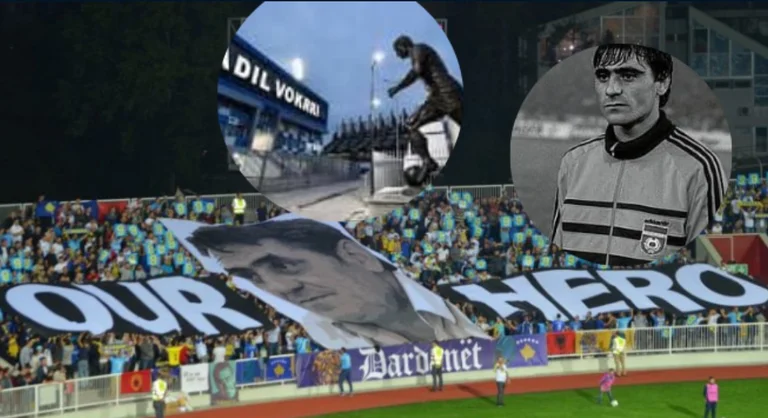
Fadil Vorkry was more than a footballer. It was a city icon. Albanians living in the former Yugoslavia had worshipped it. He was an extraordinary athlete. But besides his football skills, his management and good diplomacy led Kosovo to be recognised as an official team. For all these reasons, the Pristina National Stadium bears its name and is decorated with a September of Fadil Vokrrit. So far, the most important football player in Kosovo's history. Even though Fadil Vokry was more than just a mere footballer. Perhaps the greatest flag of a freedom - hungry people.