7 minutes ago
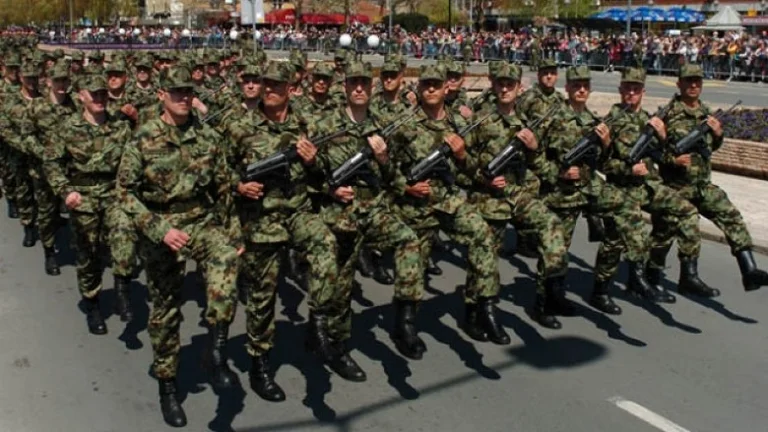
Albanians discriminated against in Northern Macedonia Army
Periskopi(4 years ago)
(4 years ago)Reforms in the state administration of Northern Macedonia must be made by following the principles of the Ohrid Agreement, which have been followed in drafting the country's laws. However, there is still uncertainty when it comes to full implementation in practice. Recently, several Defence Ministry employees announced the Voice of America regarding [...]
Reforms in the state administration of Northern Macedonia must be made by following the principles of the Ohrid Agreement, which have been followed in drafting the country's laws. However, there is still uncertainty when it comes to full implementation in practice. Recently, some defence ministry employees announced the Voice of America over their complaints of discrimination on ethnic grounds. Our correspondent, Isak Ramadani, spoke with one of them and with a senior ministry official who rejects these accusations.
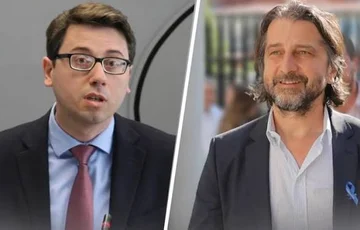
Muhaedin Bela, colonel in the North Macedonian Army and administration employee of the Ministry of Defence, says in an interview for Voice of America that Albanians are not sufficiently represented in the military and defence ministry's leadership structures in line with laws issued by the Ohrid Agreement.
He emphasises that Albanians in this ministry but and in the military face obstacles in terms of career progress. Meanwhile, he has filed indictments in court against the defence minister and two other officials for discrimination.
“in Defence Ministry from 15 State advisers, only 1 is Albanian. Out of 18 sectors' leaders, none is Albanian. Out of 77 sections, only one is Albanian. Of 20 battalions, or 13 battalions and 7 Centrals, only 3 commanders are Albanian. The percentage in special units is very small; I think it's now about 4 percent. I am the author of the Plan for Fair and Equipation drafted in 2012-2015, which predicted by v.2015 to complete everything”.
Mr. Bela also says that in the army, of the nine specific sections or divisions of the General Staff, such as J-1 to J-9, as they are known in military terminology, only one is Albanian.
But, Deputy Defence Minister Union Hasani, in a conversation with the Voice of America, says Mr. Bella's claims are politically motivated.
The number of Councillors is not 15 but there is 5 in the Ministry of Defence and of these five, one is the same person who accuses us of allegedly discrimination. Of the 16 leaders in sectors 15 are complete, authorised, and four are Albanians”.
However, there seems to be uncertainty about the number of leaders of the MM sectors. On the Ministry's website of 18 figures, two appear to be Albanians, while most of them in these posts are authorised, meaning temporary exercise of office. Mr. Bela says it's a criminal offence to appoint authorized individuals to the head of the sector while there are directors suspended from these posts.
Deputy Prime Minister Hasani says that the fulfillment of these countries depends not only on the political will, which exists but also on respect to the rules and laws; that the league rules do not allow discrimination on ethnic grounds, because during the opening of the competition, a mechanism for balance on ethnic grounds determines how many of the Albanian competitors should be accepted at work and other communities.
“In the latest management competition here at the Ministry of Defence, out of five admitted to work, two are Albanians, and not only are they Albanians, but they are also prepared”, he says.
Mr. Hasani adds that the successful integration of Northern Macedonia into NATO military structures speaks of the country's dedication because the Alliance's principles, according to him, do not allow discrimination of any kind.
Meanwhile, Mr. Bela says the ministry is preventing staff progress and the promotions of military rank officers. It refers to the Plan adopted in Parliament, which stems from the Ohrid Agreement, which envisions the establishment of 35% of representatives of non-party communities, to 25% of Albanians in Defence (MM) and the military respectively:
According to the Constitution, the Defence Law, the Ministerial Law in the Armed, the Strategy for Protection, it is envisioned that movement, advance non-combatities, be done not only horizontally and quantitatively but also in a vertical and qualitative way. And we have the framework, maybe not enough, but the question is why isn't this done by now?
But, Deputy Prime Minister Hasani says that under the structure and organisation of the Albanian Army, Albanians in the military hierarchy are represented by 50 per cent and are also prepared and responsible:
The General's <x0). There are four commands in the military hierarchy and that: The Logistics Base, which is led by an Albanian (Muarrem Muharremi), Operation Command, one from Top-1 to military centre, is led by General Besnik Emini, and there are two other units and commands which are led by other soldiers”.
Mr. Bela has been following institutionalally following his complaints, while announcing a series of domestic institutions and international offices for what he considers injustice and discrimination. Other employees, speaking on condition of anonymity with the Voice of America, complain of irregularities, discrimination; of their lack of contribution to the Ministry of Defence, as they have filed complaints with the Commission for Protection from Discrimination.
Colonel Bella has already tried former defence minister Radmila Sugarinska and two other Ministry representatives. The indictment was filed nearly two years ago, but courts have not prosecuted the subject. The ombudsman's office, which has been interested in the case, has received the answer from the Constitutional Court that “exhumation of the prosecution of subjects dealing with rights in the workplace is being made due to the lack of judges”.
For two years I have been assigned four preparation sessions (in court); neither has been held, and five judges have been changed on the other side”.
The Voice of America asked Mrs. Sugarinska to be promoted while she was on duty, but didn't get answers from her office.
However, the situation in the army and in defence cannot be compared to that of a decade ago, when Albanians found it difficult to reach high degrees in the military.
There have been two mini-protection defences in 2011, ' 2014, who were Albanians.
The implementation of the Ohrid Agreement has taken time and not everywhere respected. But on the other hand, it has markedly raised the degree of representation of communities in state and public institutions, though no cases of injustice are ruled out. VOA