The diaspora vote count is continuing, VV achieves the 53rd term, PDK remains at 22, LDK falls to 18
 4 hours ago
 (5 years ago)
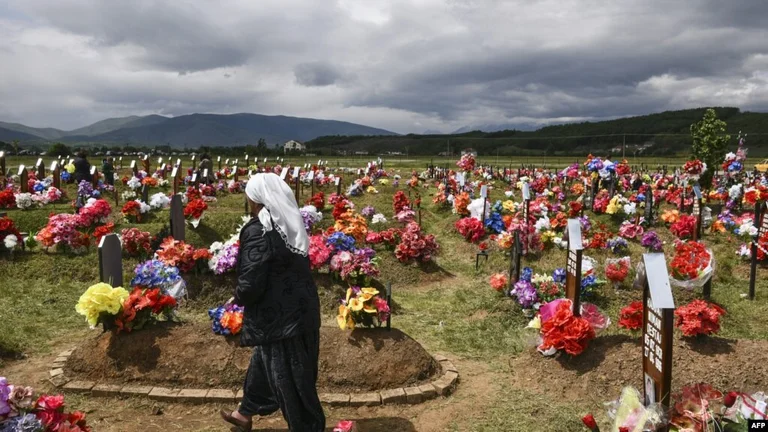
Kosovo must start preparing and collect evidence to prove that Serbian forces have committed genocide in Kosovo, while Kosovo Prime Minister Albin Kurti must lead to realisation the promise of establishing the genocide indictment against Serbia, assessing connoisseurs of international law cases, Professor Africa Hoti and Professor Ismet Salihu. [...]
Kosovo must start preparing and collect evidence to prove that Serbian forces have committed genocide in Kosovo, while Kosovo Prime Minister Albin Kurti must lead to realisation the promise of establishing the genocide indictment against Serbia, assessing connoisseurs of international law cases, Professor Africa Hoti and Professor Ismet Salihu.
According to the Fund for Humanitarian Law, about 13,500 people have been killed in the last war in Kosovo. The bloodiest month was April 1999 when 4,082 people were killed.
In his exhibition, Prime Minister Kurti, in the case of gaining confidence from the Kosovo Assembly in forming the government, on March 22nd, has declared that during his ruling mandate, it is intended to realise the establishment of “suit of Serbia's genocide crime at the International Court of Justice (GJND)”.
However, Hoti and Salihu have differing views about whether Kosovo should aim for such an indictment to be filed at the International Court of Justice, as well as for the possibilities that are for such a thing, considering that Kosovo is still not an issue of the United Nations organisation.
Such an indictment, former Kosovo president Hashim Thaci had mentioned several times, but he had never specified where the court would be established.
Africa Hoti, professor of International Law at Pristina University, tells Radio Free Europe that in establishing a lawsuit against Serbia's genocide in Kosovo, the possibility exists, taking into account the fact that war crimes, including genocide, are acts that cannot be submitted.
But, according to him, in a formal sense, Kosovo is faced with certain difficulties, because at the International Court of Justice, only states that are members of the United Nations Organisation, of which Kosovo is not yet part.
As Hoti estimates, there is also the possibility that with this court, even certain entities, which are formerly obliged to submit to the rules and procedures of this court.
Professor Hoti says Kosovo can take advantage of this opportunity, though, he is sceptical that a positive result could be found for him.
The “is a declaration, which is deposited in the International Court (of Justice) through which the Republic of Kosovo, as a state that is not a member of the UN, states that it accepts the authority of the court and accepts decisions handed down by the JND. In very rare cases known as such, however, the court statute allows such an opportunity. There are also very rare entities or subjects that have relatively similar positions like Kosovo, because the parties before the International Court of Justice are only independent and sovereign states, which are part of the UN”, Hoti points out.
He added that Kosovo could use the opportunity to file charges against Serbia for genocide crimes, but he is sceptical whether any positive results can be obtained for him, taking into account that the procedure is quite complicated.
“We need to make an essential and elementary distinction between political statements, because if we deposit the declaration, respectively, the indictment does not mean that we have closed the process. It would be considered a legal act, but, for its confirmation or confirmation of the existence of crime, many more facts should be deposited to accept the court”, Hoti said.
The JND lawsuit clash
Professor Hoti commemorates that in 1999, an indictment against Serbia in the JND had filed Croatia for genocide during the 1991-1995 war.
Meanwhile in 2010, Serbia had filed a counter-suit, claiming that some 200,000 ethnic Serbs have been forced to move when Croatia had begun military operation in search of its alleged territories.
In 2015, The JND has ruled that neither Serbia nor Croatia have committed genocide against Croats, respectively, Serbs, during the war that lasted between 1991 and 1995.
In 2007, the International Court of Justice in The Hague has found that the killings of about 8 thousand Bosnia and Herzegovina Muslims in Srebrenica have constituted genocide.
This court had said Serbia had not prevented genocide, but also that there was insufficient evidence that Serbia had direct responsibility for it.
In 2017, the JND had rejected Bosnia and Herzegovina's demand for revising the 2007 decision.
Salihu: The best JPN option
International Criminal Law Professor Ismet Salihu, in a conversation with Radio Free Europe, says the idea that Kosovo will file charges against Serbia for genocide crimes is good, though delayed.
However, as he says, the International Court of Justice's ruling, whatever it is, should Kosovo eventually presupposes the indictment, would have character only counseling and non-binding.
Consider this and other complications, as he calls them, Kosovo will act justly in the event such an indictment is filed at the International Criminal Court (GJPN).
In law literature, this court is also known as the Court of Rome because of the adoption of its statute in Rome in July 1998 at the Diplomatic Conference.
As the signatories of Rome's Staut are 123 UN members, among them Serbia. All those states accept the jurisdiction of this court.
The Rome statue stipulates that the International Criminal Court prosecutor could launch investigations on the basis of recommendation from any state that is a party or by the UN Security Council.
But the prosecutor can also launch investigations on the basis of information on crimes within the jurisdiction of the court, which he receives from individuals or certain organisations.
This court, according to Professor Salih, brings judicial verdicts. But, in view that Kosovo is not a member of the UN, nor is it a signatory to the Rome Statut, as he says, the broad possibility of the prosecution's action could be exploited.
The possibility of launching criminal procedure near this court is quite broad. This allows the exercise of jurisdiction for this court in a broader way. So far, according to my knowledge, over 100 subjects are in position at the International Criminal Court, which is permanent. So a group of people, like our entity or a group of Kosovo activists, can initiate the procedure with the prosecutor of this court”, Salihu stressed.
He added that to initiate criminal procedure with the International Criminal Court, extremely serious work is required in Kosovo.
Professor Salihu stresses that a group of criminal experts should be formed at the country's national level.
That group of experts, professionals, should collect facts and evidence, with at least a year or two of systematic work and determine that with evidence and controversial data the proposal will be made. That is because the prosecution can initiate criminal procedure or be held on the basis of evidence alone, rather than on the basis of media debates, proposals and opinions. This is a serious matter, so there's a lot of work to be done here so that the indictment can succeed”, Salihu said.
Kosovo Prime Minister Albin Kurti, in his exhibition, when he has declared the target for <x0Padi against the genocide crime of Serbia at the International Court of Justice”, has stressed that in the work of this target it will “be founded the Institute for War Crimes Research, with a clearly defined mission, with adequate financing and professional and competent”.
He has also warned of the empowering of the <x0-department for war crimes within the Special Prosecutor, the establishment of a special and specialised unit within the Kosovo Agency for Forenzic, for scientific verification of facts and evidence, as well as the adoption of a special legislation for the protection of identity and crime victims' data in Kosovo”.

 6 hours ago

 8 hours ago