The diaspora vote count is continuing, VV achieves the 53rd term, PDK remains at 22, LDK falls to 18
 8 hours ago
 (5 years ago)
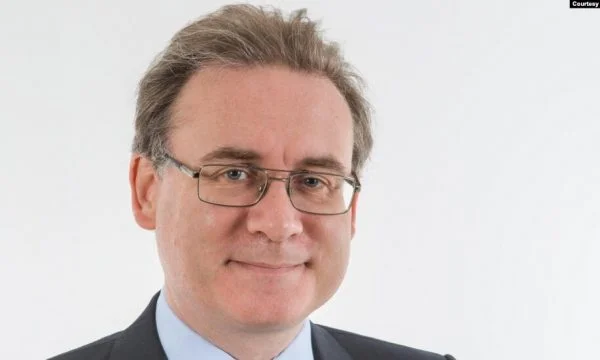
Kosovo's adviser on the road to independence, Nicholas Whyte, has said that Kosovo Prime Minister Albin Kurti's new government will be judged by works, not words, and that Kurti himself should be cautious of the promises he makes. In an interview for Radio Free Europe, Whyte, who heads the office in Brussels [...]
In an interview for Radio Free Europe, Whyte, which runs the Organisation for Consultancy Services office in Brussels The APCO has said that Kosovo's authority on its territory should be recognised, and has called the fact that the cadastre registers have not yet returned to Kosovo on Serbia's side.
Under US President Joe Biden's leadership, Whyte has said he expects more US engagement in the Balkans. He has also said that the new Kosovo government may have fewer contacts with diplomatic officials in the world, unlike other political parties.
Radio Free Europe: Kosovo now has new government and new prime minister, Albin Kurtin. He has won over 50 per cent of the vote and has not needed the support of other Albanian parties to create the government. How do you see the new Government of Kosovo?
Nicholas Whyte: You say he is the new prime minister, but in fact he is the old prime minister, who has but returned, though the impression arises that almost yesterday was the day he became prime minister for the first time and actually it happened a year ago.
A parliamentary majority government is useful to each state. I think that foreign observers will be satisfied that Kosovo institutions have created a new government, with clear mandate. It should also be mentioned that elections have been held well and that this is not good for all neighboring countries. This point is in Kosovo's favour.
But like any other government, this government will be judged by works more than words. So it will be interesting to see how far the prime minister can move forward with the agenda he has created. I think that officials in the European Union and the United States will expect to see development in the economy and forward, not combating the processes of the past.
Radio Free Europe: In Kosovo, too, expectations for Kurti's government are huge. He has promised to put pandemic under control, reform in the judiciary, fight against corruption, new jobs. How feasible are these, taking into account the situation with the pandemic and damage done in the economy?
Nicholas Whyte: Larger and more powerful states than Kosovo are facing pandemic. Unfortunately, Kosovo is more demanding than giving, so the situation in Kosovo will be influenced by decisions made elsewhere.
At the same time, it is important that certain levels of basic competencies and plans exist. Kosovo is not the only country facing this situation, and I think there are good models from abroad that can be followed. If I were to advise Kurt, I'd say he's very attentive, because talking is something else, acting is something else.
Radio Free Europe: Critics say it is not healthy for democracy when a party has such power. In this case, the Vetevendosje Movement is leading the government, has the position of chief parliament and the candidate for the president's position is from the LVV list. What is your opinion?
Nicholas Whyte: I was raised in the United Kingdom, which has history of parliamentary governments. The fact that you are asking this question may be because Kosovo has faced an unusual situation from the formation of institutions for the first time, nearly 20 years ago.
States create different paradigms, based on the way they act. Albania has a history of government created by a single party. Albania has problems and I am not sure they are the result of the traditional system. Meanwhile, Northern Macedonia has always had coalition governments. Again the question arises, has this matter left behind in Northern Macedonia, or is there a problem elsewhere? Political culture is unique in each country. I think it is fair to say that there is a new experience in Kosovo to have government formed by a party. Each step in democracy is an experiment.
Kosovo-Serbia relations have recently been toxic”
Radio Free Europe: Let's focus on the outside relationship. This year, dialogue between Kosovo and Serbia, with European Union mediation, has entered the tenth year, but the end is not being seen. Kurti has already said that this process will not be a priority for his government and that no other compromises should be made. In his exhibition, he has said Kosovo needs a dialogue to solve existing problems, rather than create new problems. How do you see this process under Kurt's leadership?
Nicholas Whyte: I think it's fair to say that dialogue did not result as people expected ten years ago. I remember the euphoria for reaching the agreement between Pristina and Belgrade, and I think it is perfectly reasonable to say that initial promises have not been realised. A specific point, which I have mentioned in other interviews, is that I find it scandalous that the cadastral records have not returned to Kosovo on the part of Serbia. I think this is essential in recognition of Kosovo's authority on its territory. And I think not only the authorities in Kosovo, but also the international community should pressure Serbia more at this point.
Serbia is the largest neighbouring country in Kosovo. Kosovo is linked to Serbia on several roads. There must be relationships between them. I don't think it's unreasonable to say that relationships have been of a toxic form in the time of the end, and it's reasonable to say, there must be other ways of communication and restoring relationships.
That doesn't mean turning away from the dialogue and doesn't mean rejecting already reached agreements. The international community will be extremely disappointed if there are suggestions that the new government will discuss, for example, the Ahtisaari Plan. I noticed Kurt mentioned several times he wouldn't do that.
At the same time, Kosovo is a sovereign state and must make its own decisions and take responsibility for its decisions.
Serb majority municipality association fate
Radio Free Europe: In fact, Kurti also mentioned the Ahtisaari Plan in his exhibition. He has said Kosovo has made enough compromises through that plan. Do you think Kosovo should stop compromising with Serbia?
Nicholas Whyte: Each agreement requires compromises on both sides. I think it is fair to determine the negotiating position and say no further compromises will be accepted. In reality, though, if an agreement is reached, both sides must compromise. I stress, both sides.
Radio Free Europe: What should be the compromise on the part of Kosovo?
Nicholas Whyte: One issue, which I believe technically is not compromise because reconciliation has been reached, but has not yet been implemented, is the relationship with Serb majority municipalities. I know this subject is subject to many rhetoric in Kosovo. It is a fact that this is a pledge, made by past governments in Kosovo. A solution that is acceptable to Kosovo and Serbs living in Kosovo must be found. This is a compromise that has been made with the Ahtisaari Plan, but has not yet been implemented.
Radio Free Europe: In its exhibition, Kurti has been talking about a range of issues, but has not mentioned the Association of Serb majority municipalities.
Nicholas Whyte: I can't blame him.
Radio Free Europe: Why?
Nicholas Whyte: I think it's better not to negotiate on the speaker.
Radio Free Europe: With Kurt elected now, will Serbia have new representatives in the dialogue?
Nicholas Whyte: I don't think Serbia's policy determines who is prime minister in Kosovo. I don't think that this is important for what happens in Belgrade.
“Must have full diplomatic recognition”
Radio Free Europe: How do you see the final agreement between these two countries?
Nicholas Whyte: I remember first Ambassador Ischinger talking about relations between the two Germanys. I admit that at that time I thought that something like this was just a dream, because it sounded unrealistic. But now I think it's quite possible for two sovereign states to treat each other as independent.
Full diplomatic recognition may not be the ultimate goal, though it would not be well thought out if it were not.
The ultimate goal should be Serbia's full, functional and operational accession to Kosovo's sovereignty. If Serbia decides not to recognise the territory of Kosovo, then that should be Serbia's problem. The problem of Kosovo is to ensure that Serbia has a decent attitude with neighbours. So I see an angle that can be feasible, something like the relationship between the two Germanys that has been recognised as sovereignty. Technical issues are something else. I think it's good to have full diplomatic recognition, but we also have to clarify that the end is Serbia's problem.
<x)
Radio Free Europe: As for dialogue, how do you see the role of American administration in this process? Kurti has said he intends to deepen ties with the US, while there are rumours that Kosovo should take advantage of the opportunity, because American President Joe Biden's personal ties with Kosovo are already known.
Nicholas Whyte: It is true that the new administration is more informed about the Balkans, compared to the Trump administration. Twenty years ago, when I went to Washington to talk about the Balkans, from few doors I could knock and expect intelligent conversations from the other side, it was the door of Senator Biden.
Therefore, it is clear that the new administration will be more engaged. It's not necessarily better. The problem with the new government seems to stand in terms of having fewer contacts in foreign capitals than other political parties. On the other hand, I must mention that such a network has not resulted in any results for Kosovo.
Radio Free Europe: You have advised Kosovo on its path to independence. What would your order today be for Kosovo leaders?
Nicholas Whyte: Stay in a favourable position, be active, stress the need for solutions, not problems, and make sure that existing pledges are respected and that you expect others to respect their vows as well.
 10 hours ago


 12 hours ago