2 minutes ago
“The president's non-election produces the deepest constitutional crisis in Kosovo”
Periskopi(5 years ago)
(5 years ago)The February 14th elections have not produced a completely clear situation for the election of the new Kosovo president. Convenients of the Constitution and political analysts, Wisar Morina and Albert Krasniqi, say the country could slide into a deep constitutional crisis, if the president's task leader's mandate expires and [...]
Connoisseurs of the Constitution and political analysts, Wisar Morina and Albert Krasniqi, say the country can slide into a deep constitutional crisis, if the mandate of the president's task leader expires and the Parliament fails to vote on the new president within the constitutional deadline.
Presidential Choice Under the Constitution
Article 86 of the Kosovo Constitution envisions the election of the president to take place no later than 30 days before the end of the current president's mandate.
Vjosa Osmani, currently a lawyer for the president's office, could hold this position further by May 5th of this year.
Article 4th point 86 says the election of the president is done by two-thirds of the votes of all Parliament deputies.
If in the third vote, no candidate receives the majority of votes (61), the Assembly is distributed and new elections announced, which should be held within 45 days.
Osmani has come to this position following former Kosovo President Hashim Thaci's resignation on November 5th, 2020, when he has been confirmed the indictment for war crimes and crimes against humanity by The Hague's Special Court.
A scenario leading to crisis
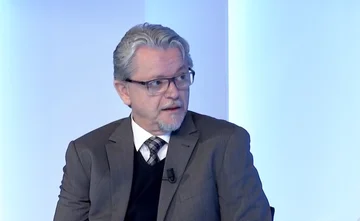
Constitutional Law Professor Wisar Morina says the failure to elect the president causes deep constitutional crisis.
According to him, the position of the presidential task leader cannot be held more than six months from taking office.
“If, eventually, within the 60-day deadline of the start of the election procedure, the president of the Republic of Kosovo is not elected, then the Assembly is distributed and the country goes to re-election parliamentary elections”, Morina says.
According to him, this would be an inappropriate scenario, since it constitutes the pure <x0maniment of lack of political stability, respect of the political will of citizens and democracy in general”.
The deepest constitutional crisis, according to Professor Morina, could be caused if U.d.'s mandate expires. The president's Vjosa Osmani is not elected president.
Kosovo's “Constitution offers no reference to which organ enjoys the right to set the date of elections in the absence of a legitimate president, in constitutional and democratic terms. In such a situation, the choice would certainly have to be sought only in a decision by the Constitutional Court of Kosovo”, Morina says.
Krasniqi: Inevitability for president
Albert Krasniqi, policy researcher in the organisation “Democracy Plus”, says that based on the preliminary election result, none of the parties will be able to form Government and elect the president.
“Compromis among political parties is inevitable if it is intended that within this new legislature the president be elected and avoid an institutional vacuum, which could be caused. There is no time for any other combinations, but also the calculations of political parties, to maximize their vote through repeat elections”, Krasniqi says.
Krasniqi says the current situation is a good opportunity to elect a consensual president, who would represent the interests of all, not to serve only a political subject.
According to preliminary results published by the Central Election Commission (KQZ), the Vetevendosje Movement has won 47.85 per cent of the vote, the Democratic Party of Kosovo 17.41 per cent, the Democratic League of Kosovo 13.08 per cent and the Alliance for the Future of Kosovo 7.43 per cent.
With this result, the Vetevendosje Movement is expected to have 56-57 MPs in the upcoming Kosovo Assembly legislature.
For the government, Vetevendosje Movement needs 61 votes. To launch procedures for electing the president, in this case Vjosa Osmani as a candidate, 80 deputies present in the hall are needed in the first vote.
Are MPs obliged to participate in the presidential vote?
The Central Election Commission (KQZ) must first confirm the results of the February 14th elections, to then call for the Constituent Assembly session, in which MPs' mandates are confirmed.
After that, parliamentary groups are confirmed and elected chairman of the Assembly as well as members of the leadership.
At the moment of completion of these procedures, institutions proceed with the issue of mandate and formation of the Government.
Following the February 14th elections and the publication of preliminary results, Vetevendosje Movement officials -- the party that has won the elections -- have ruled out the possibility of any of the Albanian parties having a coalition.
The Vetevendosje movement has competed in elections with Albin Kurti as the candidate for prime minister and with Vjosa Osmani as presidential candidate.
But, given the preliminary results, the Vetevendosje Movement appears to have problems making the necessary quorum of 80 deputies during the session in which the president is voted.
Constitutional Law Professor Wisar Morina says the quorum issue is adjusted to some provisions of the Constitution.
“There are some constitutional provisions that regulate this aspect, such as Article 70 of the Constitution of Kosovo, which stipulates that the ʹdeputs of the Parliament are the representatives of the people and Article 74 which envisions that the Kosovo Parliament's deputs will exercise their position in the best interest of the Republic of Kosovo and according to the Constitution, the laws and the work regulation of the Parliament”, Morina says.
The issue of staying in the hall or not is highlighted in a Constitutional Court decision in 2011, at the time when Behgjet Pacolli's choice of president was disputed.
Pacolli had knocked down the Constitutional Court, as in the first round of voting, there were only 67 deputies in the hall from 80 to get the necessary quorum.
Despite the fact that there was no quorum, then Jakup Krasniqi, as speaker of the Parliament, after the third round of voting, has concluded that Behgjet Pacolli has been elected president of Kosovo.
The 120 deputies of the Parliament must feel obligated according to the Constitution, the Law for MPs, the Parliament's Labour and the Code of Conduct, to participate in the plenary hearings of the Parliament”, the Constitutional Court's act on the issue is said to be in the court's case.
As far as the current situation is concerned, Constitutional Law Professor Wisar Morina says that the <x0Refuse to stay in the hall and vote, manifests a deep lack of consideration for voters and constitutional patriotism, which Kosovo MPs have pledged on the occasion of swearing in as deputies of the Kosovo Assembly”.
Currently, there is no precise date when the voting counting and recounting process will end, so the CEC can make the results certificate.
The call of the Parliament's constitutional hearing, and then the formation of the Government, as well as the election of the new Kosovo president, will also depend on this process.