13 minutes ago
American professor says EU '%s' is preparing a major agreement for Kosovo- Serbia
Periskopi(6 years ago)
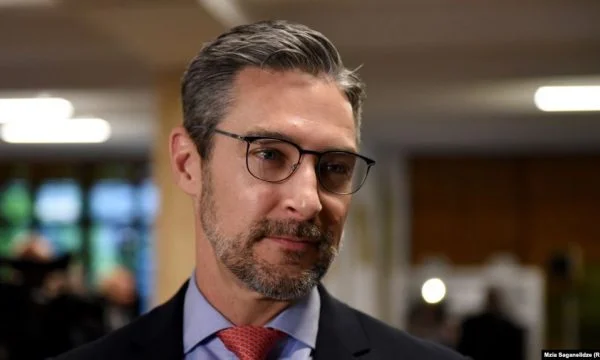
(6 years ago)Atlantic Council Deputy Executive Chairman Damon Wilson says documents signed by Kosovo and Serbia at the White House should be viewed as part of a broader historical process, which is being resolved. In an interview for Radio Free Europe, he says despite the fact that most of the deal [...]
Atlantic Council Deputy Executive Chairman Damon Wilson says documents signed by Kosovo and Serbia at the White House should be viewed as part of a broader historical process, which is being resolved. In an interview for Radio Free Europe, he says that despite the fact that most of the agreement is on economic topics, negotiations and agreements in this context are political.
Damon points out that there must now be a common commitment by the United States and the European Union to provide support but also to pressure the parties for the agreements reached to be implemented.
Radio Free Europe: Kosovo Prime Minister Avdullah Hoti and Serbia's president, Aleksandar Vuciq, have signed two documents for normalising reports between the two countries, in the presence of US President Donald Trump. There have been many statements of a final agreement between the two countries, but it seems this was not the case. What is your opinion?
Damon Wilson: Certainly there has been a good sign of progress for normalising talks and dialogue between Pristina and Belgrade. Following elections in Serbia and changes in the Government of Kosovo, seeing continued normalisation of reports, dialogue and negotiations with the commitment of the leadership of Pristina and Belgrade is a positive thing. This was not a comprehensive agreement, but I think it is part of a broad historical process that is being resolved, and it represents a step forward, as we have the US working with both sides to make decisions for common interest, really focused on the economic aspect, but of course that political is key.
Radio Free Europe: The content of the documents is mainly about the economy and lacks political content in large measure. Do you think the economy will help reach a political agreement between the two countries?
Damon Wilson: I think they're all connected. All negotiations and agreements of this nature, which are related to this context, are essentially political, even though topics and issues are of economic focus, the decision to move forward with them is political. I think it's wise to see how a more normal relationship in the region can produce better economic, development and jobs. I think as much as people in the region can see economic benefits, then this creates a more favourable environment for making political decisions.
Campaign suspension by Kosovo, Serbia use for reaching more agreements
Radio Free Europe: How did you comment that Kosovo will suspend membership efforts in international organisations for a year?
Damon Wilson: I think it's important to give all parties a year to concentrate on reaching agreements instead of bumping into each other. No doubt both sides have tried to pursue their own interests and gain better position in the negotiations, but the company of these steps, such as the suspension of Kosovo's recognition campaigns for international organisations, as they are distracting Pristina and Belgrade on their issues. Therefore, if we can spend a year to create an umbrella through which both sides can build confidence, I think it should be deliberate, and this time it should be used to achieve more progress in the agreements between Belgrade and Pristina. Because in the end you want to see Kosovo not only by making progress in peace, but it is recognition that Kosovo wants to reach into the context of the agreement with Serbia and membership in international organisations later would be much easier. So let's focus on this.
Radio Free Europe: Do you think the deal reached in Washington will be implemented? There are many agreements reached between the two countries in Brussels, including the one for diplomas that are part of the White House agreement, but are not implemented by Pristina or Belgrade? Who can guarantee the application of these points?
Damon Wilson: I think it's a big problem. We've seen very often in the region political commitment that is positive, but that is then neglected, so I think it's important to have a mechanism to help implement. In fact, that is why the United States and the European Union should work together in a more effective way to provide support, but also pressure on the parties to implement the agreements. I hope both sides will take responsibility on themselves to achieve this, but I think the process will require the commitment of the United States and the European Union as partners with them to take responsibility to implement commitments.
- What's in the deal signed in Washington?
Radio Free Europe: Immediately after the White House deal, there was a reaction from Russia's Foreign Ministry spokeswoman regarding a photograph by the White House in which Serbian President Aleksandar Vucinq was seen sitting before the American president. In her reaction, she somehow laughed at this picture. Then came the reaction of Serbian officials. What is your comment?
Damon Wilson: I think it's been an extraordinary move on the Kremlin. Fries, derogatory, humiliating, in a way that at least as I see it, points to the geopolitical transition now taking place in the Balkans. The Western Balkans are concrete their country in Europe, putting themselves in the free world, and any progress between Pristina and Belgrade can speed up the country of Kosovo and Serbia in the Euro-Atlantic community. I think what we saw is a concern of the Kremlin that President Vuciq and Serbia have really paved a path to a relationship and partnership different with the United States. I've been shocked at the Kremlin action, and this highlights how fast transition is taking place in reports between Serbia and Russia.
Radio Free Europe: Another surprising point from this agreement is Israel's recognition, and the opening and movement of the embassies of Kosovo and Serbia in Jerusalem. How do you comment on this point?
Damon Wilson: Interestingly, this was an unexpected part of President Trump's administration diplomacy. What we're trying to show here is that difficulties can be overcome. I think this is a secondary issue compared to concern for the region. We really want to see Kosovo and Serbia as well as the region normalising reports so that they can have constructive reports with everyone else. So I think this is a reflection of Trump's priorities at this time.
Radio Free Europe: Meanwhile, the leaders of Kosovo and Serbia continued talks in Brussels on 7 September and opened new issues in negotiations, such as the Association of Serbian municipalities and financial obligations. The US envoy for dialogue, Richard Green, has said the point that was removed from the White House agreement on mutual recognition will be discussed by Europeans. Do you think both sides will agree?
Damon Wilson: This is a process. I am confident that we will see more agreements reached between Pristina and Belgrade. I am confident that it is in the interest of both sides, as Kosovo cannot gain recognition and membership in international organisations and Serbia has not opened its way to the European Union. But will they reach agreement tomorrow? Probably not. Matters like this don't happen within 24 hours. I think the European Union is focused on preparing for a big deal, I think this would be very effective if the United States and the European Union engage together.
New Montenegrin government under surveillance
Radio Free Europe: How did you comment on the election results in Montenegro, where the pro-Serbian and pro-Russian opposition is expected to form the government?
Damon Wilson: I think it's a sign that Montenegro has a healthy democracy. There are some complicated things out there. We had a coalition that came together, mobilised in response to the Serbian Orthodox Church property law, and managed to gain financial support but also, outside Montenegro, combined with those who simply wanted change, the place where the Democratic Party of Socialists led for three decades. So this is going to be complicated, but I think you can't make geostrategic changes in the country by one more vote. Montenegro is in NATO and on the road to EU membership, and I think this will be a complicated process that will require a lot of political compromises, but these are the painful and beautiful sides of democracy. We must allow this process to happen, we must be useful to our ally and hope that reform and support for reforms in the country will go into the stabilisation and assistance process of the Euro-Atlantic community. We will look very carefully to ensure that the commitment Montenegro has undertaken is not at risk and that suspicious and untrustworthy actors are not placed in security-related positions and are not sent to NATO representatives. I think it will be very important for Montenegro to show that it can fulfil its international obligations and that it can be a responsible partner.
Radio Free Europe: The winning coalition says they will respect international obligations, including those with NATO. Have you had any contact yet? How do you see their cooperation with the West?
Damon Wilson: I'm worried, but I accept what they say. I think commitment and these assurances are very important in a specific sense and I think we'll have to be very careful with them as partners, but we'll also have to look at the actions. In the past, whenever one of the Atlantic Council was in Montenegro, he tried to meet with various political actors, people in power, opposition, coalition, in parliament ... Unfortunately, sometimes our meeting requirements were rejected, but we also managed to meet with opposition representatives. I think this will be a complicated process, but ultimately this is democracy, a compromise between different views. The goal is to take over so-called normal policy in the context of a sovereign and independent Montenegro that is part of the NATO Alliance and leaders on the road to the EU. I think it's an amazing combination of the strategic achievements of that small country and I hope that every new government will manage well what it inherited, and that it will make progress in things where progress has been slow in the country and will be a good partner.