an hour ago
KMDLNj: The Special Court has repeatedly violated human rights to Thaci and Wessel through public lynching
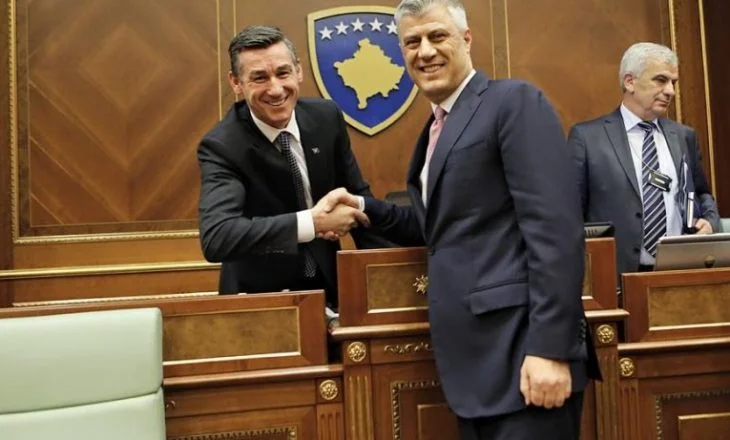
Periskopi(6 years ago)
(6 years ago)The Council for Protection of Human Rights and Freedoms has said that Hashim Thaci's human rights and Kadri Wessel's, through a public lynching that has made it to the Special Prosecutor's Office, have been violated against all rights that have been regulated and protected by national documents and [...]
The Council for Protection of Human Rights and Freedoms has said that Hashim Thaci's human rights and Kadri Wessel, through a public lynching that has made the Office of the Specialised Prosecutor, have been violated against all rights that have been regulated and protected by national and international human rights documents.
KMDLNj through a communiqué says the Special Court must handle all cases of war crimes in Kosovo, which are not handled by preliminary courts, otherwise any decision will be considered suspicious and the decision of a court campaigned by politics.
KMDLNI's complete communication:
The Prosecutor's Office specialised in The Hague, after keeping two months of secret from the indictment proposal against the president, Hashim Thaci, former head of the Parliament and PDK chairman Kadri Veselini and 9 others who have no name and surname, meaning that they are treated only as numbers. The publicisation of this panel of legal policy at a previous time for continuing talks on a final agreement with Serbia, as well as attempting to exempt from these talks by President Thaci and PDK chairman Kadri Veseli is direct intervention of the Special Court in the negotiation process, with clear intent to influence even the contents of the final agreement by severely weakening Kosovo's negotiating position and by rehabilitateing Serbia for all its crimes and one from war criminals, Aleksandar Vuci.
It is not difficult to predict the final outcome of the talks when those most deserving of the liberation and freedom of Kosovo are unable to be part of making decisions for the future of Kosovo, while a war criminal like Aleksandar Vuciq's work is done so much favour in the country to be called into responsibility for war crimes committed in Bosnia, Croatia and Kosovo, as chief for the regime and Propagandition of the chief criminal, Slobodan Miloishev. The public making of an indictment proposal, without being confirmed by the judge of the preliminary procedure, at a significant time of a process also sensitive to all connoisseurs and circumstances, was considered a dangerous pre-trial action with clear intent to intervene in the final results of a political process. Especially did the internationals, who themselves were earlier, say that part of the talks. It is surprising that for this gross violation of procedure by the Specialised Prosecutor's Office, the so-called Ombudsperson of this Court or even the Constitutional Court that would have to protect human rights that are ill-treated by the Special Court.
In the concrete case, Hashim Thaci's human rights and Kadri Veselini, through a public lynching that has made the Office of Specialised Prosecutors violated against all rights that have been regulated and protected by national and international human rights documents. With selective division of justice and with the exception of this right, politically motivated, the vast majority of victims, the Special Court violates and fully violates the principle of universality of the Universal Declaration for Human Rights of the United Nations.
Following this politically motivated public lynching that has never happened in any case before is insultary to expect that in a possible judicial process against them there will be fair, fair, impartial and politically unconfirmed judgment. War crimes and crimes against humanity do not age and are not pardoned until the international law legislation regulating this issue changes. War crimes judgments and sentences cannot be used to balance responsibility, achieve the specific goals of daily or strategic policies, impose peace or reconciliation between warring parties.
These judgments, if they are right and provide justice for all victims, make no difference as to whether they assign responsibility in accordance with the weight of crimes, following managed trials, also without any distinction on ethnic grounds, helps build and sustain peace, which is also the key condition for reconciliation between the parties that fought. The Special Court does not have that intention of having discriminatory and exclusive approaches to the victims, according to ethnic affiliation, and thus treats those responsible for war crimes. No one has the right to prevent justice for the victims as well as responsibility for those who committed crimes, but no one also has the right to share justice and responsibility according to ethnic principle.
The Special Court must handle all cases of war crimes in Kosovo that are not handled by preliminary courts, otherwise, any of its decisions will be considered suspicious and the decision of a political-managed court. Always where politics has compiled charges and where courts have mostly formalised such a decision, the problem has been maintained for a time to detonate much more violent then. Kosovo needs penalties for justice for all victims, as well as the condemnation of all who are proven to have committed crimes, without making differences, on any grounds. So far the Special Court has not proven that it is willing to do so.