The diaspora vote count is continuing, VV achieves the 53rd term, PDK remains at 22, LDK falls to 18
 6 hours ago
 (6 years ago)
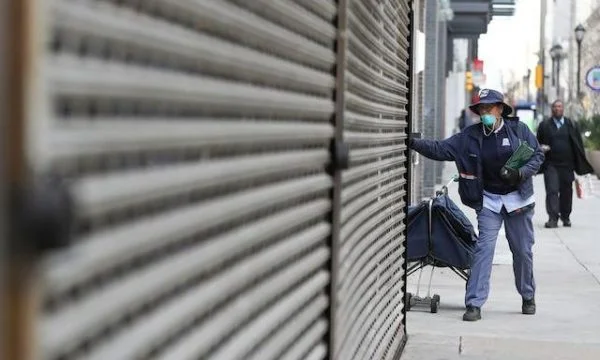
We don't have to choose: Studies by the Spanish flu show that social distance and a strong economy go hand in hand together. Experts answer questions. As cities and states around the globe have taken unprecedented social distance measures to slow the distribution of the coronary pandemic, most of the world economy has [...]
As cities and states around the globe have taken unprecedented social distance measures to slow the distribution of the coronary pandemic, most of the world's economy has stopped, raising concerns about what is ahead.
US President Donald Trump has announced an easing of restrictions by writing a status Twitter. “NE We can't live to know when I'm more about you. HOME PROBLEM.” New York Times journalist Thomas Friedman underlined that a plan could be “turned to work America” by being motivated by these questions: “Wait a minute! What are we doing to ourselves? What about our economy? In Fox News, Dan Patrick, Texas Lieutenant Governor, took this argument to extremes, stressing that those over 70 should sacrifice their lives from Coddy-19 for the economics they want to leave their grandchildren, informs window.net
All these arguments are based on the same thing, that there is a choice between saving the economy or saving life. But perhaps this is not the case, according to a new study.
Emil Werner, finance professor at MlT, and his colleagues sought to see how social distance measures were implemented by cities to reduce the impact of the 1918 pandemic -- almost identical to what is being done today, such as the closure of businesses and schools, which have affected and mortality and the post-edum economy. He spoke of the “The Inquirer” about the findings. The answers are a little updated, but without losing the point.
What was the impact of social distance measures on the distribution of the disease and the economy during the Spanish flu?
Emil Werner: What was found was done by comparing the cities that had taken the most measures compared to those less aggressive in nonfarmacetic interventions to reduce mortality.
But at the same time, they had no worse economic performance than cities that intervened less aggressively. By contrast, cities that intervened more aggressively emerged from the strongest pandemic, with stronger economies in 1919.
Can you give us examples?
Emil Werner: Philadelphia arranged late, eight days after the deaths began to rise dramatically and for a limited duration of 51 days compared to the average 88 days. Therefore, the country had high mortality (900 deaths for 100,000 residents) and a weak economy after the pandemic. Compared with Cleveland, which acted very quickly, two days before the acceleration of death, he took aggressive measures to keep them in 99 days. Death was smaller (600 deaths per 100,000 residents) and the economy in 1919 was above average, window.net writes
For some, this may sound contradictory, as businesses closed faster and longer. You explain why this makes sense?
Emil Werner: In a normal economy, if you implement social distance measures and other measures to limit people's and business movement, it will result in bad for the economy. But pandemic itself is too bad for the economy. During the pandemic, people do not want to buy and consume, go to large public meetings, and do not want to work hard because they fear that they will get the virus. Pandemia itself causes economic problems because it contracts demand, reduces labor power, and reduces investment in business, because businesses become aware of the unstable times of pandemic. Since the pandemic is destructive, any policy used, which attacks the severity of pandemic, will eventually produce a positive effect on the economy.
In your research, you have observed the time when countries took social distance measures and how long these measures lasted. Who was most important if they could isolate themselves?
Emil Werner: The right time is very important, but the length of measures is just as important and perhaps more important.
The Spanish flu teaches us that quarantine and the opening of the economy walk
The world has changed a lot since 1918. How does this change in social distance reflect the 2020 economy?
Emil Werner: We don't want to give results naively. The 1918 pandemic was just as severe and deadly based on the data we have. The 1918 flu was especially deadly than the Coronavius today. The structure of the economy was also different. At the time, the economy was based on agriculture and handwork, while today we are dealing more with a service-based economy. Some of these services we can do in a distance, and that can lower the inpacks after the shock. But there are still some services that cannot be performed at a distance, many interpersonal services from dentists to restaurants and others. If we think about the service sector today, the consequences will be relatively severe. The chain of world supply today is much deeper and the far more important source of production. The problems in these chains we are seeing today are affecting the increasing economic problems of pandemic. The analysis we have is not appropriate to answer these kinds of questions.
What can we learn from 1918 about the political discussions that take place today about the Coronacterius?
Emil Werner: Treatment should not be worse than disease. It really casts doubt on this notion that there is a balance between saving life through nonfarmacetic interventions on the one hand and protecting the economy. That wasn't the case in 1918. And that gives us reason to believe that both conceptually and empirically, it is not likely today. /Windows.net/
 8 hours ago

 10 hours ago