The diaspora vote count is continuing, VV achieves the 53rd term, PDK remains at 22, LDK falls to 18
 4 hours ago
 (6 years ago)
Experts have warned that loss of taste and smell may be a sign of the choreographer, as two NHS consultants have been placed in critical care after being infected by patients. Public Health guidelines in England currently state that a high fever or a constant new cough are the only symptoms that [...]
Public Health guidelines in England currently state that a high fever or a constant new cough are the only symptoms that should result in isolation.
But the British Otorinolaringology Society says that there are new symptoms that can even be exposed by patients without symptoms, those without fever or cough.
The latest study comes just days after scientists in Wuhan, the pandemic's epidex, analyzed the typical symptoms, which can progress from a soft cough to serious respiratory problems within just eight days, broadcast Kosova Prees.
The analysis was based on adults on COVID-19 admitted to Jinintan and Wuhan hospitals after December 29th and January 31st.
It is thought that from the beginning of the disease, the average download time was 22 days at the average time until 18.5 days.
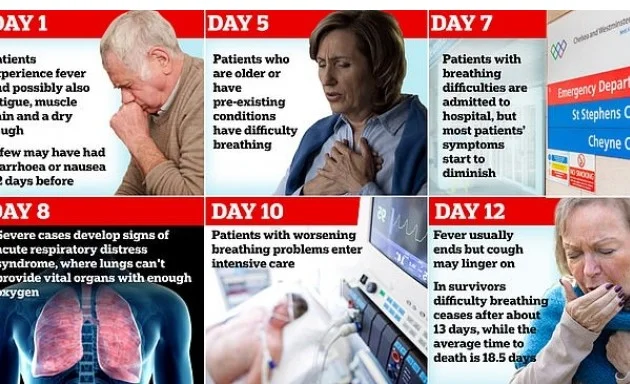
She concluded that these were the typical development of symptoms:
Day 1: Patients experience fever and may also suffer fatigue, muscle pain and a dry cough.
A small minority may have had diarrhea or vomiting one to two days ago, reports Business Insiver.
Clara Gerad, a doctor in London, and former head of the General Medical Royal College, said she began to feel symptoms like a mild cough and fatigue.
And yet it was so soft to start, I barely gave him a second opinion. ”
Day 5: Patients have difficulty breathing, known as disnea if they are older or have a pre-existing state of health.
Centers for Disease Control and Prevention say that symptoms that occur two to 14 days after exposure are fever, cough, and gasp.
In Wuhan's second study of 138 patients, about 10 percent suffered diarrhea and vomiting days before the development of fever and dyspnea.
Day 7: At this point patients showing signs of disnea will tend to be admitted to the hospital.
CDC cautions that anyone with urgent warning signs for COVIDD-19 ʹ constant chest or pressure pain should receive medical attention.
Day 7 is also the point in which for the vast majority of patients about 85 percent of symptoms begin to shrink and exit from isolation is an option, states the second study.
The British government says that if you live with others and you or one of them have symptoms of coronary, then all members of the family should stay at home for 14 days.
The 14-day period begins from the day the first person in the house is sick.
Day 8: Serious patients develop signs of acute respiratory concern syndrome (ARDS) at this point, where lungs cannot provide vital organs of the body with sufficient oxygen.
15 percent of cases reach this point, according to the Chinese Center for Disease Control and Prevention.
Day 10: Patients with respiratory problems tend to enter an intensive care unit.
Wuhan's second study also said he noted that the average stay in the hospital was 10 days.
Day 12: Ethias tend to finish around this point, according to Wuhan's first study.
The average length of fever a previous sign of COVID-19 was about 12 days, but a cough connected to the disease can last longer, they say.

 6 hours ago

 7 hours ago