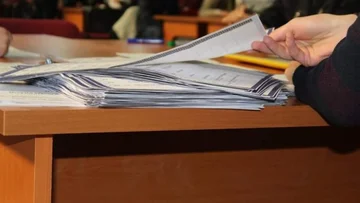
The diaspora vote count is continuing, VV achieves the 53rd term, PDK remains at 22, LDK falls to 18
 2 hours ago
 (6 years ago)
Kosovo's corrective service has not so far had support from the political level. That is why there is promised to be strength and support from the new government. Even after the removal of food packages coming from family for prisoners at the Kosovo Correcting Centre, there has been smuggling in the latter. So [...]
Kosovo's corrective service has not so far had support from the political level. That is why there is promised to be strength and support from the new government. Even after the removal of food packages coming from family for prisoners at the Kosovo Correcting Centre, there has been smuggling in the latter.
So said today in the closing part of the project for “Further Implementation of the Correcting Service and the Kosovo Sprovatory Service”. This twom-euro project has been funded by the European Union in Kosovo and implemented by the Finland Criminal Sanctions Agency from September 2017.
Justice Minister Albulen Haxhiu said the new government's priority will be strengthening the Kosovo Correcting Service, which will at the same time be the biggest challenge for the justice sector.
The Ministry of Justice prioritizes the strengthening of the Kosovo Correcting Service. We will work with the greatest dedication to bringing the Correcting Service to the right level. I know there's been an independence, but I think there's been a lack of support from the political level. Therefore, we will give the necessary support... As for the staff of the Correcting Service, let me inform you that in my agenda as justice minister, and draft the law for the Kosovo Correcting Service. The legislative agenda for this year will present proceedings in the Kosovo Assembly of this bill. Currently, the Kosovo Correcting Service functions with three laws, and given the nature and importance it has, of course we should see the possibility of addressing through the particular law for the Kosovo Correcting Service.
Haxhiu pledged that they will work on advancing conditions for the Kosovo Correcting Service staff. Among other things, she has stressed that concern remains that there is no implementation of Article 224, where medical checks are provided for corrective officials, which, according to her, did not happen.
The justice minister's concern is the lack of implementation for the next 224 years for health and psychophysic evidence employed as a corrective official in the Correcting Service. They have to measure health skills every two years, psychophysics, but this has not been accomplished. I have information that the situation in this direction is not good, because there have been no such health checks, and in this direction we will work for the Law on Execution of Criminal Sanctions to be implemented”, Haxhiu said.
She has even mentioned smuggling into Kosovo prisons, which she said even after the removal of food packages, where family were once able to send to prisoners at the Correcting Centers, the phenomenon has continued.
The head of the EU Office in Kosovo, Natilia Apostolova, said the goal of the Twinisation Project is aimed at supporting Kosovo's correctional and testing services, as well as Kosovo's support in improving judicial sector standards by further empowering the institutional framework.
She said essential measures must be taken for prisoners in their integration into society.
The European Union has based Kosovo on rule of law from the beginning financially and has supported the Correcting Centre in prisons and the Youth Correcting Centre in Lipjan. Our value since 2010 has exceeded 30m euros. European standards are very important and should be respected. Prisoners are sensitive and they have their rights. The process of properly reintegration into society is very essential. We will also co-operate and give threem euros to Kosovo for technological equipment”, Apostolova stressed.
Meanwhile, the deputy mission leader from the Finland Embassy, Sargit Salakari, said Finland has the smallest number of prisoners in Europe. Among other things, according to her, this Scandinavian country has provided 50m euros for Kosovo since 1999.
The purpose of this project was to keep Kosovo authorities... For example, rehabilitation and integration and privation of the post - prison work. When talking about the low number of prisoners, I had wanted to share the prison statistics. This report shows Finland has the lowest number of prisoners in the EU. There are 51 people for 1100 in prison. We have opened and closed” prisons, she said.
Local leader of “Twinisation Project” Rasim Selmani has announced that this project started 30 months ago, while the director general of the Finnish Agency for Sancidiorin Penal, Arto Kujala, has not been able to attend this closing project after the corruption of the Coronavirus.
 4 hours ago

 6 hours ago