4 minutes ago
From cemetery in Serbia to Kosovo war crime site
Periskopi(6 years ago)
(6 years ago)The “Kizevak“stone in the Raska municipality, near the border with Kosovo, is the fifth location in Serbia, in which mortore remains have been found, allegedly, of Albanian civilians killed in Kosovo in 1999. The number of bodies found in this country is still unknown, more [...]
The “Kizevak“stone in the Raska municipality, near the border with Kosovo, is the fifth location in Serbia, in which mortore remains have been found, allegedly, of Albanian civilians killed in Kosovo in 1999.
It is not yet known how many troops found in this country on 16 November. Two days later, the Supreme Court in Belgrade has issued a warrant for their exhumation. When exhumation will start “will be later determined”, Free Europe is told Radio from this court.
From 2001 to the present, on Serbia's territory, mass cemetery with 941 Albanian troops killed in Kosovo has been found in 4 locations.
According to data from the Office for Missing Members of UNMIK, in Batajnica, near Belgrade, 744 troops have been discovered in 2001. The same year, in Petrovo Selo, in eastern Serbia, 61 troops have been found. At Lake Peruqac in 2001, a mass cemetery of 84 troops has been discovered.
For the last time, the mass cemetery was discovered in 2013 in Rudnica, southwest Serbia, near the border crossing between Kosovo and Serbia, in Jarina. A total of 52 people have been found there.
Where's the new location?
The “Kizevak” fortress in Raske, in the southwestern part of Serbia, is several kilometers north of Rudnica and the country, in which seven years ago has been found mass cemetery with the troops of Albanian civilians.
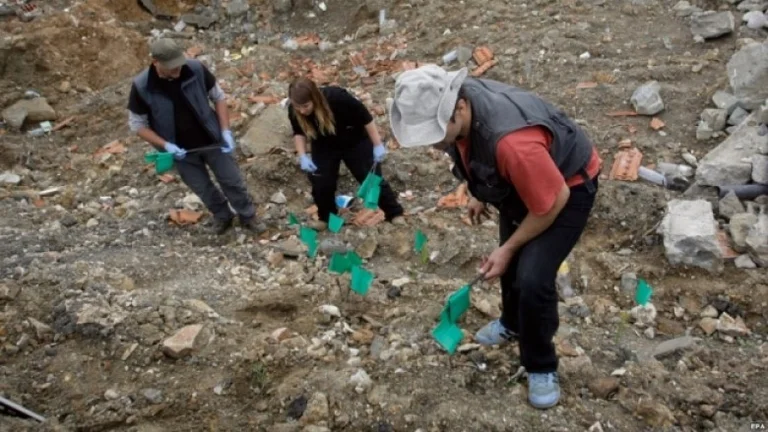
Mortar remains at the new location, on 16 November, have been found by European Union for Rule of Law experts (EULEX), the Kosovo Law Medicine Institute and the Government Commission of Serbia for Missing Persons.
On November 20, EULEX said its experts had been digging in Kizevac since 2015 and that progress was made thanks to air images.
“The problem was that it is about a large qualm and that the landscape changed over time because of the fact that the stone was still being used over many years”, Javier Santana, forensic archaeologist in EULEX, said.
The “Kizevac” was privatised after 2007. In May 2020, the geology company “Tethian” from Canada bought the former country's use of silver, Zink and lead mines from the Serbian company “EFPP”
From EULEX, they have declared that the process of determining the exact location was very complicated, because there are four to five levels in the mine, with an estimated 13m each.
Victims suspect from Kosovo village of Rezalla
Following the discovery of the “Kizevak”, the chairman of the Government Commission for Missing Persons, Velko Ordreovic, told Serbia's Radio Television (RTS) on November 18th, that information shows that there is potentially 15 to 17 troops in that country.
This location is mentioned in the Human Rights Progress Report, which the United States of America publishes annually. The 2015 report reports that in this country “allegedly Serb forces buried the remains of Kosovo Albanians killed in the village of Rezalla in Kosovo in 1999”.
The bodies of 28 victims from this village were found in 2013 at the mass cemetery in Rudnica, already two years later buried in Rezalla.
The crime at Rezalla noted former director of the Humanitarian Law Fund Natasa has persecuted, following the discovery of the new location.
This nongovernmental organisation, which handles war crimes research, published the document under the title “Rudnica File”, in which, in addition, pointed to mass crime in Rezalla and the displacement of victims' troops.
The Humanitarian Law Fund has stressed that nine victims from this village are still identified as missing in the evidence of the International Committee of the Red Cross.
Killing more than 40 civilians in Rezalla
According to the Fund for Humanitarian Law report, members of the former Yugoslav Army and police, in April 1999, have killed at least 42 Albanian civilians in Rezalle, of them 39 in mass execution.
In the file “Rudnica”, which contains army and police documents, statements of survivors, as well as documents and testimony of Yugoslav Army officers and police officials before The Hague Tribunal, the Fund for Humanitarian Law stresses that army and police members, on 5 April, have entered this village, have expelled residents from their homes, taken them to a courtyard and later shot them.
Mortar remains of Kosovo Albanians killed by Serb forces during the last war. These remains have been found in a mass cemetery in Rudnica, Serbia, and have been identified 15 years after the war ended.
Mortar remains of Kosovo Albanians killed by Serb forces during the last war. These remains have been found in a mass cemetery in Rudnica, Serbia, and have been identified 15 years after the war ended.
“Members of Serbian forces have killed 39 civilians in the country, while two have survived the firing squad, covering up with dead bodies of people falling on them. Among the civilians killed were 3 young men, while the oldest victim was 97,”, went to the Fund for Humanitarian Law report.
Noting that during the conflict in Kosovo, the village of Rezall was in the area of responsibility for the 37-strong Yugoslavia Army Brigade, the Fund for Humanitarian Law emphasises that <x0analysis of army and police documents, witness statements and other sources strongly indicate that members of this brigade and police unit, which so far is unknown”.
How did troops move from the crime scene?
The Fund for Humanitarian Law file says that “clearing ground” has also been under the jurisdiction of the 37-accomplished Yugoslavia Army Brigade.
“The bodies of murdered civilians remained at the scene of the crime. A day later, on April 6th, soldiers again came to the village, and bodies of murdered civilians were covered with and”, the Fund for Humanitarian Law report said.
The document further states that the troops remained in Rezalla until April 13 when soldiers returned to the village, exhumed them, and sent them away in an unknown direction.
The crime in this village and the removal of bodies, the international nongovernmental human Rights Watch reported in 2001.
Human Rights Watch stressed that “is possible that Serbian forces have hoped that crime would be presented as the result of the exchange of fire or the occasional fire of the Kosovo Liberation Army”, but that the evidence of two survivors “left no room for doubt because of the actual death of the residents of Rezalla”.
This international organisation also writes that “took place in the Rezalle did not end with a murder of” and broadcast the evidence of survivors, which shows that troops were displaced from the shallow cemetery.
Who was in charge of the Brigade?
At the time of the crime in the village of Rezalla, the commander of the 37th Motorised Brigade of the Army of Yugoslavia was the general, Lubisa Dikovic.
Dikovovic retired in 2018, but in advance for seven years he was chief of Serbia's Army General Staff.
After having been appointed to this task, the Humanitarian Law Fund, in January 2012 had published the file “Lubisa Dikovic”, which later along with the “Rudnica” file, stress that the unit he commanded committed war crimes on Albanian civilians in Kosovo.
“The orders that General Dickovic signed for clearing the ground show that the 37th Motorised Brigade was committed to the removal of Kosovo Albanian troops in its area of responsibility”, said in the file.
Charges against Lubisa Dikovic were rejected
Immediately without publishing the file, Serbia's war crimes prosecution reacted, which rejected the Fund's claims for Humanitarian Law and stressed that “does not exist any basis for suspicion of criminal responsibility” of Dickovic.
Dickovic himself had filed charges against then the Fund for Humanitarian Law director Natasa has persecuted. In the name of “reputation and honourary resolution” due to the file's publication in 2013, Dickovic asked the Fund for Humanitarian Law and Natasa has persecuted paying him a million dinars (about 8.5 thousand euros).
Three years later, in April 2016, the First Constitutional Court in Belgrade ruled in favour of Lubisa Dikovic. The Fund for Humanitarian Law was ordered to pay him a little more than half the required amount “because the presentation of lies caused him spiritual pain”.
After the discovery of the mass cemetery in Rudnica and publication of the new file, the Humanitarian Law Fund, late 2015, has filed a new indictment against Dickovici.
The war crimes prosecutor, on November 13th of that year, has declared Radio Free Europe that they have initiated the investigative procedure, but “against the person NN, for killing civilians who were buried in the mass cemetery in Rudnica”.
What has The Hague tribunal confirmed?
Evidence of the transfer of corpses from Kosovo to Serbia and their burial in secret graves was presented on two occasions before The Hague Tribunal.
The court treated the troop-secret operation as an indication of a joint criminal enterprise in the trial of former Yugoslav Deputy Prime Minister Nikola Shainovic and other senior army and police officials, as well as in the case against former Chief of Public Security of the Interior Ministry, Vlastimir Djordjevic.
In the trial of Shainovici and others in 2007, Lubisha Dikovic also testified, who has said that in the Kosovo region, for which he was responsible as commander of the 37th Motorised Brigade, “has at times found no mass cemetery”.
Even though your unit was directly engaged in that area, no one from the Yugoslav Army called you to account for any of these operations or to give any information about the mass cemetery found?”, Dicovij prosecutor April Carter asked him in December 2007.
Believe me, I don't know what mass cemetery you're talking about. I repeat, I haven't encountered any mass cemetery in that region”, and Dickovic answered.
Although in the case of Shainovici and others, The Hague's Tribunal Prosecutor failed to verify the further action of the 37th Brigade motorised with troops in the village of Rezalle, the court in its first-degree decision concluded that “has no doubt that during the 1999 NATO bombings, the secret operation of exhumations has been conducted on 700 troops, who were originally buried in Kosovo, as well as carrying them to Serbia<1>
The court ruling also stresses that the process of exhumation and displacement of troops “was carried out in order to cover the consequences of the joint operation of the military and police”.
The key figures involved in organising this major operation were then Minister of Internal Affairs Vlajko Stojiljkovovic, president of Yugoslavia's Federative Republic, Slobodan Milosevic and Public Security Resort chief Vlastimir Djordjeq”, recorded in the first-degree decision against Shainovic and others in 2009.
Djordjevic, the only convict for troop movement
The trial chamber of The Hague Tribunal, in the indictment against Vlastimir Djordjevic, concluded that at all levels of police and army “there was a conspiracy of silence”.
The court ruling against Djordjevic, with whom, in 2001, was sentenced to 27 years in prison for war crimes in Kosovo, is also the only one that includes transferring the bodies of slain Kosovo Albanians to mass graves. His sentence was later reduced to 18 years, and he is suffering in a German prison.
With this judicial decision, besides, it has proved that Djordjevic has had a leading role “in efforts the Ministry of Internal Affairs hide the killings of Kosovo Albanians”.
“Tests confirm that in the second week of April 1999, at least six times in the period of several weeks, the corpses of Kosovo Albanians, who killed Serb forces in Kosovo, reached 13 May, ahead of the Batajnica Special Antiterrorism Unit Centre, in the vicinity of Belgrade”, the court ruling said.
It also adds that two more shipments have been carried out at the Petrovo Selo special police units centre, and that even troops found at Perucac Lake have been buried in the mass cemetery not far from there.
“Chamber has concluded that the transport of troops from Kosovo, for the secret burial in mass graves, has been implemented in accordance with the co-ordinated operation to remove evidence of crimes committed by Serbian forces over Kosovo Albanians”, reportedly at the Hague tribunal's provision for Vlastimir Djordjevic.
No responsibility before courts in Serbia
To date, no one in Serbia has responded to the operation to hide Kosovo Albanian troops in mass cemetery.
The House of Representatives Foreign Affairs Committee at the U.S. Congress has spoken of this, reacting on November 18th, about finding troops in the new “Kizevac”>
The committee has stressed that for mass cemetery and hiding crimes no one has responded to courts in Serbia, while only one Serbian official has responded to international courts.
“Ende are being found bodies buried in Serbia, victims of Milosevic's ethnic cleansing in Kosovo. To date, more than 900 Kosovo Albanian victims have been found, ”, written on the official Twitter account of the American Committee, with a link to news of the discovery of mortor remains.
What are the next steps?
The work on Kizevac is far from complete. The process is quite complex and long-term. For work to continue, a court order is needed, the coordinator for excavations said on November 20th. EULEX, Krasimir Nikolov.
The Supreme Court in Belgrade, on November 18th, has brought the order, by which it stipulates the exhumation of an undeposed number of corpses in this location.
The court has told Radio Free Europe that police have been ordered to provide adequate location, while other important elements will be determined by an additional order that will be issued later “given the current weather conditions, the period of the year, and the lack of detailed” data.
After the court order, the next step is to continue digging and extracting mortar waste.
When the remains are extracted, the object will be performed and the bone samples for testing DNA profiles will be taken. In cases where relatives of the missing person have given blood reference samples and the DNA compliance report is positive, the identification process is complete. Then families are informed of identification and they are handed over to the remains of missing persons”, EULEX official Krasimir Nikollov said.
From the beginning of EULEX's mandate until November 19th 2020, the EU mission has conducted 662 field operations to track down undiscovered persons, including 169 excavations. A total of 457 people, including 317 found, have been identified.
More than 1,640 people from Kosovo, mostly Albanians, are still considered undiscovered.
Mass cemetery sites, unmarked
Nearly two decades after the discovery of the mass cemetery in Batajnica, Petrovo Selo and Perukac Lake, as well as seven years after the exhumation in Rudnica, there is no indication in those countries that they have concealed Serbian military and police crimes against Albanian civilians in Kosovo.
The Humanitarian Law Fund initiative, since 2015, for the formation of the memorial centre dedicated to the victims found at the mass cemetery in Batajnica, has so far been unanswered.