The diaspora vote count is continuing, VV achieves the 53rd term, PDK remains at 22, LDK falls to 18
 3 hours ago
 (6 years ago)
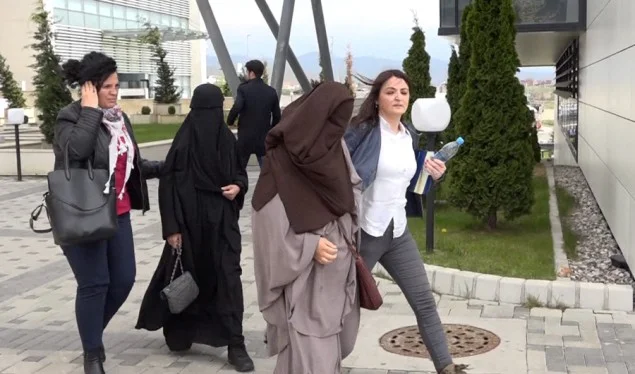
A mother, along with her two daughters from Suhareka, has been sentenced to two years in prison on bail, each from the Constitutional Court in Pristina on Friday. They were accused of criminal acts of organisation and participation in terrorist groups. All three women returned in April last year from Syria, along with [...]
A mother, along with her two daughters from Suhareka, has been sentenced to two years in prison on bail, each from the Constitutional Court in Pristina on Friday.
They were accused of criminal acts of organisation and participation in terrorist groups. All three women have returned from Syria in April last year, along with 29 other women and 74 children.
Shyhrete Tafaj, along with her two daughters Meke Tafaj and Valdete Tafaj-Dacaj, have pleaded guilty to the court.
On Friday they were not in session when Pristina Foundation Court Judge Albina Shabani-Rama announced the verdict against them.
“The court on the case of condemning the sentence has acted in line with provisions for extraordinary remuneration of the sentence, because it has specifically received relief from the defendants, their conduct before and after committing criminal acts, the fact that they have never before contradicted their law, state and repentance, and the promise that they will not commit criminal acts<1>, the judge said during the verdict's declaration.
Syrian-turned women in April last year, according to one of their lawyers, have been forced by their husbands to join in war zones.
Lawyer Besmira Hoti, who has defended accused Meke Tafaj, has told Radio Free Europe that her client, along with her mother and sister, is accused of organising and participating in terrorist groups.
Their actions, they were services to their husbands, my client, I'm talking about it personally. She was more obliged by her husband, because she had to serve someone and she simply had no idea where she was going, but when she got there, there was no way to go back and continue until the intervention of Kosovo, to get them back”, the lawyer said.
Justina Frokaj of the Kosovo Institute for Justice, which monitors the work of courts, has told Radio Free Europe that all women are being declared to regret the deeds they have performed.
The “basically these women at the initial hearings are admitting guilt, which means they're being found guilty of these criminal acts, but they're declaring that these acts have only been performed by their families, mainly by their husbands, who, according to the indictment filed by the Special Prosecutor, have gone to Syria and have actively participated in the fighting committed during the war in Syria”, Frokaj said.
According to her, almost all the cases pronounced against Syria-turned women include conditional sentences.
Frokaj has also indicated that women accused of acts related to terrorism go to court sessions with covers.
The “basically come with the headscarf, but the judges must identify the people, so they order them to remove the headscarves only on their faces to make their identification”, Frokaj said.
Shyhrete Tafaj, along with her daughters, is accused by the Special Prosecutor of the Republic of Kosovo of deliberately participating in terrorist activity, moving to Syria and joining the militant Islamic State group.
This family's route to Syria had begun in 2014. The two girls had gone first, Meke Tafaj and Valdete Tafaj-Dachaj, and then their mother, Shyhete Tafaj, along with her two sons.
One of the boys was killed, and the other returned to Kosovo and attended the session.
International terrorisation expert Adrian Steun in an interview for Radio Free Europe has said most of the women who have gone to Syria have been aware of the action they had taken.
The return of children itself has been a very good act. As for women, I think there's a misunderstanding in the way they're interpreted only as victims”.
And some are not victims, some are not, some are not, some are not, some may have been taken away without their knowledge to some degree and sent there by their husbands, but a lot of them have gone without their mates. Even such cases may have taken children without their mate's permission and have gone”, Steun said.
In total, the number of Kosovars who went to Syria and Iraq is estimated to be around 400, including men, women and children. Over 100 people from Kosovo have been killed there.
On April 19th of last year, Kosovo has returned 110 of its citizens from Syria, including 32 women, 74 children and four foreign fighters.
 5 hours ago

 7 hours ago