3 days ago
The mechanical engineer explains why time is running so fast in our day
Periskopi(6 years ago)
(6 years ago)Mechanical engineer Adrian Bayan of Duke University has an interesting theory about the strange phenomenon from which we seem to be speeding up as we get older. Perscope's editorial is still located, even though the date marks January 27, 2020. While most interpretations say one thing of [...]
Perscope's editorial is still located, even though the date marks January 27, 2020. While most interpretations say that this is because of laziness, the issue may be a little deeper. Another interpretation is that time goes so fast, and the new year comes so fast, it's pragmatic not to remove the fir at all so that there is no need for such re-location only... shortly after [in early December, we are divided only a few images of time].
In an article that Mr. Bane has recently published that he's named “Why the days seem shorter until we get older,” he links the phenomenon with the idea that visual imagery and the way we process them are the language we store up and correct our memories.
Viewing it as a matter of physics, he suggests that we more quickly capture and recall visual data when we are younger, and that puts our personal “mental time” in a revision version. Since it takes more time to capture images and memories when we are older, for a number of reasons, the same length of time results in less images. So less images mean a feeling that time has passed faster. Or the opposite, more images mean the feeling that time has passed slower.
From this point, Periscope notes that the average age of her staff has become the oldest in the last two years, which may also have affected the phenomenon of “destruction” or “pisces” of the holiday season.
When we put [we could nail this word] our memories to a degree of mental time, they seem faster to us, as if the old movies were visible. So the time they lie down seems to have passed faster than old memories.
The human mind understands the difference of time when perceived images change. Days seem to last longer in youth because the youth mind gets more images during a single day than the same mind in older age.
To better understand Bayan's concept, it helps us to understand the phenomenon of old movies. Of course, the sense of movement in film produced by issuing sequences that vary dramatically in front of our eyes that causes our brains to see timely events in motion. In the early days of the cinema, film cameras captured 16 images per second.
Since the movie The Jazz Singer In 1927 we have filmed and released films with 25 images per second. This means that when we release a second of a 16fps [frams per second], it goes to only two-thirds of a second, making it look like everyone in those days moved faster than we are now, or that their time was faster than ours. It's from Bayan's hypothesis.
According to Bayan's article, “Time represents the perceived changes in incentives [observated facts], such as visual imagery. The human mind perceives reality [natural, physical] through images that occur as visual inputs reach the cortex. ”
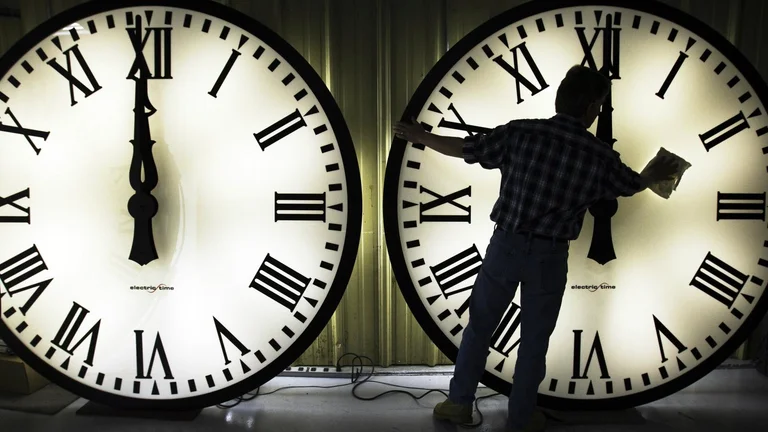
The clock time is one thing he agrees on and is measured correctly: All hours agree that when seconds and minutes pass, despite mechanical disorders they may have had. Mental time is more subjective.
The time you perceive is not the same as the time you perceive another.” It's written on Bane. /Periscope