2 days ago
Creates object with the fastest rotation in the world possible only by light force
Periskopi(6 years ago)
(6 years ago)Nano-groms in the shape of the shutter roll at considerable speed from two different light forces that hit it in a vacuum room. Researchers at Purdue University developed the 300 billion - billion - wheeled object to test and beat their previous record from July 2018 when they created a similar object [...]
Researchers at Purdue University developed the 300 billion - billion - wheeled object to test and beat their previous record from July 2018 when they created a similar object that had 60 billion rounds per minute.
By comparison, the equipment of dentists is known to reach 500,000 rounds per minute - 600,000 times slower than the new rotor.
The research team, led by Tongcang Li, say that beyond setting a record, they hope to use findings to measure quantum effects like friction in a vacuum.
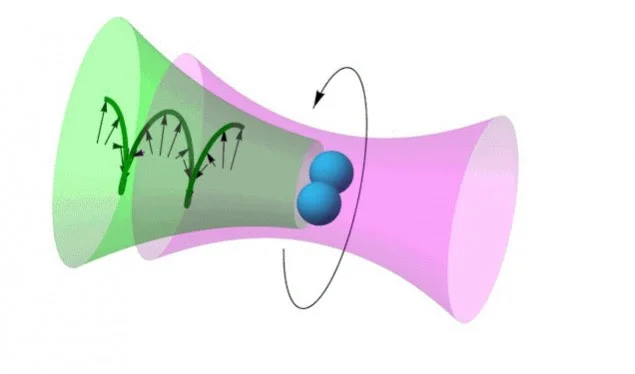
To make the object spin so fast, the team used two lasers to keep it in place and another one to start spinning.
When light from the laser ray hits every object, it exercises a degree of force on it known as radiation pressure.
This force is usually too weak to have any influence. However, in a vacuum area where there is very little friction, an object can be turned at record speed.
It's a million times weaker than the pressure exerted by gravity on people, but it still exists and, in space, can also push satellites, using light sails.
It is always exciting to set a world record”, said study author Tongchang Li.
In the 1600 ' s, Johannes Kepler saw that comet's tail always left the sun because of radiation pressure.
“We use the same thing, but with the concentrated laser, to plow and rotate nano-grimcat”.

In addition to the new record as far as rotation speeds are concerned, nanogroms can measure rotating couples at 60050 times more sensitive than any device before.
Previous surveys have suggested that even objects in a vacuum run by lasers experience a very small level of friction.
They found that this was caused by virtual photos, a quantum fluctuation within the vacuum, something Professor Lee wants to study further.
The nano-griming detector can also be used to measure the interlinking effects, including Cassmir effect and nano-scal magnetism, which may eventually allow engineers to develop and control nano-electric equipment.
Nano-groms are microscopic substances in size between one and 100 nanometers.
The characteristics of nano-gromca substances are different from those of the same substance in a much higher amount.

This change makes them interesting to science, since they create a bridge between materials and molecular structures such as atoms.
Nano-grain produced are used in medicine, engineering, environmental science and clean research.