6 hours ago
BBC writes about legend Fadil Vokry: Kosovo football growth through its reputation

Periskopi(7 years ago)
(7 years ago)The BBC has published an article about Kosovo football growth, particularly mentioning our legend Fadil Vokrin. Periscope brings them the translation, cut short, and adapted article in our mother tongue. All day, the miracle “ ” goes on to say. Perhaps these thousands of people who behave in the streets of Pristina just have [...]
All day, the miracle “ ” goes on to say. Perhaps these thousands of people who behave in the streets of Pristina have just faced another one.
It was September 2016 when Kosovo played its first international football contest.
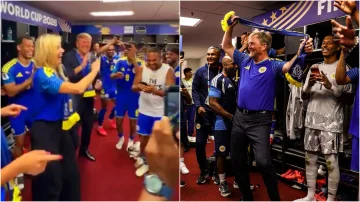
On Saturday, they further expanded the performance without losses already amounting to 15 matches to a 2-1 victory over the Czech Republic. It is the longest performance in all of Europe.
Kosovo already has a very good chance of reaching Euro 2020. And the next qualifying match is against England on Tuesday. They're enjoying the most of the time.
This country of some 1.8 million people campaigned eight years in a row to be admitted to Fifa and Wafa. This was accomplished in 2016. The process began immediately after Serbia declared independence in February 2008. Several countries including Serbia still do not know the right to exist.
For this young, troubled nation in the heart of the Balkans to shine on the biggest stage of football, it was not one man's dream. But there is one figure that is more honored than all others, and its confession helps to understand the origins of this special team.

Vorri in Montluco, France
He was a strategic in Kosovo's campaign to be accepted as a national football team, and is considered a hero in his country. After his death last year at 57 years of age, the national stadium was named for honour: Fadil Vokry Stadium.
Like many other people, Vorrit's life was followed by war, whose destruction in the region can be observed after 20 years. Interethnic tensions between Albanians and Serbs still continue.
Yet, Vorri was among the few perhaps the only one who had the opportunity to communicate in the depth of human life. Football was his language.
When Vokrri became president of the Kosovo Football Federation. [ Footnote] RECK was starting work in ruins. His offices were a couple of rooms in a housing block in Pristina; two tables and two computers. It was February 16, 2008. Kosovo declared independence the next day.
Vorri took over the post of a money-free federation, had a national team that had the right to play official matches, in an isolated nation with tired infrastructure.
What he had was just his reputation. He was the biggest footballer Kosovo had produced, although that title could be challenged quickly by the amazing new generation of talents that has emerged.
He was charming, charismatic, and persuasive. He and Secretary General Erol Salihu were two campaigners who stole from this country.
When we spoke at home, all at first, Father thought this process would be easy. Now we've been accepted as a state, it'll be easy, he'd tell me. She soon realized that it would actually be too difficult, but she did not eat the dick. His eldest son, Gramoz, told us.

Vorried with President Rugova
Gramoz lives in Pristina. When he grew up, he accompanied his father and helped him with his work. As a father, he is known in Kosovo's capital. Our conversation with him is often interrupted, every five minutes while friends and relatives come and greet him. Some even sit at the bajagi table long. Among them are government officials, football agents, former KLA generals and so on.
Dad never said a political word in his life and he was totally addicted to football. Football is higher than anything else. This was his vision,” continues Gramoz.
This allowed Dad to help us achieve the goal of being admitted to Wafa and Fifa. ”
Vorri was a fantastic double-leg striker [play with both]. He was loved by Kosovo fans. They thought of Fadhil themselves even when he wasn't one of them.

Kosovo's wartime players
Vorkri grew up in Podujevo, a small town near the northern border with Serbia. At that meal, like all the rest of Kosovo, Podujevo was part of Yugoslavia. During his childhood, Yugoslavia was a communist country composed of many nationalism, language and religion, all together ruled by its charismatic leader, Josip Broz Tito.
It was a time when Kosovars rarely arrived. But Vorrit's talent was too great to be ignored.
Vorri was the first to play for Yugoslavia and would remain the only one. His debut came in humiliating loss 6-1 against Scotland, in which the match would mark the only goal. There were 12 goals between 1984 and 1987.
He began his career at Llap's before moving to Pristina, where he got the reputation. Then, he went on to Partizan in Belgrade, where he played some of his most beautiful career matches “.
Partizan had won the league title in 1987 and the cup in 1989. It was Italian giant Juventus who had called him to play for them, but Vorri had refused them. He had not performed compulsory two - year military service, and in that form he could not go abroad. He carried out his duty to the state while playing for Partizan.
Many people think the point when the collapse of Yugoslavia began was Tito's death. They say he left behind a power vacuum that would be filled by rival nationalist faxes.
And in 1989, Vokrri and his family fled to France, where he signed for the Nimes team.
During the wars of the 1990s in Yugoslavia, 140 thousand people would be killed. From these wars would come modern - day states: Serbia, Slovenia, Croatia, Montenegro, Bosnia and Herzegovina, and Northern Macedonia. Kosovo would be the last country to declare its independence.
Vorri had returned to Kosovo from France five years after the war ended.

Dardanians
In 2012, when Switzerland was playing a match against Albania, 15 players in the field could choose to represent Kosovo,” says Gramoz. “Dad was at the match, looking at Sepp Blatt, then Fifa's president. And he said to his father: He had replied: “It is like seeing Kosovo A against Kosovo B.”
When Vokrri died in June last year, his burial took place at special state ceremonies in Pristina.
Serbian officials also attended the funeral, including former federation president Tomislav Karadzic. It is very rare to receive such a visit,” said Gramoz.
“Later, the Belgrade Partizan invited me to visit. I went to Belgrade, and they showed great respect. It wasn't like I was Albanian, they told me I was part of the family because of my father. ”
The “will be a great victory for us the day a Kosovo Serb decides to join our national team.” he adds./Periscopi