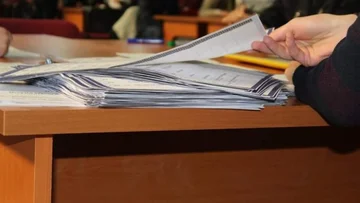
The diaspora vote count is continuing, VV achieves the 53rd term, PDK remains at 22, LDK falls to 18
 6 hours ago
 (8 years ago)
I think that Kosovo has made its own compromises. There are compromises, which have been granted to the Ahtisaari Pack... You know the formulas, which we don't find in any other country, in the way of governance, for the presence of minority communities, for their rights, especially if we take the Serb community”, says in the interview [...]
I think that Kosovo has made its own compromises. There are compromises, which have been granted to the Ahtisaari Pack... You know the formulas, which we don't find in any other state, in the way of governance, for the presence of minority communities, for their rights, especially if we take the Serb community”, says in the interview for Radio Free Europe, former Kosovo president Fatmir Sejdiu.
Radio Free Europe: Mr. Sejdiu, Kosovo and Serbia are already entering the final phase of the dialogue. How much do you see possible achieving a binding agreement for both sides leading to mutual normalisation and recognition?
Fatmir Sejdiu: I think it is always necessary for Kosovo and Serbia to end this part of talks on a single and very important purpose, for the people of the two countries, in the sense of overcoming what is a barrier to normal communications, the free movement of citizens, in other ordinary walks that make other sovereign states and to accelerate the process of integration. So I think that this very part, with all its difficulties, has some signals that can eventually result.
But I have to say, as well, and express my concern that this form of dialogue has lasted too long. It has lasted, unfortunately, due to the lack of much needed preliminary elements, to get into such dialogue and to realise Kosovo, the goal that we have expressed even at the time of previous negotiations, that this process be concluded by an agreement, or a peace treaty, an agreement that would be the outcome of all this part that could be the eventual obstacle.
What is important for Kosovo is that Kosovo has completed its political status part, is an internationally accepted state. It is a state that has been put in the black bank at the moment of raising Serbia's request to go to the International Court, to assess whether it is Kosovo's declared independence, in accordance with international law or not. That response has been given and unfortunately, in walking, Serbia has managed to install a logic, which has also been an obstacle in this process of dialogue even in further walking because a dialogue which Serbia has always thought according to its vision prism, is dialogue which means in some other form or form, the breakdown of the progressive concept, of all that we call a completed process.
With this, whether we wanted it or not, the very nature of the dialogue originally said as technical dialogue and went to later levels, which have practically prevented Kosovo from membership in important international mechanisms and, likewise, in general views between the two countries.
I've had my reservations since early on about this nature of Serbia's demands. A UN General Assembly resolution is known to continue dialogue. Since that time I have said that the dialogue should be clearly defined. This is in September 2010. I said that his format should be known and know what we want from him, but not a dialogue that will be entered with a stranger or many unknowns a dialogue that has often slipped into issues, which are extremely sensitive because we see Serbia's continued interest in getting involved in Kosovo's internal affairs.
This is not only about parallel structures, but also about the other requirements that have produced negative effects so far, because they have infrastructured Serbs, even those in the institutions of Kosovo, especially in the final phase, to be a threat to our normal movements, and which movements will be just a fulfillment of the guarantees given to the Constitution of the Republic of Kosovo, a constitution which is standard for dealing with the rights of human and community, and minorities extremely advanced.
Consequently, we see these developments, especially in the final phase, of how they came and something that has always been like attempting to misinterpret previous documents. We are assuming, Ahtisaari's document, the question of the Association of Serb majority municipalities, the way Serbia wants that through an added demand and the pressure it makes with people, especially in the north and in Serb majority municipalities, to raise it to the share of their responsibilities, at executive levels, which is impossible.
Therefore, I am very afraid that these moves Serbia has made, unfortunately, have imposed on many situations. Practically, they have put them in an extremely sensitive position, the dialogue reports, the reports between the two countries, in view of and not strongly insinuated and full ambition to complete, in nature what I would call the best situation to think of this type of dialogue.
Now we have a situation, which I say is sensitive to Kosovo, a situation which has practically brought the dialogue ready, in some form or other form, to be the daily topic even in the media, and to be the daily theme, to call it, to the ambitions of other factors and here Serbia, unfortunately has played its own game. See the parallel that Serbia does, at the same time, how people in Serbia run, so the Foreign Ministry, of other sectors, hinders Kosovo recognitions. At least push states, or ask them to withdraw recognition made to Kosovo, like other issues you'll consider. U n NCO two years ago and so on.
Radio Free Europe: Difficult compromises on both sides have also been warned. If for Serbia, the biggest compromise would be recognition of the state of Kosovo, what would Kosovo compromise be in relation to Serbia?
Fatmir Sejdiu: I think Kosovo has made its own compromises. There are compromises, which have been given to the Ahtisaari Pack, is an extremely comprehensive document, and its name is of nature as well as content itself. You know the formulas, which we don't find in any other country, in the way of governance, for the presence of minority communities, for their rights, especially if we take the Serb community. Serbs, about 5 per cent, as long as their participation in Kosovo's general population, have equal rights with Albanians who are the majority who are beyond 92 per cent.
You are aware of that, the reserved countries in Parliament, the reserved countries in local power and other issues related to decision-making, at 2/3 mandatory and necessary minority communities for important issues, and I see today, whether we want to say or not, they, as I said before, have prevented many processes even inseparably preventing the issue of forming the Kosovo Army, or any other initiative, which should be passed through constitutional changes.
Therefore, it will also be good for (Serbia) and for the Serbs in Kosovo themselves to end up with the process of recognition, because we have said a formula that, with Kosovo's declaration of independence, which has been adopted by MPs and with the essential promises given by international mechanisms, as mediators that this is the conclusion of a process given the international supervision of two years as it lasted until 2012, and is then completed.
What's next? The other is that Serbia, practically, has wanted to evolve consistently throughout the internal structure and internal spaces, instructing people to do also instructions that have been harmful to their prospects. And, I don't know what the painful compromise should be for Kosovo now! I know there's a lot of them. There is a point, to suppose, the division of Kosovo is talked about and said in various and complex circles, which I don't want to take very seriously, but maybe, at times, there's also that they enjoy talking that they're lying in such forms even earlier. The division of Kosovo and the effort to somehow have border re-diagnosions in these Southeast European areas is extremely dangerous.
I have said even at the time when I was president of the country, even earlier, and I repeat it again; living within an ethnicity within its borders, is ideal choice, in this case even for the ideal Albanians, it would be what Serbia says or anyone else, to call it, joining Albania. However, rational choice is what Kosovo has chosen and I think is an extremely big compromise. A compromise that consistently coincides with the positions that have been with the Contact Group. We have in mind those three important points of early autumn 2005, that Kosovo cannot return to the state of 1999 and before it; that Kosovo will not have border changes; and that Kosovo will not join any other country.
So let me call it an extremely essential three-pointer, who has been a leader in later processes.
I have led the dialogue with Serbia almost two full years and I know the positions that have been and the big debates that have developed. The debate was essential because it was also the Russian federation's representative, Mr. Archenko at the time, was the US representative, Ambassador Frank Wisner, and was EU representative, Ambassador Wolfgang Ischinger.
And what was important was that at the essential points, they obviously agreed, they were in common. On the other hand, Serbia, unfortunately, in various forms of pressure, has managed to create to call it a status quo disgusting, not easy for Serbian citizens.
You have in mind the recent developments, pressures on them, because they accept (the pressure) to release the Kosovo Security Force, or other mechanisms of Kosovo institutions that are harmful to Serbs themselves.
Of course, it's also bad for further processes. So, I wish that this final phase they're calling, I don't know what the finals are, I wish these processes were completed. The good news has been that the nature of dialogue is nature of technical dialogue, not to rise to the plains that are essential to tax (touch) the fundamental frames built so far with the international community and, of course, have a comfort in the next walks.
Radio Free Europe: Red lines of dialogue have also been mentioned. President Hashim Thaci has warned dialogue without red lines, while there are many differences over his statements. How do you see a eventual dialogue without putting red lines on it?
Fatmir Sejdiu: The essential for a process is to know the main scheme of where and how to get to it. In other words, be a clearly defined agenda. Of course, I do not say that it should be debated with everyone, but be very clear and be acceptable to the interests of the country.
I hope so. I'm never about forms of dialogue that might be effective. I don't want to believe that Kosovo's representatives in this case can be released on such a level that they go without red lines or without a form of conglomerating the dialogue process and be endless.
But it has to be something that practically known walking, essential points of treatment, or problems that will be laid out and of course focus, or what we consider legal, natural and acceptable for the future of Kosovo and its citizens.
Radio Free Europe: Meanwhile, that dialogue is heading towards the final, there is still no consensus among political parties in Pristina. Why is this inner consensus so difficult to reach?
Fatmir Sejdiu: I think it's necessary to have big themes in this case or not, it's come to us as an important topic in our daily, to have consensus, to have a deal.
Any good agreement and need, should lead, call it a sense of communication and deep, busy, and early communication itself.
If that doesn't happen, I think it can be a little awkward and may not be the result in the sense of that, because citizens have concerns. I don't say and don't want to believe in institutions that this could be a form to invest in further divisions.
Radio Free Europe: Why is this consensus so difficult to reach?
Fatmir Sejdiu: I think maybe there was missing a little bit earlier, just a need of communication and at the same time, a much more serious effort. I don't know what's going on in the inside of activities, but I don't think it's enough just calling that in the opinion, del“come or we're going, or like...
It is very important to me, as is worked on other channels and with other partners, as well as in part of our inner life to have genuine communication.
Maybe there's someone who just says that about them, as they say, "Shut up and it's not there." But it is very important that it is the critical moment that people have to find energy, it should be a permanent respect for the structure of domestic institutions, their hierarchy and their responsibilities, as well as a communication that must result. This is because, after all, as part of the formula that is essential, that even position and opposition have their responsibilities. Both create Kosovo institutions and its physicalisation. For us it is important that that moment be found properly, people co-ordinate their actions, ideas and, of course, consensus comes out simply, perhaps even from an eventual effort a dialogue that may be even deeper, but that has to come up with results.
Sejdiu: Always ready for LDK leadership
Radio Free Europe: If we can also return to the Democratic League of Kosovo, which you have led for several years. Do you plan your return to party functions, so to LDK?
Fatmir Sejdiu: I've given my answer to this question you put on, that it's paved in different forms. I have always been, I am, and I will be willing that if the Democratic League of Kosovo and its people think that I can be in separate responsibilities, in this case even in the party leadership, I'm ready, absolutely yes.
I am not the man who absolutely insist, but I insist that the LDK make the best possible choice. In this case, I'm one of the people that I remember that I have energy, I have my luggage, I have my luggage, just political and also my extremely abundant experience, but it can always prosper plus to make my contribution to any situation.
So, what makes me say this, it's her dough, it's her essence, it's her content, it's her project from the beginning of her political philosophy. There are issues that I have not agreed with or agreed with today, with developments within the LDK, and it's not the time now for them to emerge.
But what keeps me in LDK is what you understand and it's just an expression of mem, its real identity in its broad membership, and its vast structures. This, because the LDK is a party, I always say, powerful, despite the timings and moments that have been in certain electoral processes, sometimes just inaccurate processes, sometimes not, but sometimes not, but many cases, you know yourself in your own chronics, and sometimes extremely incorrectly, injuries that have been done. People have thought that (the word for the LDK structure) will only be the result of the box, but the result is someone else filling the box or being abused, and those processes have occurred.
But it is important that the LDK has a real identity, in a philosophy that has its foundations from December 1989, when President Ibrahim Rugova also takes its wheel. And let's call it all the feeling that's in its developed membership we often have extremely qualitative members who are not in the structures of today, but they're people who don't get to the other party. They may also have grief with the LDK, not to put the vote, not to come up with the election process, but they are people who have not moved from there. I'm one of those people, because you know at the time when you even passed some of the processes that have been, I've had my sorrows, which is logical, it's humane, but I haven't gone to any other subject.
And, I think this is a new approach that a political party has, because we're fed up with movements, as they call them in Albania, with “merkaton” being made for a market of players, with movement people have made from one party to another party, in different forms. It is disgusting and we have had it present in Kosovo, and unfortunately it is now.
But, I say that this very approach that I have and that many people that we think with have made the LDK maintain its physical performance in this respect as well. Those who have come out, tried new parties, were screaming, I speak in the worst sense possible, or have done services simply for the party... The worst could be when within the LDK, as in other parties, there could be people working for other parties.
There may be people in their projects who are in certain services, who practically want to hold two positions and see that they carry the load. Practically, it's an incorrect thing, it happened, there's signs like that, so there's been signs like that, but I don't want to say names.
 8 hours ago
 9 hours ago