4 minutes ago
Hodges: Political stalemate makes Kosovo more vulnerable to external influences
Periskopi(an hour ago)
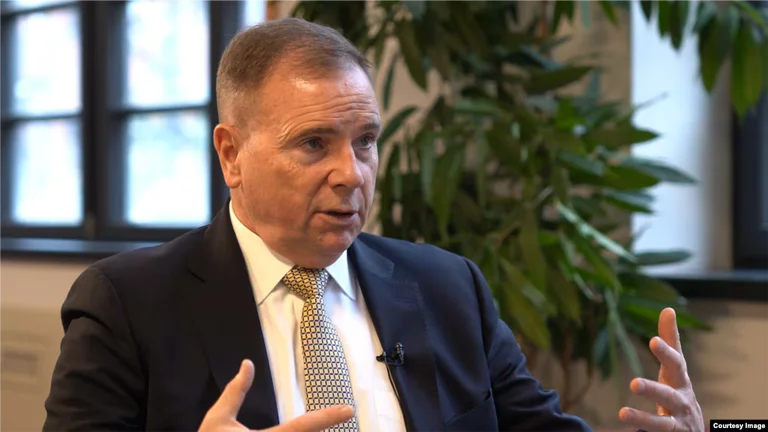
(an hour ago)Kosovo remains vulnerable to external influences as long as it fails to get out of political stalemate and build stable institutions, estimates former US Army Commander to Europe Ben Hodges.
In an interview for Radio Free Europe, he says Russia has no interest in seeing Kosovo as a strong and integrated state in Euro-Atlantic structures, while stressing that KFOR's presence remains a “mood of stability”.
Hodges also speaks of NATO's targeted transformation after the summit in Ankara, increasing Europe's role in defence, hybrid threats from Russia, and how artificial intelligence and new technologies will change the Alliance's preparedness for future conflicts.
General Hodges, what do you think was the most important strategic message coming out of the summit? NATO in Ankara?
Ben Hodges: The most important message is always unity of the alliance.
Of course, many worry that [US President Donald] Trump will come and disrupt this unity. At first, he did something about it by bringing back Greenland's case, criticising Spain and similar things. But at the end of the summit, he said that the hall was filled with love and that there were really good people there.
I think it's important that the summit ended in such a tone and that he left with a much more positive approach.
Therefore, preserving the unity of the alliance remains the main priority in such summits.
Second, it was also very important to demonstrate European defence investments as well as Canada. All reports made during the last few days speak of money and real military capacities. This was a very positive development.
And, finally, support for Ukraine. Not only the tone of statements but also the announcement to grant Ukraine license to produce Patriot interceptors, PACE missiles.
We'll see if this happens. I hope so, although I remain skeptical, because President Trump has not been a constant supporter of Ukraine. But I hope this time it's a real commitment.
A More United NATO, With Stronger Europe
The statement speaks of a stronger Europe within a stronger NATO. In practical terms, does this signal a new division of responsibilities between Europe and the United States?
Ben Hodges: Yes, it signals that and I don't have a problem with that, as long as the United States doesn't turn their backs on Europe.
Nuclear prevention is, of course, very important. But it must also be fulfilled by a conventional American presence, whether through air, sea and land power or intelligence exchange. So it can't be just: You have nuclear weapons, we're leaving. That wouldn't be useful.
However, transferring much of the responsibility for conventional prevention to European allies makes sense.
And, not to be forgotten, Canada, which is often left in some shadow in these discussions. She is increasing her contribution to the alliance, and this is necessary because of her geographic position and quality of men and women in her armed forces. Canada is also an important part of this change.
Thus, European allies are expected to take on greater defence responsibilities, while simultaneously continuing to co-operate closely with Washington. How important is this change for the future of transatlantic security?
Ben Hodges: The most important thing is the continued commitment of 32 Alliance member states to collective protection. This is the most important thing.
There will always be dynamics among allies, disputes or tensions for different reasons. As is true within the European Union, where there are debates on migration, financial policies, visas, or other issues. That's natural.
But the commitment of all countries to collective protection is the foundation of the Alliance.
And, of course, the best way to protect NATO countries from a potential Russian attack is to make sure Ukraine succeeds. Therefore, support for Ukraine remains an essential part of the Alliance's overall defence and security.
Future War: Drone and Artificial Intelligence
NATO is increasingly devoted to artificial intelligence, cyber capacity, missile defence, crewless systems... How much is this changing the way the Alliance prepares for future conflicts?
Ben Hodges: I think the Initiative for Prevention on the Eastern Wing is one of the most modern approaches to prevention and protection. It does not replace traditional elements, such as ground forces, obstacles or mines, but complements them.
Throughout NATO's eastern wing, an integrated system is being built from northern Finland to the Black Sea. I wouldn't call it <x0mur”, because it doesn't describe it correctly, but it's a combination of all the capacities you mentioned, connected to a network, which significantly increases the speed by which commanders identify threats, make decisions and react to them.
This is an important adaptation and a step forward in using new technologies.
I think much of this has been prompted by what we've seen in Ukraine. There has been created a type of <x0) death cell that extends to a large part of the territory, where Russian forces have so far failed to penetrate because of continued surveillance and ability to strike thousands of fears.
I believe the Alliance has learned from this experience and is applying these lessons by combining them with other capacities. This is a positive development.
However, there is still a major shortage of air and missile protection. We are not yet prepared to protect our entire critical transport infrastructure from attacks - similar to what Ukraine experiences almost every night.
And I would add one more thing: The alliance has yet to find a clear answer, as well as individual states, to the way it should face Russian operations in the so-called grey-zone “”.
It is all designed to intimidate European societies so that their governments can stop supporting Ukraine.
Therefore, we must find ways to impose consequences on Russia, even when most of these actions cannot be directly attributed to it and remain below NATO's threshold of Article 5.
This is a challenge we haven't solved yet.
Why should NATO respond more strongly to Russia?
But why is there still no response to these threats?
Ben Hodges: I think that here every state faces its own challenges - has its own legal framework and internal political considerations, which should be resolved.
For example, recall the occasion when about 12 fears entered Poland's territory a few months ago. Nobody denied they were Russians, but what was the reaction? F-35s and F-16s were airborne.
But that was not the right answer.
On the other hand, you do not want to drop your fears on your cities when you are not in a state of war in a traditional sense. If you drop a drop, his remains will fall somewhere.
Then there are institutional disputes. For example, here in Germany, the question is, Who is responsible? Is it a matter of police? For the army? Who controls air space over Frankfurt or Berlin Airport? These are issues that have yet to be resolved.
I think there is a tendency for these incidents to be handled as cases of law enforcement, such as criminal acts. This means that irrefutable evidence must be collected and proven, as in court, that this or that is responsible.
Of course, the Russians know that. Therefore, they will not send a soldier in Russian uniform and flag to his side. They use people who pay or sponsor them to perform these actions.
The same applies to the so-called “float in shadow”. It is part of the same strategy. We already know that these ships not only transport Russian oil and gas illegally to the Baltic Sea and the Black Sea, but some of them have also been used as fear-free platforms, for example against Denmark.
Therefore, we must accept the reality that Russia is at war with us, even if we do not consider ourselves to be at war with Russia.
What message does a lack of meaningful answer send to Russia?
Ben Hodges: It requires political will, political courage, but also practical solutions.
Of course, this is more complicated when you are part of democratic countries trying to act in accordance with international law and law. There must be ways to react within this framework.
I believe this is possible. There are legal grounds that can be used, but serious work is required by governments.
The danger is, if we don't find a way to respond to these actions, Russia will continue to push the borders ever further, until one day it can also launch a limited attack on a NATO country.
For example, he may attack an area like Daugavpils in Latvia and then ask: Okay. NATO, what are you gonna do now? Will you enter nuclear war for Daugavpils? )
If the answer was no, then the credibility of Article 5 and the Alliance itself would be severely damaged.
Where does Kosovo remain in transforming the Alliance?
We talked about NATO transformation. In this context, where do Alliance partners remain, like Kosovo? Can new technologies create more opportunities for cooperation, or are they at risk of expanding the gap between member countries and partners?
Ben Hodges: I think even the smallest countries of NATO, of the European Union, or other European states like Kosovo, have much to offer. They have talented young people with good technology skills.
Therefore, not every country should have F-35s or aircraft carriers. Each state can contribute to its capacities, including in the field of intelligence and awareness of the situation - that is, understanding what is happening on the ground.
I am quite convinced that the Alliance will continue to work to find ways to better integrate smaller countries with larger ones.
It is not desirable to rely on the capacities of the United States alone. This is what France's president, Emmanuel, has long warned of. Macron, stressing the danger of excessive support for the United States.
Because if a situation develops where the American administration is not perceived as fully reliable, or if everything is treated only as a transaction, then the rest of the Alliance becomes more vulnerable.
The Western Balkans are not mentioned in the NATO summit declaration, although the region continues to face unresolved issues and security risks - from the north of Kosovo to Bosnia and Herzegovina and Republika Srpska. Do you think NATO still views this region as a strategic priority? And what should the Alliance do to prevent these managed crises from becoming open conflicts?
Ben HodgesYes, I think this is a challenging and multidimensional situation. I don't know exactly where the Western Balkans rank on the Alliance's list of priorities or how NATO praises the region.
However, I would not give any particular meaning to the fact that the Western Balkans were not mentioned in the declaration released after the summit. After all, the summit consisted of a dinner, a joint meeting and several bilateral talks that took place in parallel.
The upcoming summit is expected to host Albania. Now there is an idea that next year is not kept, so if that happens, Albania would be hospitable in 2028.
This would be an opportunity to turn attention to the Balkans, just as Turkey's summit organisation helped focus on the Black Sea and Turkey's role.
I think NATO has responsibilities in this region because it has Alliance member states, and the European Union has interests. But, frankly, I can't say where the Western Balkans are ranked on the list of priorities.
Kosovo is again struggling to form stable institutions after repeated elections. From the NATO and security perspective, how harmful is this political stalemate for a country intended to be viewed as a reliable Western partner?
Ben Hodges: Of course, such a situation keeps Kosovo vulnerable to external influences.
Russia has no interest in Kosovo becoming a strong, liberal-democratic state, integrated into the European Union, NATO, or similar structures.
Therefore, as long as Kosovo fails to resolve this situation, it will remain vulnerable to those who aim to preserve the status quo and continue to destabilise the country.
Think about security threats...
Ben Hodges: Yes, but also constantly promoting old divisions and undermining citizens' trust in institutions and democratic processes.
As Europe takes on a larger role in defence, should Kosovo expect any change in the NATO mission, KFOR?
Ben HodgesI don't know. I hope KFOR's mission continues. I think I mentioned it to you in an earlier conversation we once had: a senior Kosovo official and a senior Serbian official told me the same thing: Please, don't attract KFOR, because it is the only anchor of stability.
That was a couple of years ago, but that conversation remained in my mind. It shows there is no need to have a large number of troops on the ground; KFOR's very presence serves as a point of stability.
How important is the American presence in Kosovo?
Ben Hodges: I think the presence of the United States in Kosovo is important because it is also in the interest of the US itself that Europe is stable and secure. Only then can it also be prosperous, since Europe is America's biggest trading partner.
Thus, instability in the Western Balkans contributes to instability in other parts of Europe and creates weaknesses Russia will try to exploit.
So I would formulate the importance of the American presence in Kosovo.
And beyond the summit, what should Kosovo now do to remain important and useful partners for NATO?
Ben Hodges: Keep working on meeting the conditions required for membership in the European Union. That's the way it should go. I think it would also meet the goal of making Kosovo a more valuable partner for NATO, if that's in its interest. /Periscope/