6 minutes ago
More than a verdict on four former KLA leaders what is expected
Periskopi(an hour ago)
(an hour ago)For years, Kosovo's war has been confessed through history, politics and collective memory. Soon another judicial chapter will be added.
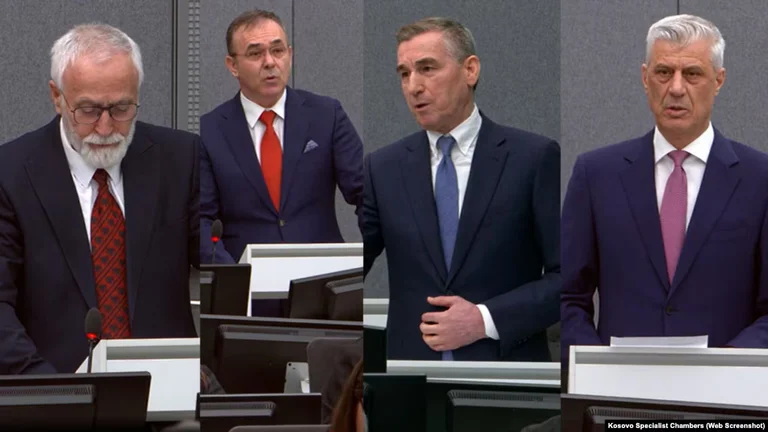
Specialised Chambers in The Hague - known as the Special Court - are expected to declare the indictment of four former Kosovo Liberation Army leaders: Hashim Thaci, Kadri Veselin, Jakup Krasniqi and Rexhep Selimi.
They are accused of war crimes and crimes against humanity, allegedly committed long and immediately after the war in Kosovo.
Initially, the Judicial Chamber had until May 19th to declare the decision. But, calling for the complexity of the case, he decided to postpone the deadline until July 20, 2026.
This date may also not be final.
In a response to Radio Free Europe, Specialised Chambers said there may still be changes in the envisioned deadlines.
The judges may decide for another delay, if it is considered absolutely necessary. Once the panel sets a date for announcing the decision, we'll let it know”, it says in response.
Thaci and his co-independents - all top KLA figures during the 1998 and 1999 war - have been in custody in The Hague since November 2020, when the indictment against them became public.
In that file, they are described as part of a “joint criminal enterprise”, aimed at taking and exercising control through intimidation, mistreatment and departure of opponents.
According to the indictment, their victims included Serbs, Roma and Albanians who did not support the KLA. At least 102 people were allegedly killed, while more than 20 remain missing.
The prosecution also claims that the accused, due to their leadership positions, are responsible for the crimes committed by their subordinates.
Today, over three years after the trial began, the court has heard dozens of witnesses and examined hundreds of evidence presented by the prosecution and the defence.
At the conclusion of the process, the prosecution sought a 45-year prison sentence for each of the four indictees.
The Specialised Prosecutor's Office has demanded a verdict on the sentence for all ten points of indictment and the establishment of a single verdict for 45 years, based on individual contributions to the crime...”, said specialised prosecutor Kimberly West, on February 9, 2026.
The four have denied the charges.
Thaci, who over the years has held the positions of prime minister and president of Kosovo, has described them as completely false, absurd and deeply offensive”.
It is painful that this prosecutor tries to refute the evidence of senior NATO officials, the United States of America, Great Britain and the UN in this court of theirs and their people who were with us all the time on the ground”, Thaci said addressing the court on February 18th 2026.
In support of the defence, some of the most well-known figures of wartime diplomacy and Western security, including former US State Department spokeswoman James Ruby, and former NATO Europe Commander Wesley Clark.
They have claimed that the KLA did not function as a centralised structure and that the accused had less influence and control than allegedly in the indictment.
This is a stance that shares a considerable part of Kosovo citizens who continue to see Thaci and his fellow fighters as figures of liberation war.
In some cases, they have protested the court, considering it unjust and unilateral.
For part of them, including political representatives, the court's focus only on alleged crimes of KLA members creates the perception of equalising Kosovo's war with crimes committed by Serbia, which was the aggressor state during the 1998-1999 war.
The eyes are now on the judges - what will be the verdict?
The answer is not the same among jurists and scholars who have followed the process closely. Some expect a loosed trial, others avoid any prediction, while there are those who see several possible scenarios.
For a lawyer licensed in Specialised Chambers, Artan Kerkeyni, the Prosecutor has failed to prove the two main pillars on which the indictment is based: the existence of a joint criminal enterprise and the command responsibility of the accused. Hence, he expects the four to be declared innocent.
The Kosovo Liberation Army has been a voluntary army and there has been no strict hierarchy. Its members have joined them with their will, were no professional soldiers, and had no obligation to endure to the end. Under such circumstances, effective control in the field cannot be said to have existed, which is one of the foundations for determining the joint criminal enterprise”, says Qerkeyni of the programme Expose Radio Free Europe.
However, not all are willing to draw conclusions about the outcome.
University of London International Law Professor William Schabas says that processes of this nature are often established by specific details of evidence, which are not always visible to the public.
The judges considering this case are not from Kosovo. They are not cut off from Kosovo's political reality, because it is part of the issue being tried. But they are independent and impartial. I think that the concerns or sensibilities that their decision may cause do not affect their work - they will decide on the basis of the facts and evidence that they have before themselves”, Schabas says of Expose.
As a longtime researcher with The Hague Tribunal for the former Yugoslavia and a close observer of the process towards Thaci and others, Nevenka Tromp does not rule out any possibility.
According to her, there are three scenarios: declaring innocence for the fourth, condemning the fourth, or a mixed result, where some could be punished and some released.
The very third one, she sees the best.
This court will have to maintain some kind of balance between the expectations of the Serb and Kosovo parties. For this reason, it is likely that some accused of being acquitted and some be punished. It remains to be seen whether one will be released or punished by a... Or some other combination. But it will compromise”, Tromp says of the Expo.
Tromp's attention does not stop short of results. She argues that during the development of the process, there have been serious concerns over the procedural standards, including the length of detention and the way of implementing the presumption of innocence. She notes that similar criticism has been raised by the England and Wales Bar Council.
Previous Report This mechanism, published on May 11th, raised concerns about the length of detention, restrictions on provisional release, acceptance of evidence and equality between prosecution and defence during the judicial process.
How such criticism will affect the perception of the act remains to be seen. Because for some experts, the verdict is only part of history. The rest begins after it is declared, in the way it will be read and interpreted in Kosovo and beyond.
So does sociologist and professor at London University Eric Gordy.
According to him, one of the biggest weaknesses of the Specialised Chambers has been communication with the public. Instead of explaining more to citizens that the process involved individual responsibility, public space was filled with political interpretations, where judgment was presented as a confrontation between warring parties and not as a criminal process against individuals.
Who wouldn't want to achieve historical justice? But I would like judges to focus more on judicial justice, while historians and philosophers concerned themselves with historical justice”, Gordy says of Expose.
Gordy does not expect the bias to bring a common concern for the war in Kosovo. Rather - interpretations, he says, will continue to change because they are built on experiences, collective memories, and different political and social perspectives.
For this reason, he sees dialogue between societies themselves as the most reliable way to face the past.
We need to separate history from politics and promote a dialogue, where people in each state also speak of the responsibilities of those who represented them. Separating people into heroes and enemies serves no one”, according to Gordy.
Professor Schabas is also sceptical that a judicial decision could produce reconciliation.
Referring to the experience of the International Criminal Tribunal for the former Yugoslavia, he says that even after dozens of acts and more than two decades of work, his impact on the approach of regional societies remains limited.
According to Sabbas, a similar scenario can be repeated even after the decision of the Specialised Chambers.
If the bias is against them, there will be people who will not readily accept it. Simply, because of their loyalty and beliefs, not because of a cool, impartial assessment of the 34x1> law, he says. For the Kerin, a punishment act would weigh beyond individual responsibility. He says that the fact that the Court has handled only alleged KLA crimes has fuelled the perception of a selective justice, with possible consequences even in the way Kosovo war is perceived.
“can negatively affect perception for KLA, because accused are KLA leaders. So the KLA is not made up of weapons and logistics, but men. And these people accused of being KLA leaders and, of course, could criminalise the entire KLA”, says Krkin.
Tromp goes even further - perception for The KLA is not alone in the game.
She argues that a condemnation act could also affect the way Kosovo's citizenship will be confessed in the international arena, giving Serbia and skeptical countries more space to challenge the moral legitimacy of its liberation war.
That, according to her, could put Kosovo in a more difficult position in diplomatic battles for recognition, as well as in reports with international partners.
Kosovo's “Society wants to be accepted in the European political context. She wants to move forward and build her future. But this process risks keeping him in touch with the past and questioning good intentions and the outcome that this court aims to achieve”, Tromp says.
Founded by the Kosovo Assembly, the Special Court is part of the country's judicial system, but operates at The Hague with international judges.
It followed the report by former Swiss Senator Dick Marty of 2010, who filed allegations of serious crimes by former KLA members, including organ trafficking.
Since the latter were not confirmed and are not part of the current indictment against Thaci and others, Kerkin says Kosovo is “mapped out”. /Periscope