23 minutes ago
Two giants, the same fate how Italy and Spain were eliminated amid controversy at the 2002 World Cup
Periskopi(2 hours ago)
(2 hours ago)The 2002 World Cup, organized by Japan and South Korea, was a football party and a historic tour of the Asian continent. It was the first time the World was held in Asia, and so was the first time it was organized by two countries.
In addition to the Brazil triumph led by Ronaldo, Rivaldo, and Ronaldinho, this tournament is also remembered as one of the most controversial in football history.
Many analysts, former players and fans have claimed over the years that South Korea was favoured by judgment on its journey towards the semifinals, in order for the enthusiasm of the tournament to be maintained in the host country.
The 2002 World Cup was also marked by the early elimination of some of the main favourites. The defending champion, France, has been eliminated since the phase of the groups without a score, while Argentina suffered the same fate.
On the other hand, the tournament brought great surprises. Senegal reached the quarterfinals, while Turkey held one of the best presentations in its history, winning bronze.
In the end, Brazil triumphed in the final against Germany with a score of 2-0, thanks to Ronaldo's two goals, winning its fifth world champion title. However, that World's best comment was the arrival of South Korea in the semifinals under the direction of Dutch coach Gus Hidddddnik. The locals' success was accompanied by numerous controversy, especially after matches against Italy and Spain in the preliminary phase, where arbitrator decisions continue to be considered among the most controversial in football history.
Italy The Fight That Still Hurts
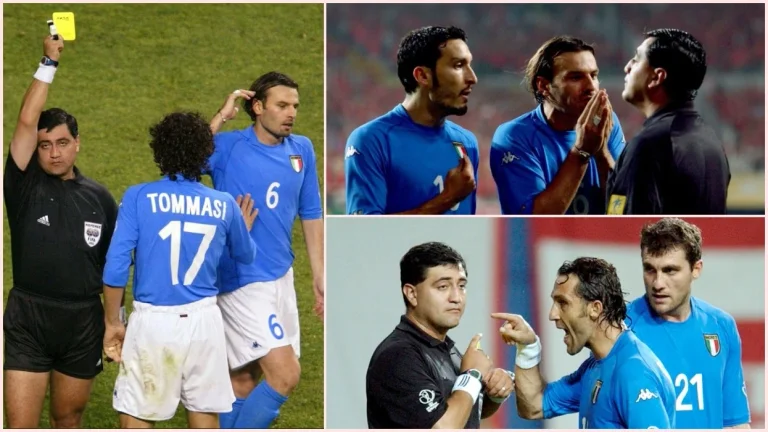
On June 18, 2002, Italy faced South Korea in Daeion. The match was led by Ecuadoran Judge Bureau Moreno, whose name remains closely linked to the controversy of that confrontation.
South Korea won a controversial penalty at the start of the meeting, but Gianluji Buffon managed to cut the shot. In spite of that, the Italians advanced to Christian Vier's goal.
In the 88th minute, Seol Ki-hyeon equalized the score and sent the match forward.
That is where the most controversial episode took place. Francesco Totti was expelled with second yellow card for simulation, although television images suggested contact within the area. Italy remained with one less player in the field.
A few minutes later, Moreno cancelled another goal of Damiano Tommas for an out-of-play position, a decision that caused great anger in Italy.
In the end, Ahn Jung-hwan scored the gold goal in 117th minute and secured the historic qualifications of South Korea in the quarterfinals. Ironically, Ahn was part of the Italian club Peugia at the time. Just a day after the match, the club president decided to get him off the team, claiming he had no intention of paying a player who had eliminated Italy from the World.
Same as Spain
The Controversian judgments did not end with Italy. In the quarterfinals, on June 22, 2002, South Korea faced Spain. The meeting was conducted by Egyptian Judge Gamal Al-Gandour and was accompanied by decisions that continue to be debated today.
Two goals were canceled in Spain. The first was canceled for a suspicious foul in the attack on Ivan Helguera, while the second came after an assisting Joaquín for Fernando Morientes. The assistant judge incorrectly signalled that the ball was out of line before the cross, though television footage clearly indicated otherwise, Telegrafi reports, broadcast Periscope.
Throughout the match, the Spaniards protested numerous controversial decisions, especially for out-of- play positions and disruptions of offensive shares.
Regular time and follow-up ended without goals, while South Korea won 5-3 after the penalty execution, securing a seat in the semifinals.
A World That Left a Mark
The 2002 World Cup remains one of the most special tournaments in football history. On the one hand, it brought great surprises, inspiring stories, and the triumph of Brazil.
On the other hand, controversy over arbitration in South Korean games continues to be a topic of discussion more than two decades later.
For many fans and analysts, the 2002 World Cup remains a reminder of how much arbitrator decisions can influence the fate of the teams, making it one of the most controversial championships in sports history. /Periscope