21 minutes ago
GAP budget analysis: Government mostly shares the budget for VV) municipalities investments
Periskopi(5 months ago)
(5 months ago)The distribution of investments from the central level to the municipalities is not fully proportional to the population and the surface, highlighting inequality in the adoption of investments. The Vetevendosje (LVV) movement benefits most of the investments, with 40.3% of total investments and 34% of new investments, though representing 23.8% of the population and 18.3% of the surface. [...]
A similar situation, especially in terms of new investments, is noted in the Alliance for the Future of Kosovo (AAK), which, with 14.0% of the population and 16.8% of the area, benefits 29.5% of the new investments. On the other hand, the Democratic League of Kosovo (LDK), although it has the highest percentage of the population (30.5%) and a significant share of the area (25.6%), gets 17.3% of total investments and 10.6% of new investments. The Democratic Party of Kosovo (PDK) represents a more balanced distribution, where investment rates are closer to percentages of the population and the area it covers.
The Serbian list, representing 6.7% of the population and 6.2% of the area, benefits about 2% of investments. Meanwhile, smaller subjects such as KDTP, NISMA and Civic Initiative have a limited impact on both population and surface and investment
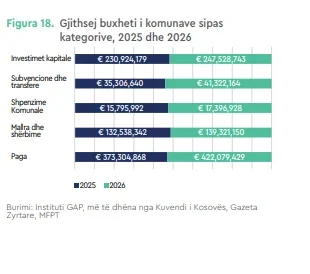
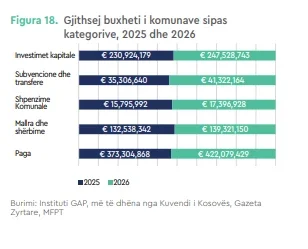
The GAP Institute has published analysis on the municipal draft budget for 2026, where spending increases in all major categories compared to 2025 are envisioned. However, the report underlines that the distribution of investments from the central level continues to be accompanied by considerable differences among municipalities.
According to the data, the wage fund in municipalities is expected to increase for 48.8m euros, or 13 per cent. Spending on goods and services will be added to 6.78m euros (5%), while municipal spending for 1.6m euros (10%). Growth of 6.02m euros, or 17 per cent, is also spent in the category of subsidies and transfers. Capital investments, meanwhile, are expected to be 16.6m euros higher, representing 7 per cent growth.
11 Risked municipalities for budgetary stagnation
GAP estimates that the budgets of 11 municipalities should be revised between the two readings in the Assembly, as they had not approved the budget until September 30th, 2025, due to local elections and the lack of information of assemblies.
If it does not interfere with the amendments, the Vushtrri municipalities, Suhareka, the Year, Lipjan, Malisheva, Shtime, Junik, Zubin Potok, Gjilan, Prizren and Pristina could face the same budget in 2026 as in the preceding year. The institute suggests MPs make corrections in line with budget accounting methodology, so that these municipalities do not remain out of the overall budgetary growth.
Central Investments: less new projects
The report considers the fact that the Finance Ministry has not reduced the budget of municipalities that have marked population decline, not penalising them despite the needs for investments.
However, GAP stresses that the Fourth Grant for municipalities has not yet been functional, what, according to them, is affecting the creation of inequality in the benefit of funds from the central level.
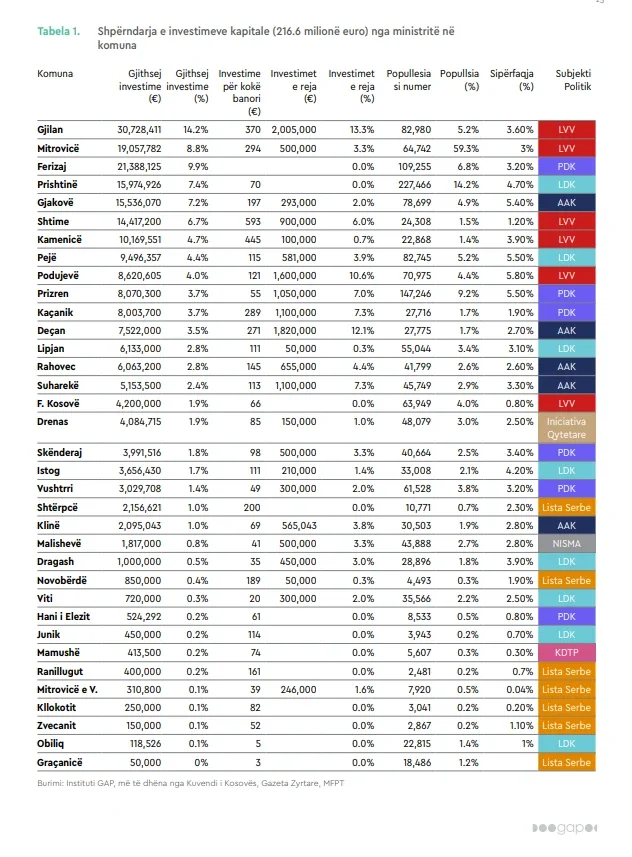
For 2026, ministries plan to invest about 216.6m euros in municipal projects, making up 29 percent of their total capital investments. Of this amount, only 15m euros are dedicated to new projects ʹ 32 percent less than in 2025 ) and only 23 municipalities will benefit from them.
Large communities like Pristina, Ferizaj and Fushe Kosova do not figure at all on the list of new capital investments for next year.
Inequity in Political Dividement
The GAP analysis shows that the sharing of investments is not fully proportional to the number of the population or territorial area of municipalities.
The municipalities led by the Vetevendosje Movement benefit 40.3 percent of total investments and 34 percent of new projects, although they make up 23.8 percent of the population and 18.3 percent of the country's surface.
The Alliance for the Future of Kosovo benefits 29.5 percent of new investments, with 14 percent of the population and 16.8 percent of the territory. The Democratic League of Kosovo, representing 30.5 percent of the population and 25.6 percent of the area, receives 17.3 percent of total investments and 10.6 percent of new investments.
According to the report, the Democratic Party of Kosovo has a more balanced distribution of funds, while the Serbian List benefits about 2 per cent of investments.
Communities With Greater and Smaller Benefits
Among the municipalities with the highest accommodations from the central level are mentioned at Gjilani with 30.7m euros, Ferizaj with 21.4m euros and Mitrovica with 19m euros.
On the other hand, the lowest investments are counted in Gracanica, Obilic and Zvecan.