2 minutes ago
Serbian cheeseists in Russian Duma against Kosovo independence
Periskopi(3 years ago)
(3 years ago)Two deputies from Serbia have appeared in Russian Duma holding in their hands a flag with the “inscription no surrender”. They have thus conveyed the message to Russian officials in Moscow on March 16th that they reject the European proposal for normalising relations between Serbia and Kosovo. European proposal will be the point [...]
They have thus conveyed the message to Russian officials in Moscow on March 16th that they reject the European proposal for normalising relations between Serbia and Kosovo.
The European proposal will be the main point in the agenda of the upcoming meeting between Serbia's president, Allexander Vuciq, and Kosovo Prime Minister Albin Kurti, in Ohrid, during which Western officials expect progress in relations between the two countries.
The proposal, however, tests domestic opportunities for Aleksandar Vuciqi, who is facing the rightist protest.
The two MPs, who conveyed their position to Russian officials in Moscow, belong to the right-wing Dveri movement.
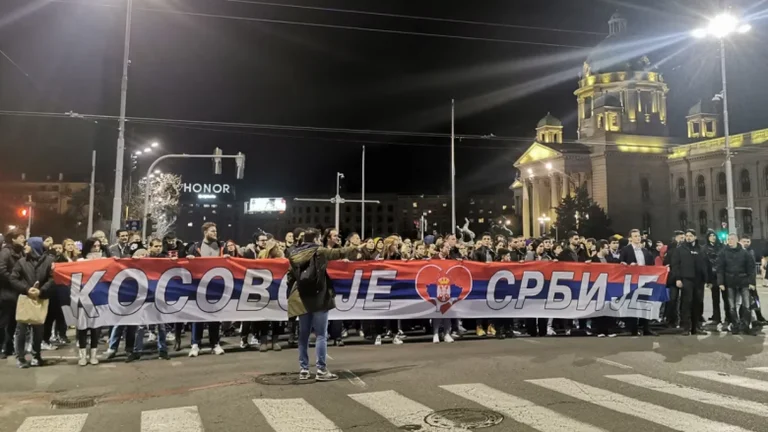
Dveri is part of the bloc of right-wing options in Serbia's Parliament, the Nada (Spressa) coalition and Zavetnici (Swearing) dealt with a protest in Belgrade for 17 March.
The main requirement in this protest will be to reject the European proposal for Kosovo.
This proposal for resolving the long-standing conflict with Kosovo, whose independence Serbia refuses to recognise, was accepted in late February by Vuciq and Kurti.
The right forces protest has been warned to hold a day before the new meeting between the president of Serbia and Kosovo prime minister in Ohrid, North Macedonia.
What did Dvery's deputies tell Moscow?
On March 16th, as reported on the Dveri website, the deputies of this movement -- Ivan Kostic and Borko Pushkiq -- in a conversation with Russian Duma deputies, expressed the opinion that the European proposal is “devastating to Serbia”.
The Dveri movement's statement also says that their deputies in Moscow have estimated that Russia undoubtedly cares more about Serbia's interests than Serbian authorities.
Russia is among the countries that do not recognise Kosovo's independence, as well as blocking the country's membership in international organisations.
That is one of the reasons authorities in Serbia imposed no sanctions on Russia, following the invasion of Ukraine.
To the REL question of whether they have Russian support for the protests that are organising in Serbia, Dvery has not returned answers to publishing this text.
The two deputies of the Dveri movement also met with Russian Foreign Minister Sergei Lavrov at the founding convention on March 14th. International Russian Movement.
The convention participants have also received a message from Russian President Vladimir Putin.
“We highly appreciate your strong determination to oppose the Russian campaign and develop mutually useful dialogue and cultural co-operation”, Putin said.
The international Russian movement has been warned as a rally of friends of Russia and those who love its history and culture, against the hard anti-Russian <x0fust of the West”.
The movement was formed at the time Russia finds itself in international isolation due to its aggression against neighbouring Ukraine and is facing war crimes charges in that country.
Zavetnici urged Russia's involvement in Kosovo talks
Dvery is not the only right-wing parliamentary option, which in Moscow sees co- talkers about its policy towards Kosovo.
In February 2022, in Moscow, Zavetnic (Religional) head Milica Djurdjevic Stamkovski, the deputies of Russian Duma and representatives of the Ministry of Foreign Affairs presented the proposal for Russia to join negotiations between Kosovo and Serbia.
The media reported she was in Moscow just before Russian aggression against Ukraine, as a candidate in the presidential election in Serbia.
In those elections held in April 2022, Aleksandar Vuciq won the second presidential term.
A Zavetnic delegation stayed in Moscow even in December 2022.
REL has contacted Milica Djurdjevic ) Stamkovski, leader of the Zavetnic party, with the question of whether they have Russia's support for protests against the European proposal for Kosovo.
Of course, if Putin cannot come to the gathering, he will delegate Lavrov to speak for him”, she replied through a telephone message.
She did not respond to the request to determine whether this means they have Russia's support for the protests.
Beshiri: Moscow Convenes Quo status in relations between Serbia, Kosovo
Naim Leo Beshiri, director of the non-governmental Institute for European Affairs in Belgrade, told Radio Free Europe that Moscow wants to have a destabilising factor in the region.
“Moscow is convinced that if it would lose the Kosovo issue, and then the issue of Republika Srpska, [the freedom of Serbs in Bosnia and Herzegovina, Milorad] Dodik and Bosnia and Herzegovina would completely lose any influence in the Balkans”, Beshiri said.
He added that this would completely isolate Russia, following aggression against Ukraine.