The doctor for the 27-year-old knife attack in Prizren: We couldn't save him. He had chest injuries.
 2 minutes ago
 (4 years ago)
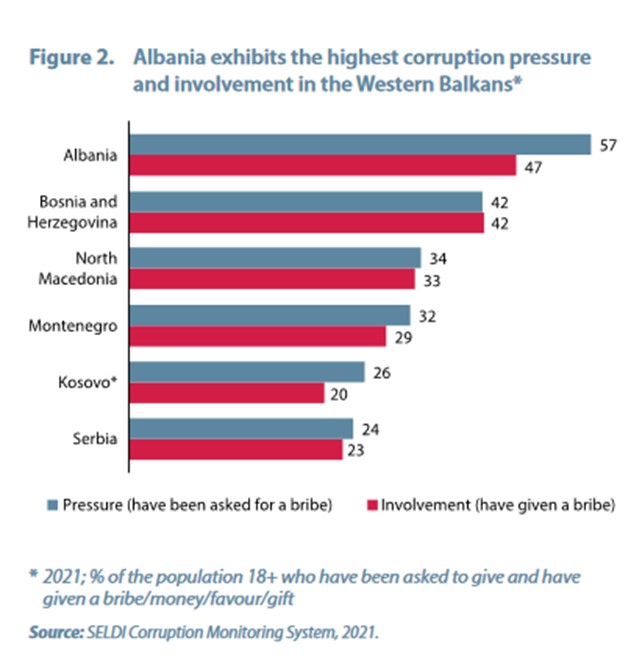
56% of Albanian respondents claim they have been asked a bribe, and 47% admit they have given it. Both figures are the highest in the region, according to the latest report “Monitorisation of the corruption system 2021x1>, published by SELDI, the Southeast European Leadership for Development and Integration. According to the report, Albania [...]
Both figures are the highest in the region, according to the latest report “Monitorisation of the corruption system 2021x1>, published by SELDI, the Southeast European Leadership for Development and Integration.
According to the report, Albania has the highest pressure and involvement in corruption in the Western Balkans for the entire indicator, such as bribery research, giving it in, consolidating corruption, falling prey to it and until the seizure of state by businesses.
“Albania appears to be the country most affected by the highest administrative corruption in the region with 57% of citizens required bribes at least occasionally, and 47% actually participate in corruption transactions”, the report said.
Serbia remains the country with the lowest rate of corruption pressure in the region, while Kosovo has lower rates of current involvement in corruption activities by 20% of citizens who have paid bribes in at least some cases compared to 23% in Serbia.
According to the report, direct involvement in corruption transactions is accompanied by the prevalence of specific attitudes towards corruption and corrupt behaviour and the perception that corruption is widespread in society.
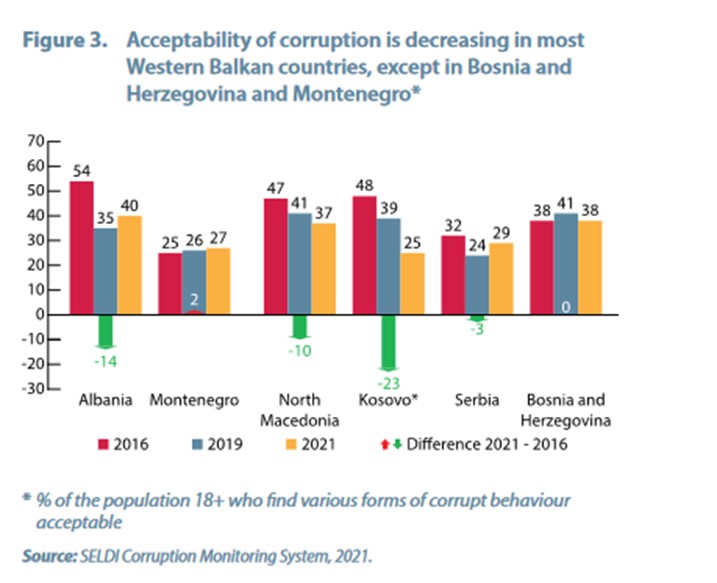
Another indicator, that of corruption vulnerability reflects the citizens' belief that some corrupt practices by public officials are normal and can be tolerated.
In 2021, compliance is the highest in Albania (40%), Bosnia and Herzegovina (3.8%) and Northern Macedonia (37%), but also the lowest results (Kosovo 58 25% and Montenegro 27%) remain very high.
However, the continuing decline of vulnerability in all countries except for BiH and Montenegro since 2016 shows increased sustainability of corruption among citizens, the report stresses.
Businesses in Albania Catch the State More
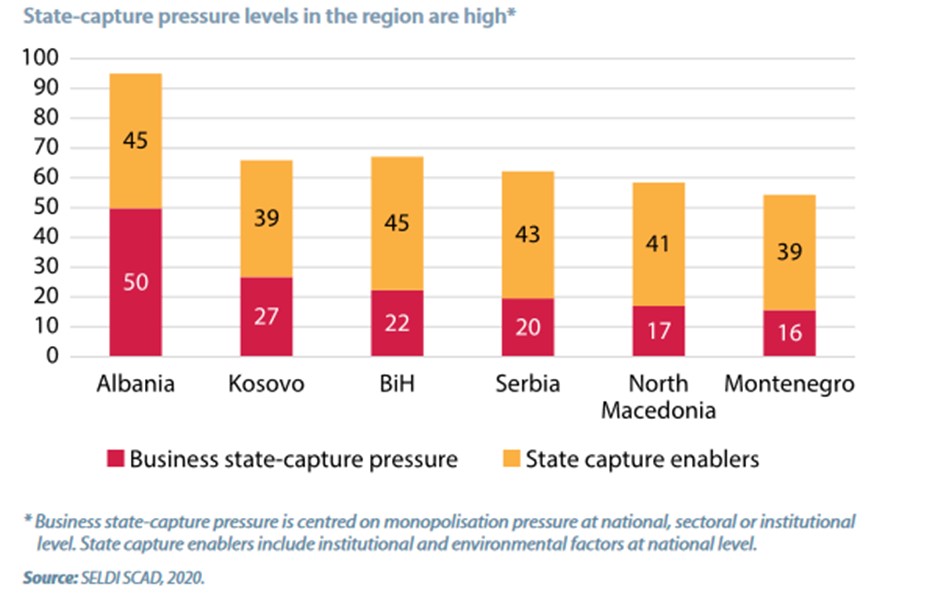
Even the capture of the state is prevalent in the Western Balkans, where Albania still holds the record, as a country where private interests significantly influence the decision-making processes of a state in their advantage.
Index of Pressure for Grip of State by Business, which focuses on the pressure of monopoly on national, sectoral or institutional level, Albania has 45, the highest in the region, along with Bosnia and Herzegovina. And for the other indicator, State capture wrestlers, which includes institutional and environmental factors at the national level, amounts to 50, almost twice as high as the second place behind us as Kosovo.
The capture of the state in the region is a mechanism through which the drafting, adoption and implementation of government regulations and regulations in some important areas of government functioning is distorted in favour of a small number of beneficiaries at the expense of society and business in general.
The report expresses concern that although the capture of the state is high, none of the anticorruption strategies approved by the countries of the region can mention it. It's mostly civil society, and occasionally foreign partners, who call it a major concern. The European Commission, which raised it as an issue several years ago, now appears to be avoiding this problem.
Earlier, EC progress reports for countries in the region stressed that they had found the “clear state capture elements, while recent publications mention only a few, which could be a reflection of geopolitical priorities to accelerate enlargement in the face of threats from Russia and China.
The fact that the capture of the state is missing on the anticorruption agenda shows that <x0mass” that make up that agenda are mainly administrative issues which cannot affect the deeper causes that hinder the progress and construction of democratic sustainability, the report stresses. /Monitor. al
10 minutes ago14 minutes ago
 3 hours ago