3 minutes ago
The Balkan jihadists' disappointment with I Kalifatin's SISU

Periskopi(9 years ago)
(9 years ago)Hilmiu, an ethnic Bosniak, went to Syria hoping that life at the Islamic state Califat would be an ideal religious environment, but he managed to escape 16 months later, disappointed with what he had found there. There was nothing there. No electricity, no books, no Internet, nothing,” said Hilmiu [...]
Hilmiu, an ethnic Bosniak, went to Syria hoping that life at the Islamic state Califat would be an ideal religious environment, but he managed to escape 16 months later, disappointed with what he had found there.
There was nothing there. No electricity, no books, no Internet, nothing.
I had about 400 euros in savings, which was quickly spent on food. Then I started getting about $50 a month after reporting that I was sick. My wife helped other elderly women, so she sometimes received a payment. I was going crazy, and all the time I thought about how to save my family and get out of there, he's coming back to mind.
“Look,” he went on, opening his laptop and showing a video.
There's no nature, there's no bar. Everything was dead, abandoned. Look at the weak sheep! The only thing we could do was run around a bit,” said, before showing photos of his family and friends, some of whom never managed to return from Syria.
Hilmiu, who has Bosnian and Montenegrin citizenship, is just one of 250 people who returned to the Balkans after spending time in war zones in Syria and Iraq some, like him, because they were disappointed by the ISIS.
Although many of them refuse to go to war, the Balkan states treat them all as terrorists after a series of laws were passed in 2015 and criminalised any kind of involvement in foreign conflicts.
But even though many of them were tried after returning, some have joined campaigns that convey messages against it in an effort to convince other Muslims not to make the same mistakes that led them to the battlefields in the Middle East.
Life on Caliphy
Hilmiu has been a Muslim throughout his life, and when he heard that the Islamic State had created a potassium, he was eager to go and find out if he was really guided according to the principles of maturity.
His destination was a province of Alepos, where his friend from Podgorica, capital of Montenegro, already lived. His friend guaranteed that there was nothing missing, that the fighting was too far away and that he and his family could stay there as his guests.
My plan was to go, check and then return, sell the house, and go to Syria forever,” recalls Hilmiu.
But when he arrived in February 2015, he got bad news. His friend died on the battlefield near Kobaan.
As the battles over Cobani grew in intensity, the Islamic State declared the state of emergency, took passports from all newcomers and informed them that they could not return because the perfect “society has already arrived”.
With the help of a Bosniak who lived there, who made bail for Hilmi, they moved into a house of refugees from Cobani. After several months, they acquired a destroyed property on the outskirts of a town near the Turkish border, where they lived for more than a year.
In Syria, Himmliu said he met many other people from the Balkans.
Many of our people, mainly Bosniaks, arrived, but there were also from Serbia and Montenegro. They were different. Some were believers and were good, but there were also criminals trying to escape the law. Some of them filmed each other, pointing guns at their hands,” remembers Himliu.
He said the situation changed quickly when the shelling by Bashar al-Assad's regime and its Russian supporters grew. The city was no longer known, roads were empty, buildings were destroyed, and many people died.
We were hopeless. We just went down the stairs, embraced our children, and prayed for God to save us,” he remembers.
After he was disappointed by the Islamic State California and denied the return of his passport, he was seeking an opportunity to escape and once even reached the border with Turkey, but was not allowed to pass through Turkish border forces.
He later met a Syrian who offered to help him escape to Turkey for 1,500 dollars.
I called my family home and told them to sell everything that was left at home and send me the money,” he said.
His way out of territory controlled by I SIS involved crossing into mined fields and fences with wires at the border. He managed to survive thanks to his local guide.
However, when he entered Turkey, he was arrested and spent two and a half months in custody as a refugee.
I moved from one prison to another and had only one opinion. What had I done to my child?
Turkish authorities offered to release him, but he had to return to his country or go to another country that was willing to accept it. But Hilmiu decided to return to the Balkans, where he was arrested shortly after arriving for activities related to terrorism.
Mercenaries kill for I SIS
Unlike Hilmiu, who went to Syria to practice his religion and live on a model potassium, many fighters from the Balkans went there for money.
With experience gained during the wars of the 1990s, they proved to be a valuable asset to militant Islamic forces in the Middle East.
Make sure they talk to other people about God and Hourin (the virgins believed to be provided to martyrs in Paradise). I know God would never tell me to kill another man in His name,” told me about noble BIRN, a Macedonian-born warrior.
I don't want to lie. I care about money. I was in wars in the former Yugoslavia, I participated in armed robbery, I was in prison,” he explained.
The noble man investigated in Serbia, Montenegro, Turkey and Germany, which helped him connect with jihadists.
Unidentified Armed Persons in Syria, published by terrorist propaganda I SIS.
“People across the mosques in Europe are easily connected to each other and they know what contribution you can make,” he said.
The Gent initially joined Al Nussra in the summer of 2014 with friends from the Balkans and Caucasus who originally lived in Germany and Austria.
He says he was promised 2,000 dollars a month, plus the opportunity to commit additional robbery on the battlefield.
Assad's “Army had bad morals and low motivation. We succeeded in Alepo and people started talking about us,” he remembers.
The brutality he witnessed in Syria was far more extreme than what he saw during the Balkan wars.
Look at how, after the battle, they cut off the heads of captured soldiers. At first, it was terrible, since I had not seen this in Yugoslavia. Then you get used to it, he said.
After two months, the local noble commander announced it and its unit was joining the Islamic State.
I didn't care who I fought for, as long as he paid us,” he said.
New mercenaries, including Christians, arrived for money and adrenaline. After the battle, people continued to rob, plunder, arrest people under suspicion of being spies, alcoholics, and so on. This was often an excuse to torture, rape, and burn,” he continued.
According to the Gent, the largest amount of money he won was when he transported some cultural objects to the Turkish border.
It was about statues and other things that those guys broke in front of the cameras, he said.
After almost three months of fighting under the Islamic state flag, the noble commander disappeared. It was not clear whether he was killed or not and his young bosses then demanded that he kill civilians, which he said was prepared to do.
I went for money, not to massacre innocents,” he insisted.
The Gentman said the price he was asked to pay to allow him to leave was for him and four other warriors to kill five “spiun”, including two women.
The alternative was for them to kill us in the square,” he said.
Former fighter fights extremism
Disillusionment with the Islamic State prompted Albert Berisha to create an NGO after he returned from the conflict zone in Syria to help other former fighters return to society and remove extremist ideology that led them to fight in a foreign war.
The state has never realised that our intentions were not to become terrorists,” Berisha told BIRN, referring to 300 or more Kosovars believed to have fought in the Middle East in recent years.
Each had his own history and purposes. But the only important thing for those who have returned is that their return means they were disappointed by what they saw,” he said.
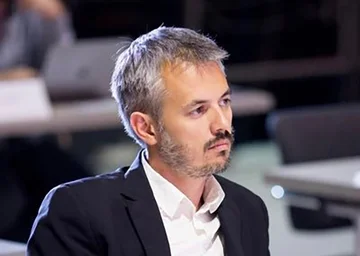
Albert Berisha created an OJF to help those who returned from Syria
Berisha is a typical jihadist. He graduated for political science at Pristina University and has master degree from the University of Tirana.
Berisha said he went to Syria from 6 October to 20 October 2013 to help the Syrian opposition in their fight against Bashar Al-Assad's regime, but never committed themselves to fighting.
He said the reason he went was that he found no meaning in Kosovo society and wanted to help his Muslim brothers in their fight against a dictator.
After arriving in Syria, he sought to join other Albanian-speaking groups “to avoid linguistic barriers” and was taken to meet Lavdrim Mujarri, commander of Albanian Islamic State fighters.
I swear to God that I had never heard of him before and that I had never met before,” said Berisha at his trial in Pristina after returning.
He claimed to do Internet research during two hours of electricity per day, trying to understand where he had ended up and found a mujaer video.
Because that leaving I The SIS proved to be almost impossible, he used his Facebook to contact a friend in Kosovo and regulate an evacuation plan.
He then sent me a message saying that a relative of mine was sick and that I should return home, which I used as an excuse to return to Kosovo,” he said in court.
The first-instance court in Kosovo sentenced him to three and a half years in prison for terrorism. His case is currently at the appeals court, and he is awaiting his decision in freedom.
The most difficult things for me were social prejudice, continuing doubts and constant pressures from all state institutions. Their tendency to meet their political or institutional agendas through us,” said Berisha.
The hardest time yet was when I was released from custody. Then, we (returned jihadists) had become public faces in Kosovo, and people began to stigmatize us even more,” he added.
It's very difficult for people found between the two fires, when you don't know where you belong anymore, he said.
His NGO, called I NSTID, aims to fight religious extremism in Kosovo and doordialise people who have returned from conflict zones in the Middle East.
The fact that most of them were victims, I thought further victimisation was not a solution and threatened to radicalise them even more, he explained.
“So I decided to freeze an institution that will exclusively handle this so that people can become useful again in society and not be stripped of freedom, which creates the potential for an even greater radicalisation and even radicalising others in prison,” he said. /
Die Morina and Labino Leposhica contributed to this article. The article has been published as part of the Resonant Voices Initiative and has been carried out in co-operation with the Centre for Investigative Journalism in Montenegro.
Share