7 minutes ago
Letter written by a Srebrenica child in 1994 will deeply touch your heart

Periskopi(9 years ago)
(9 years ago)I want peace, I want to live. These are the words of a child”, written in one of the letters, most likely one of the Srebrenica children in 1994. The letter contains a drawn hand and the name Hasan Hasanovic, while writing: “
I want peace, I want to live. These are the words of a child”, written in one of the letters, most likely one of the Srebrenica children in 1994. The letter contains a drawn hand and the name Hasan Hasanovic, while writing: “
This, as well as some other letters, but also the 1995 Srebrenica and Potocari video regimes from Anadolu Agency (AA), showed Osman Avdic, one of the survivors of the genocide in Srebrenica. This is the first time these letters and records are presented publicly.
Avdic took them from a Dutch soldier who was at the time engaged in duty in Potocari. Letters and shoots have been given to Srebrenica residents who have thus tried to communicate with their relatives in other parts of the world.
They have been trying to convey events at Srebrenica and Potocari, but also to say they are good and that one day will be seen by God's permission. It is not known, however, whether the authors of the letters, which never went to the desired address, are of the few who survived the Srebrenica genocide in July 1995.
Srebrenicas had not lost hope
Osman Avdic was born in Milic, while his family came to the Srebrenica enclave in 1993. A year later he lost his father, and the seven children were left alone with their mother. They have lived near the base of the Dutch soldiers. They have associated with them, they have learned English, but they have also exchanged things for food. After all the events, he's stuck in touch with some of them.
I was in Holland in January this year. I went to meet with a former soldier we met in 1994 in Srebrenica. When we first contacted, he told me there are some videos and letters from that period.
When he returned to Holland, he couldn't find the families he had to deliver the letters through which they would learn they have relatives alive”, confesss Avdic for AA, as he reads a letter to Hasan Hasanovic, where it says that “We are good at Srebrenica, at the place that's the end of the world for Muslims”
The letters were written on July 10th, 1994, specifically one year before the fall of Srebrenica and the genocide that would begin in that region.
These are shoots from the Srebrenica war, people's life in the war years. The letters in which people write about separation from their families, describing the situation in this city... In a letter, a man describes a small child, how he wants to play with him, enjoy himself, work and associate”, Avdic said.
The letters were then counted as a reliable means of communication with those who were not in Srebrenica at the time. One way to send them to the destination address were Dutch soldiers who were then part of the UN safe zone, which was declared in 1993.
The money, cards and videos, according to Avdic, has been sent to the Netherlands, where relatives of the Srebrenicas had to be sent to Germany, Britain and other countries in which they lived.
With as much as I can understand, some things have managed to send to the right addresses, however, some have not. Many of the people living there have sought to contact their relatives and send them things. Maybe that might have seemed difficult, boring, or perhaps not understood the” situation, said Avdic, who kept four letters about two families living near the Potocari base.
As Avdic says, when reading some of the letters, he notes that these people in 1994 at Srebrenica, however, have not lost hope.
Dutch soldier's letters and shoots have preserved them for two decades
“They wrote: One day, when we meet, we'll do different things. I hope this situation goes through this city with a lot of people with little space and one day that happens and people be happy”, Avdic relates.
For more than 20 years, this Dutch soldier, whose name remains anonymous, has been held by him.
He says he wanted to save them because maybe one day they'll get to the destined persons, so that they can remain a good memory, because maybe the people who appear in these footage are no longer alive”, showing Avdic, adding that letters and shoots will remain on him, until people who are part of letters or shootings or any museum who want to pose these Srebrenica memories from the 1990s, these difficult years for this region.
Thousands of Srebrenicas, including women and children, set off in July 1995 at <x0). Many were killed in the forests around Srebrenica, but there were also those who reached Nezuk's free territory.
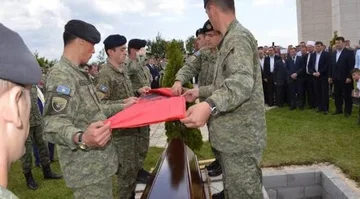
At the Postochari Memorial Centre on 11 July, the Bulgarian Prayer and the burial of dozens of remains of victims of recently identified genocide, which in July 1995 were killed by police and the Republika Srpska Army and paramilitary formations by Republika Srpska and Serbia in the UN-protected “ ”.