Without political agreement, neither Constitution solves the crisis in the Assembly
 (a year ago)
Kosovo's Constitutional Court is priorityly considering the requirement for assessing the constitutionality of changing the way of voting for electing the Speaker of the Parliament during the constitutional procedure. However, this highest judicial body in the country has not indicated when it is expected to come up with a plea to the case, although it has passed [...]
Kosovo's Constitutional Court is priorityly considering the requirement for assessing the constitutionality of changing the way of voting for electing the Speaker of the Parliament during the constitutional procedure. However, this highest judicial body in the country has not indicated that when it is expected to come up with an act on the case, although more than a month has passed since Alliance for the Future of Kosovo MP Time Kadrijaj, backed by several other MPs, has submitted the application to this institution.
Despite the Constitutional decision on this case, connoisseurs of political issues are sceptical that it will be able to resolve the current political crisis in the country.
A day before the continuation of the constitutional hearing for the 36th time stresses the need for reaching a political agreement on selecting the constitution's organs and forming the new government after the February 9th parliamentary elections.
In this direction, as another option, is seen as the possibility of presuming a request to the Constitutional Court on the part of Kosovo President Vjosa Osmani, to clearly clarify whether the first party in the election can consume the right to propose the candidate for Parliament's chairman, even if there are not sufficient numbers in the Parliament.
Also read the special Roma Ministerate in Prizren Constitutional Court General Veton Dula, in a written response to Kosova Preress, has said the decision will be taken after all aspects of the constitutional aspects of the issue filed by ten MPs, who submitted the application on 12 May.
This request is being considered with priority from the Court. The decision will be made after the Court reviews all constitutional aspects of the case put forward in its request and its decision-making will be announced over time all interest and opinion parties --” said Dula.
Meanwhile, political science professor, Dritare Arifi, estimates that the demand for interpretation of the secret vote will not bring any substantial solution to the political stalemate.
According to him, the problem lies not only with voting procedures but with the lack of a political agreement that would enable normal functioning of institutions.
The request that was made is not that it has solved many problems. Request is specific ) whether or not it can be made. Even if the Constitution decides that the vote is not in harmony with the Assembly procedure, we go back to zero and there is no solution. The solution would be if the first one could hold hostage for a name whenever he wants to be voted in. If the first one doesn't solve the problem, what can be done? There are some elements that are not only solved with the question of secret voting. I don't expect there to be any other choice. If there is no political agreement, any decision the Constitutional Court makes will not solve the political problem,” he declared.
Arifi calls for President Osmani to present questions to the Constitutional Court how many times the winning party has the right to propose the name for Speaker of the Parliament, in case the same fails to get the 61 votes needed.
Arifi: The president has been delayed with the question in Constitutional.
The president has been delayed with the question at the Constitutional Court, as this has nothing to do with the secret vote, but with the procedure for the first to have a limit. There's no sense of law without restrictions. We cannot go indefinitely from the first one, if others disagree, to maintain that position forever. This is logical, not functional and not pragmatic,” added Arifi.
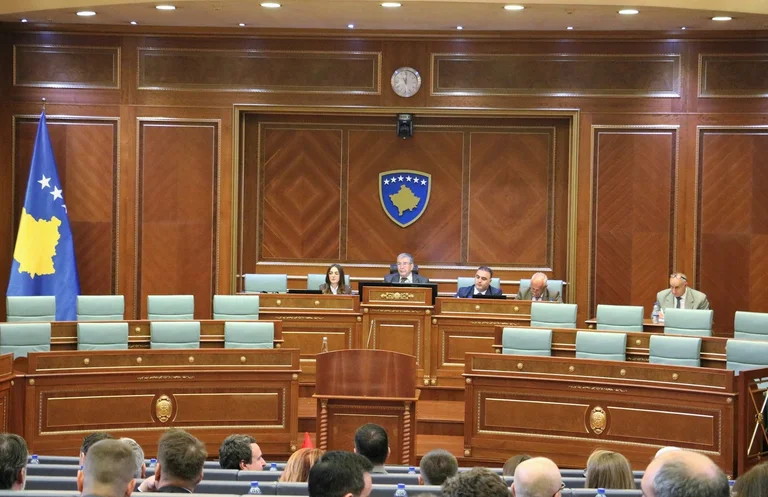
The Assembly, five months after the elections, has not been constitutionalised. The Vetevendosje Movement, like the first party in the election, has failed to secure the 61 votes needed to elect Albulen Haxhiun to head of the Parliament.
As of 1 May, the Vetevendosje Movement insists that its candidate for speaker of the Parliament's vote, Albulen Haxhiu, should take place by secret vote, as the same has failed to be elected to this position by a six-time vote./Periscopi/