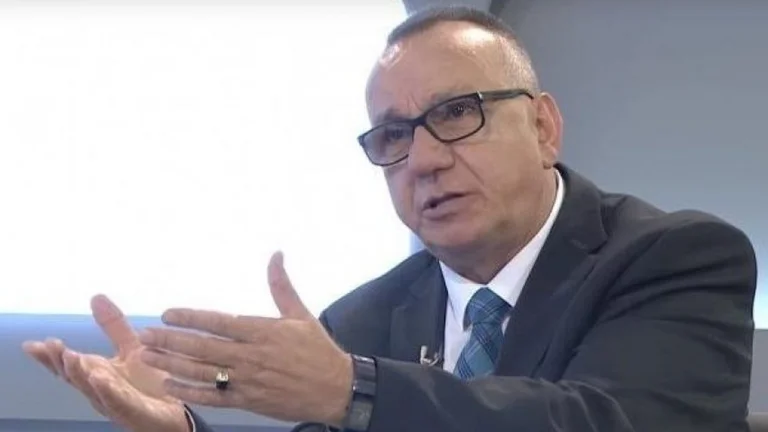
Enver Hasani: The Constitution can change the circumstances, the president has no role, and has not maintained his position as a figure on parties
 (a year ago)
Not even three months after the election has reached the assembly. This is due to VVA's insistence on Albulen Haxhiun as chief parliament and the opposition's refusal to support this proposal. Former Constitutional Court Chairman Enver Hasani, in an interview for Gazeta Express, has described the political immatureness created in the Assembly. [...]
Former Constitutional Court Chairman Enver Hasani in an interview Journal Express He's named it political immature created in the Parliament.
Hasani has said the main reason for blocking the constitution of nine “connected with the implementation of Serbian political-territorial autonomy on Kosovo territory”, which he says “was freely accepted by Prime Minister Albin Kurti in Ohrid”.
As for the launch of consultations by Osmani with political leaders, Hasani has said that the president's role is not related to the process of establishing institutions, but to ensuring and caring for their normal functioning, within the constitutional and legal framework, following the constitution.
He has added that there are legal grounds that the AAK, with the support of the LDK's PDK, sent to the Constitutional for the matter of secret voting.
Total interview:
As far as the country failed, the 15th attempt to consolidate this institution is the impression that elected representatives have drawn a conclusion that we don't have much to rush “. What conclusions have you drawn from this situation when you see them making those chosen to represent citizens?
Enver Hasani : This situation, indeed, makes us all feel very bad and, in a sense, ashamed, because it is creating on completely absurd reasoning. If this logic were followed as consistently followed by certain political forces in Kosovo then any constitutional standards and principles, as well as any act of Constitutional Court, would be misinterpreted in order to evade them, creating endless institutional cramps. This is a political immature.
With a gesture of compromise on either side, this situation could be overcome. Is the current situation the product of major hostilities, international interference or normal party tact?
Enver Hasani : As I said a few months ago, during another interview with you, the main reason for procrastination and institutional stalemate relates to the implementation of Serbian political-territorial autonomy on Kosovo territory, which was freely accepted by Prime Minister Albin Kurti in Ohrid in the spring of 2023. All other issues are simply reasons and excuses to avoid this Kosovo international obligation.
Even the hostilities created during the campaign before and after it, which still continue with the same intensity from current government exhibitors, are in the works of preventing the implementation of this international obligation, taken by former government Kurti II. As a result, present tact is in the service of that purpose and purpose.
International intervention, like once, is now lacking and rightly so. Our long-standing international friends have given up support in the process of building Kosovo institutions and other issues, due to the insults, contempt, and constant humiliations they have been given, often with brutality and an unforgiving primitive by the exhibits of two governments led by Mr. Albin Kurti and by Mr. Kurti himself.
From the presidency, they have said Osmani will launch a series of consultations on May 15th and that invitations to the first meetings have been submitted. So far The PDK, the AAK's LDK have responded positively. Do you think there'll be something for the President?
Enver Hasani : As I noted earlier, the role of the president of the Republic of Kosovo, according to the Constitution, is not at all related to the process of establishing institutions, but to ensuring and caring for their normal functioning, within the constitutional and legal framework, after the constitution. In this regard, all involvement is unreasonable and without need. Such a role of the head of state is found, without exception, in all the constitutions of European countries that implement the parliamentary system of governance.
Politically, meanwhile, the influence of Mrs. Vjosa Osmani, as the current president of the Republic of Kosovo, is zero and this is quite right: during its mandate, Mrs. Osmani has failed to maintain its constitutional position as a figure on political parties and beyond the daily political clash.
The AAK, with the help of the LDK PDK yesterday, has been addressed to the Constitutional Court on the matter of secret voting. Is there a legal basis for this?
Enver HasaniOf course there is a basis. I have the impression that lawyers close to current power have created the illusion that there is no constitutional basis for addressing the seat at the Constitutional Court, with the argument that there is no formal decision of the Kosovo Assembly. This is a serious mistake because it justifys a constitutional and judicial anarchy in the country's parliamentary and institutional life.
I strongly believe, without hesitation, that there is a solid constitutional basis for unlocking the current situation. This is also the constitutional duty of the Constitutional Court of the Republic of Kosovo, especially when there is a formal requirement for its intervention, and when the political will to get out is clear. The court has the constitutional mandate and the human and intellectual capacities to clarify the constitutional ways that must be followed for the constitutional framework in light of facts created by institutional stalemate.
Let me explain that this mess is naturally different from that of 2014 and the act of the day. The actual situation then was contrary to this today: then, the opposition had taken over institutional control as it is today. Avni Dehari, but in the opposite direction, preventing the formation of the legislature issued by the February 9th elections. At that time, the opposition elected a Parliament chairman unconstitutionally, while today the opposition expresses clear political will to elect anyone other than Mrs. Albulen Haxhiu.
As a result, in 2014, the Constitutional Court had no way of predicting what could happen in 2025 - much less so about mortgage situations in the future. In that sense, Mr. Dehar is an abuse of power, usurping the function of Kosovo's Parliament Speaker, as well as misusing that act of justice in 2014, similar to what did a part of today's opposition and the Vetevendosje Movement at the time, when they said: “there is no need to teach us how to vote! ”
In contrast: This situation proves that the Constitutional Court was right both then and today. Criticism to that act comes from people who have no basic knowledge of constitutional issues and, unfortunately, are the same persons who acted the same way then and today.
What decision do you think the Constitution can make regarding the party's request?
Enver Hasani I can't say or speculate because that's none of my business. What I do know for certain is that the Constitutional Court will exercise its constitutional mandate within the defined judicial-unconstitutional framework, based on the demands and countertakes of the parties.
Do you think the Constitution can change the circumstances we're in and unlock the stalemate created in the Parliament?
Enver Hasani : Of course it is, because it is within its constitutional mandate. In what direction will that constitutional framework shape, in which the parties will then be forced to act and act, I cannot say that.