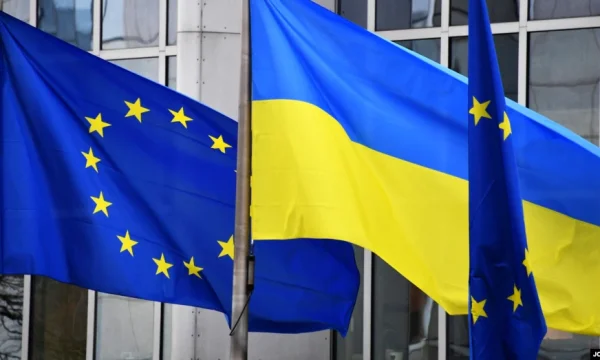

Croatia's prime minister, Andrej Plenkovic, said the European Union needs a more ambitious budget in the future in order to realise its political goals. Meanwhile, in terms of the impact the bloc will have on the EU budget, Plenkovic said that “the accession of countries in the Western Balkan region will not be a huge financial burden to the EU, but Ukraine's accession will be different”.
Pllenkovic said that given the fact that Ukraine has a huge territory, it has a huge dependence on agriculture, while it is a country that is currently facing Russian aggression. Therefore, according to him, for Ukraine, the EU membership process should follow a particular path where financial aspect would be considered.
All countries of the Western Balkan region together have fewer residents than Ukraine.
On Monday, April 29th, the first conference dedicated to the EU's budget strategy was held in Brussels.
Other European bloc officials said Ukraine's integration would have a visible impact on EU budgetary flows.
The biggest impact will be specifically on agriculture policy and on regional cohesion and development, where much of the European Union's budget goes. The cohesion policy aims for countries which are less developed to receive more financial means from the EU to reduce differences with the more developed members. This makes the bloc's more developed countries a net insolvency in the budget, while less developed as net users.
Earlier, the Bruegel Institute had estimated that in a seven-year period, Ukraine's EU membership, under current rules, would cost around 132 billion euros, without counting the costs needed for the reconstruction of Ukraine due to the war.
During the conference in Brussels, it said the EU should also consider accepting new countries during drafting the multi-year framework for the period after 2017, when the current budgetary framework expires.
The EU usually approves a financial framework for a period of seven years, and under it, budgets are approved one year.
The current multi-year financial framework is set for the period from 2021 to 2027, and according to it, the EU's annual budget could total around 170 billion euros. But, already in the EU, preparations have started for the new framework for the period 2028-34.
After the European Union estimates that enlargement will happen by that period, accepting new members, this should be predicted in the budget framework. The first proposal for this is expected to be among the first tasks of the new European Commission to start working at the end of this year. And in 2025 it should propose the first draft of the EU's multi-year financial framework to then start negotiations with the European Parliament even among member states to reach compromise.
Several EU commissionors, representatives of the Belgian EU presidency, have attended the conference in Brussels, but also leaders of several member states.
EU budget commissioner Johannes Hahn said the EU for the future needs a budget that will be in line with the bloc's ambitions for a stronger, more competitive and secure EU.
Ten states are in the EU enlargement process. Of them nine have candidate country status, while only Kosovo does not have that status. Besides six Western Balkan countries (Albania, Bosnia and Herzegovina, Northern Macedonia, Mount Yi, Serbia and Kosovo) in the process are Ukraine, Moldova and Georgia. Turkey continues to have formally candidate country status, but its negotiations for EU membership have been frozen for years now. /rel