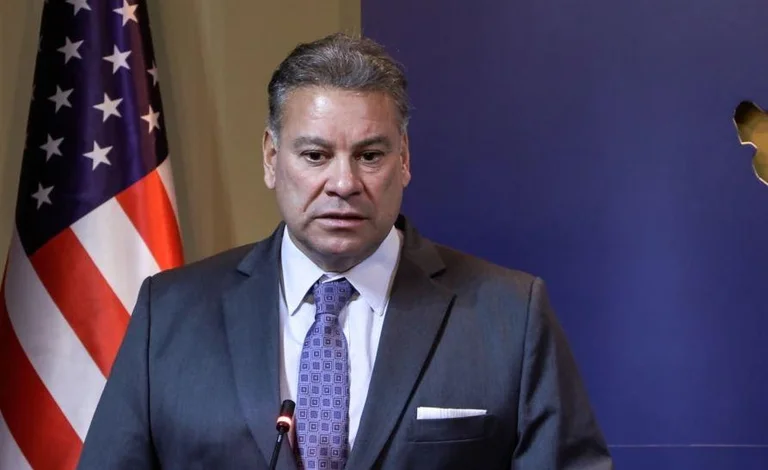
Escobar: Resigning mayors in northern Kosovo municipalities would be the fastest, easiest way
 (3 years ago)
On the eve of the meeting between Kosovo Prime Minister Albin Kurti and Serbia's president, Aleksandar Vucic, the US envoy for the Balkans, Gabriel Escobar, told Voice of America on Tuesday that he expects the parties to take their obligations seriously, emerging from the comprehensive agreement on normalising relations between the two countries, and start [...]
On the eve of the meeting between Kosovo Prime Minister Albin Kurti and Serbia's president, Aleksandar Vucic, the US envoy for the Balkans, Gabriel Escobar, told Voice of America on Tuesday that he expects from the parties to take their obligations seriously, released by the comprehensive agreement on normalising relations between the two countries, and to begin meeting them to mark progress in its implementation.
The meeting between the two leaders will be held Thursday in Brussels, with the European Union's mediation, after months of tension and escalation in Kosovo.
US Deputy Assistant Secretary of State Gabriel Escobar says the UN “states continue to strongly support dialogue facilitated by the European Union as a way to achieve a peaceful and fruitful relationship between the two countries”.
We would like to ask the parties to take their obligations seriously from this agreement and start to progress with the fulfillment of existing and previous obligations from dialogue and agreement and start to mark progress this year”, he says.
Voice of America: Initially, there was little hope that Kosovo and Serbia would approach some sort of consensus. We are already awaiting the meeting between Prime Minister Kurti and President Vucic, under even more difficult circumstances. Kosovo is facing Western measures because it is blamed for the situation in the north and Serbia continues to undermine Pristina. What is expected to happen next?
Gabriel Escobar: The agreement the parties agreed on was of a vast and very historical spectrum. It is really normalised agreements with European conditions, but it is also a guide to the way the two countries can harmonise their integration into European structures.
The agreement offers great potential for both countries' progress and for their strategic goals for European integration. Since the agreement has been signed, we have seen a series of escalations and useless activities and actions that have hampered progress.
Now we have to overcome all the challenges that have been created since March. And I believe we can. We hope that through the handling of obligations and requirements that have not yet been implemented by the Ohrid Agreement, we will be able to resolve all issues, from elections to car plates and IDs, and other issues that became sources of escalation. It's very important that we solve a lot of things.
Voice of America: You're talking about the stress process, a word that's been used for the past few months. Can you explain more about what parties must apply in order to do so?
Gabriel Escobar: Let me tell you what escalation is. On the one hand, we applied to the Kosovo government.
We understood the need for special elections following the resignation of mayors. We understood and recognised the election results, although the election appearance was extremely low since there was no mandatory vote and elections were free and fair, people were invited to participate, vote.
However, we agree, we all agree, including the Kosovo government, that participating 3 per cent in elections is not a long-term solution to managing these municipalities. But we also agree with taking office from mayors.
And we made sure that the mayors would not take controversial measures, that they would be on duty simply to manage daily duties in municipalities. And despite this promise and despite our support of Kosovo and its system, without co-ordinating with the international community, they decided to take some of these municipal buildings. As I said in the past, the U.S. government, when the situation requires it, has abandoned buildings because of storms, fires, floods, COVID, even protests.
This does not undermine the credibility or legitimacy of the American government. We have told the Kosovo government that there has been no need to escalate tensions by placing mayors in those buildings. That was one part. As for the Serbian side, we were deeply concerned about the fact that although 90 percent of the protesters were peaceful, there were some who were very violent and had come prepared to hurt police and KFOR during the protests.
Some journalists, independent journalists, were also hurt. That was part of the escalation.
Meanwhile, what concerns us in Kosovo is the continuing lack of co-ordination between the two sides for the road forward, including the exploitation of special police units for expropriation and expulsion of several Serbian institutions from government buildings.
All must be resolved within the dialogue, and we are calling on the two sides to make sure that all issues are co-ordinated with the international community.
Voice of America: In your call with Prime Minister Kurti, you seem to have taken some sort of commitment from him to implementing its agreement and annexes and that he has pledged participation in the “negotia active.” Did you make a similar pledge by President Vucic this time, since he has not signed the Ohrid Agreement?
Gabriel Escobar: I didn't take a vow from Kurt.
Voice of America: But, he said last night that you had discussed the next meeting between him and President Vucic and that he had pledged to implement the agreement, according to Twitter post, and “active internationalities”.
Gabriel Escobar: We want concrete pledges to start implementation. And as far as Kosovo is concerned, this includes presenting the draft association for Serb majority municipalities. He did not vow to do so. He, in essence, vowed to go to Brussels and attend meetings, but nothing beyond that.
Voice of America: What will be the consequences if the parties fail to seize this opportunity?
Gabriel Escobar: We're already beginning to see the consequences. Although Kosovo calls the sanctions, they are not really sanctions ) measures the EU has decided, not to continue with some of the membership mechanisms, are very serious. Even for Serbia, it will be the same.
But for Kosovo, opportunities for new recognition, donor conferences, for strategic bilateral dialogue with the United States and for a close relationship with NATO. Unfortunately, if we don't score progress, we'll lose this chance this year.
It will be very similar for Serbia. The European Union would like to see clearer signs from Serbia that it is interested in implementing this normalisation agreement, while deciding on Serbia's progress on its path towards integration.
Voice of America: Critics say the West is pursuing a facilitating policy towards Serbia and that such a policy is wrong. Serbia has not yet joined the West in imposing sanctions on Russia. Is the West trying to lure Serbia into its orbit at the expense of its neighbours?
Gabriel Escobar: This subject is flowing. It's actually wrong. For Ohrid, we have recognised Kosovo's authority and Kosovo's right to hold elections. We have recognised the election outcome, despite voter turnout of 3 per cent. We recognized the authority of the mayors after taking office.
We welcomed the (membership) application to the Council of Europe and visa liberalisation. None of this is supported by Serbia. In fact, all are actively opposed by Serbia.
And above all, we imposed sanctions on Serbia's intelligence service chief. So I want to ask critics when we were in Serbia's favor. It's completely wrong. It's misinformation.
Voice of America: There are rumours saying Serbia can hold elections in the future, perhaps in March. How will the likelihood of a possible agreement between Kosovo and Serbia affect?
Gabriel Escobar: It would not be (to influence) because the agreement is not between Vucic and Kurti. The agreement is between Serbia and Kosovo, and those agreements remain in effect regardless of which leader is in power.
Voice of America: Do you trust that the current leaders will implement the agreement?
Gabriel Escobar: They reached the agreement and now it is a question of implementation. We need to see political will on both sides to implement their part of the agreement. It's not a matter of faith. It has to do with legal effects for people and governments.
Voice of America: Last week, Secretary General NATO, citing the 2013 agreement between Kosovo and NATO about sending the Kosovo Security Forces to the northern part of Kosovo, asked Kosovo President that every step, including the deployment of police, should be co-ordinated with NATO. Do you support such a change of approach? Are Kosovo authorities now expected to co-ordinate the deployment of Kosovo police in the north with the international community?
Gabriel Escobar: This is a request, which is really important. KFOR has part of the responsibility to ensure a safe environment within, as EULEX does. Hopefully the Kosovo government will consider international community, and in particular NATO, as an important partner to consult and coordinate with. Absolutely so.
And we will continue to ask the Kosovo government to maintain close communication with NATO and KFOR on the ground. I think it's very important to prevent any miscalculation.
Voice of America: Meanwhile, Kosovo is preparing a petition initiative about mayors. What is your position on this, is this initiative that you support or consider resignations are less complicated solutions?
Gabriel Escobar: If you want to have new elections with Serb participation, I think resignations are the fastest, easiest way. The petition as an initiative has never been proven before. In fact, there are not many of the regulations and laws for that. However, we are looking for any possibility within the Constitution, which would enable us to hold new elections.
We are asking Serbs to participate fully in the elections when they are decided to be held. How we get there is a matter that will be discussed between the parties. However, I believe the resignations would be the fastest. However, we are following the situation very closely.
About forming government in Montenegro
Asked about efforts to form government in Montenegro, US Deputy Assistant Secretary of State Escobar said the United States and Western allies, including NATO, they have recommended that “Montenegro avoid a political party from ruling coalition, which opposes NATO, against the West, against the European Union”.
He said that the United States looks to <x0-partys we consider our partners... dedicated to the European path, dedicated to NATO membership and dedicated to fighting corruption”.
Asked about the possible involvement of anti-Western parties in the new ruling coalition, Mr. Escobar said that: “if Montenegro does that, then it is choosing to accept pressure from another state and not the recommendations of the transatlantic community. I hope we don't need to think about what happens next. Montenegro is a very solid and very good member of NATO and an ally, and we expect it to continue to be this”.
He dismissed rumours that non-involved parties with anti-Western attitudes oppose the will of voters and criticised the possible involvement of parties taking orders from Belgrade.
“There is at least one party that says it is ready to accept any government decision on foreign policy issues if Belgrade would allow that. The idea that part of the coalition would be controlled by a foreign state and that it would be more loyal to a head of a foreign state than to Montenegro's prime minister or voters is deeply undemocratic and unacceptable”, Mr. Escobar said.