Dukagjin Goranin: Get rid of trouble with Serbia
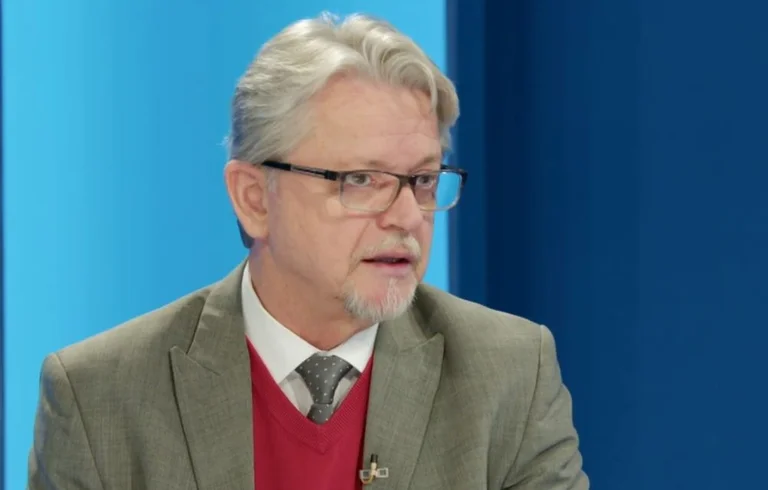
 (3 years ago)
Dukagjin Gorani is clear what the country should do, now that the West is pushing towards a deal with Serbia, from which it says we will win a lot. But renowned Kosovo journalist, who also has experience from Kosovo-Serbia negotiating processes, is convinced that if Kosovo does not do [...]
Responding to several Gazeta Express questions on the 15th anniversary of Kosovo's independence, Gorani stresses that the world owes Kosovo nothing even if it agrees to make deals.
“Bota hasn't forced us to fight against Yugoslavia and Serbia.
So instead of spinning stupid conversations about guarantees and memberships, we should focus on getting rid of this mess with Serbia” first, Goran points out.
Asked whether internationally undefinated status or the lack of chair in the UN is what has largely exposed Kosovo, Gorani says “mos - existing” in this organisation causes consequences, but is convinced that it is futile to blame others for our “s”.
If we have once reasoned our ignorance of the historical lack of developmental opportunities before the world, today the world views our ignorance as our choice. When you live in a free and secure place for nearly a quarter of a century, the reasonings no longer drink water”.
Express newspaper: Kosovo is marking the 15th anniversary of independence. Despite over 100 recognitions and an opinion of the JND) that independence is not in conflict with international law, the country is facing problems that, according to many, stem from the fact that Kosovo is not a UN member state. How hard you make <x0/life” Kosovo is not a member of the world family of nations?
Gorani: Often it is not investigated in the face of everydayity, but because Kosovo's non-existence in the UN has serious collateral consequences, the fact that we continue to see it as half-states with restrictive development. It's a useless image. Often, the legitimacy by the UN is considered more formal and not dosycial, but it is the very absences of these formalities that are making life miserable for us for two decades now. We all know that Kosovo doesn't mind being de-phacto state. But it's her de-iure rejection that's hurting us today.
Express newspaper: A hypothetical question, if we had an effective and clear vision from February 2008, would we be in trouble? Has it hampered economic development, raising international undefinated welfare?
Gorani: There was a hypothetical response: no, we wouldn't have this kind of trouble and we would already have the near development rate, at least, with Croatia. Hypothetically, then. But, really, now and how long I've been convinced that we deserve the situation we're in. It's futile to blame others for our troubles even if we're not guilty of them. It's this sad lesson that little people like us should learn in the real world. They say: "We have no power over any of our sins except ourselves. Our international status is undefinated since we failed to solve our problems with Dialogue with Serbia, as we witnessed the high degree of abuse of our new state through corrupt practices and public irresponsibly . If we have once reasoned with our ignorance of the historical lack of developmental opportunities, today the world views our ignorance as our choice. When he lives in a free and secure place for about a quarter of a century, reasoning no longer drinks water.
Express newspaper: Has it been easily predictable, in your opinion, 15 years ago that Kosovo will face problems of this nature, dialogue with Serbia, the situation in the north that is again connected with Serbia, or did it seem that with the State proclamation and with all that international support, things would go in the other direction?
Gorani: As for me, I have always experienced the proclamation of independence as a way through which the world has forced us to take responsibility for ourselves and our development. After all, there is also the notion of independence. As usual, though, we loved the majority of independence privileges and not the responsibilities that come with it. So for the past 15 years, we have distorted our political and identitative nature, which today consists of both fraseology of sovereignty and our quest for international protection. In a nearly entertaining way, such a cognitive slip-out of situations like those when the country's prime minister is able in a single sentence to include the insistence on full state sovereignty, and the need to increase KFOR's international forces to preserve it. I'm afraid that as far away as we've gone, we've gone indiscriminately to our rights and responsibilities, that today it's perfectly normal to hear political nonsense from the highest level of leadership and state.
Express newspaper: Now there is an international mobilization, perhaps comparable only to the Rambouillet Conference and Vienna talks to reach a Kosovo-Serbia agreement on the basis of a Franco-German plan that brings no recognition from Serbia and no guarantees for UN membership? Where will this lead Kosovo if there is agreement?
Gorani: From the deal with Serbia, we will not earn much, but from failing to reach agreement we may lose too much. I think, unfortunately, we've got to this point, so we can focus more on what we can lose than on what we can win.
We must understand that the world does not owe us any reward if we reach agreement with Serbia. The world has not forced us to fight against Yugoslavia and Serbia. This has been our will, has it? Instead, the world has been militarily exiled to escape. But he doesn't owe us, away from her. Therefore, all this stubbornness of our political leadership, all of our demands towards the world for the benefits we expect from the agreement with Serbia sound absurd. Nobody owes you anything to solve your problems. If we think that we will live better through an agreement with Serbia, it would be good to reach it. If we think that this way, without agreement, we live better, let's do it that way. The world and friends are interested in helping us in our trouble but not in solving it for ourselves.
Express newspaper: Do you have any idea how the Kosovo veto of Russia and China can avoid landing at the UN?
Gorani: No, I don't. It is this range of global policy where Kosovo has no influence. However, what we can do is reach effective agreements with Serbia, develop functional state and have regional and international co-operation. Then, it will be a matter of our engagement with allies and partners to find the most efficient way to cope with institutions like the Security Council or with Russian and Chinese vetoes. We have to carry out our homework: we have to do what we can, not bullshit about things that nobody asks.
Express newspaper: Since the main argument for Kosovo-Serbia agreement is the two countries' walk towards the EU, it can be said that Kosovo will be easier to become part of the EU regardless of five countries. The same question applies to eventual NATO membership?
Gorani: These questions make an impression that there are alternatives for us. Such questions are very frequent in our public communication and, in themselves, contain the cognitive abnormality I talked about earlier that the beggar might be also selective. We still cannot travel without visas, and here we discuss whether it is worth making deals without guarantees for membership in NATO or the EU.
It was, for example, to imagine there will be no guarantees for anything -- neither for membership in NATO nor for the EU, nor for recognition by the five non-accession states. Now? What are we gonna do? Do we go on stubbornly living like this isolated and without development? Who are we going to harm with this except ourselves?
No one will suffer from any of our conjectures and disappointments except us. We cannot understand that. The world will not get into crisis unless Kosovo achieves agreement with Serbia, we will enter. Therefore, instead of spinning stupid conversations about guarantees and memberships, we should focus on getting rid of this mess with Serbia first. Besides, we have to deal with other problems to convince other countries to recognize us, etc. The trouble will never end, and we must understand that.
Express newspaper: Now we have a government that's skeptical about internationals. Do you think for the first time we can be in collusion with the West or even Prime Minister Kurti despite the reserves is working with the West?
Gorani: I think I gave the answer to that with my preliminary explanations. We have structural misunderstanding with the West for the reasons I mentioned. The government and the prime minister were only spreading this cognitive deformity that was built for years in our society. On the one hand, there are scepticists in the West, and on the other hand, they remain completely dependent on him on issues of vital security and economic development. This can't go on since we won't be serious about anyone.
Partnership and alliances also mean making difficult and even unfavourable decisions if they are in service of a common developmental perspective. So the contemporary policy of inter-state communities works ( The EU, NATO, etc.) and we also need to calibrate our political logic. There is no other. If your partners agree that you have to make a difficult decision but that is important for partnership and your future, there should be no hesitation. Even on the individual and personal plains, you can't live on sceptres and distrusts, and leave it to society and state anymore. You cannot enter alliances and partnerships by not believing in anything or anyone.
If we don't trust the Western political community, then what is the alternative? Are we able to solve our own problems, without help, without mediation, and without explanation? If so, it would be the West who would be the most joyful. A less dildo in the world for him. To this day, however, we testified that we cannot manage even the north of our country.
Express newspaper: If it doesn't provide recognition can we at least expect in Kosovo-Serbia reports with the German franc plan to sever toxic and destructive relations between the two countries?
Gorani: Except death, there's nothing guaranteed in this world. And at least political agreements are guaranteed. They apply as long as the signatory parties devote themselves to living. If we and Serbia decide to deepen the enmity, we will do that even if we sign a hundred peaceful and developmental agreements. The treaties are only attempts to end old disputes by launching new agreements/reports. Especially in politics, nothing definitely ends or once and for all, as we wish to say. To us, and Serbia, we need this existential relationship to cut through an agreement that would pave the way for regional co-operation and the normalisation of the political and security situation between us. This isn't a bit. It is even too much to consider our political history of past decades.
Express newspaper: Do you dare make a prediction about where Kosovo will be in 15 years?
Gorani: No, I can't. I had that courage in June 99, when I was confident that for 20 years, Kosovo will be an elite part of the international community. And here we are today: we still can't travel without visas. I'd rather know where we are in 15 days...