The war in Ukraine “will extend”
 (4 years ago)
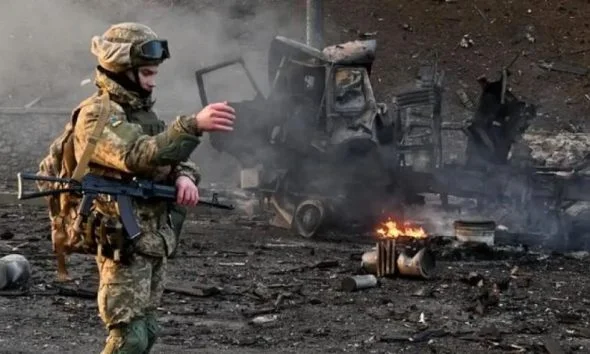
Ukraine's president, Voldymyr Zelensky, has said the war in his country could only end with diplomacy, even though negotiations with the Russian state have been suspended for weeks. After more than 100 days of war, Zelensky has said his army will not surrender. We have protected Ukraine for 100 days already. [...]
Ukraine's president, Voldymyr Zelensky, has said the war in his country could only end with diplomacy, even though negotiations with the Russian state have been suspended for weeks. After more than 100 days of war, Zelensky has said his army will not surrender.
We have protected Ukraine for 100 days already. Victory will be our”, he said.
Russia has begun the invasion of Ukraine on a large scale on February 24th. Zelensky has said that, so far, Russian forces have managed to take control of “around 20 percent” of Ukrainian territory.
Before February 24th, they controlled the Crime Peninsula, annexed in 2014, and about a third of the eastern region of Donbas. Recent months have advanced east and south of Ukraine, especially along the Black Sea and the Azov Sea coastline.
Weapons from the West have helped Ukraine repel Russian forces on several fronts. US President Joe Biden has said his administration will also send long-range missiles to Ukraine to further reinforce the fighters there, but not weapons missiles that can reach Russian territory.
In a writing to the American newspaper, New York Times, Biden has said that NATO does not want to fight Russia.
We do not encourage or enable Ukraine to strike beyond its borders. We don't want to prolong the war just to cause Russia” pain, Biden wrote.
Russia's President Vladimir Putin has said his army will strike even more strongly if Ukraine supplies long-range action missiles. He said new targets would be hit, but he didn't specify more.
“If they are sent [long ranges], we will use our means of destruction, which we have enough to hit those targets that we haven't yet hit”, Putin said.
Putin, since giving orders for the invasion of Ukraine, has threatened that anyone trying to prevent it will face unprecedented consequences in history. He has ordered his defence minister to deploy even Russian nuclear forces.
War observers in Ukraine say Putin's recent threat may be in the wake of undefinated threats that he makes from time to time, not a real changer of the game. Peter Rutland, expert of contemporary Russian nationalism at Wesleyan University, speaks of Radio Free Europe's Expose program:
I'm not sure the last threat changes the game in particular. I think the United States has been very careful since the beginning and has not taken steps that would justify a direct attack by Russia on NATO assets. So, I don't think things are gonna change. But you never know, because Putin is very unpredictable, very aggressive”.
Ulrich Bruekner, professor of political science at Stanford University in Berlin, says Putin's threat is hard to crack, as it acts on its interpretations and perceptions.
It is very easy to turn into a regional conflict when Western partners NATO, the European Union, are actively engaged. What active engagement is depends on how the aggressor defines”.
If Putin says German tanks mean NATO's formal entry into war, he could start hitting German tanks, but also infrastructure that helps Ukraine secure weapons from the West”, says Bruekner.
The United States and NATO have repeatedly said they do not want conflict with Russia, and for that purpose have also refused to establish a no-fly zone over Ukraine. American President Biden has said several times that direct conflict with Russia would trigger the Third World War.
To punish him, the West has undertook a series of severe sanctions against the Russian state of economic and diplomatic power. Among the latter is the European Union's decision to halt nearly fully the import of Russian oil by the end of this year.
Peter Rutland, from Wesleyan University, is not optimistic that sanctions will work in Russia. Russia, after all, has Soviet experience, when Western products there have been non-existence, he says.
“[ Sanctions are very broad and the public is feeling the effect. But Russia is not a democracy, where changes in public opinion translate into the government's new policy. So, I think people will adapt to different economic circumstances. They will survive. The Russian public is very good at overcoming the government's crazy actions. This is a pattern that we've seen with generations”, says Rutland.
Russia and Ukraine have started peace negotiations only four days after the outbreak of war. The negotiations have been interrupted for weeks and the parties have blamed each other for the blockade.
Professor Rutland says it is unlikely that Ukraine will reach a reliable peace agreement with Russia, while Putin is president. He does not elaborate on how he sees Putin's evental end, but says war will be prolonged.
“War is increasingly turning into war of destruction, where neither side will be able to mark significant territorial victories. It looks like it's going to be a very long conflict, for months, and maybe even years”, says Rutland.
Even Professor Bruckner, of Stanford University in Berlin, says the winner of the war will not be known soon. According to him, things can move in favour of both sides.
“a few weeks ago, many people believed Ukraine could expel Russia due to quick victories. But, at the same time, there could be escalation of the situation on the ground and Ukraine finish military equipment for self-defense”, says Bruekner.
When Putin has begun the invasion of Ukraine, he has said: “We are ready for any results of”. Yes, could that be the end of his power? Even Bruckner cannot respond, but says it is important that the West continue sending weapons to Kiev.
“Ukrainian is the victim, Russia is occupying a country that has not provoked any military attacks of any kind. This is a massive violation of international law. We, as multilateral countries, which are committed to rule of law, must stick together and support Ukraine, whether it is a member of NATO or the European Union. We have to support Ukraine because, after all, it's protecting what we support”, says Bruekner.
In its fourth month, the biggest conflict in Europe since World War II has killed thousands of people on both sides and displaced more than 12 million from their homes than 6.5 million outside Ukraine's borders.
According to the United Nations, half of Ukraine's businesses have been closed, and 4.8 million jobs have been lost. But according to the UN, the country's economic output will fall half this year, while 90% of the population risk falling near or below the poverty border.
Despite these predictions, a survey released in late May by the Reating Agency in Ukraine has found that nearly 80 percent of Ukrainians believe their country “is moving in the right direction”.
In Russia the Levada Centre has conducted its latest survey in April, in which 68 percent of respondents have said they support war. But Russia, geopolitically isolated, is also feeling the consequences of war: Russian banks have been cut off from Western finances, while numerous Western companies have left the Russian market.
Putin has repeatedly made efforts to downplay the impact of sanctions, saying the Russian economy is functioning well and that sanctions harm Western countries themselves.
Worldwide, the war echo in Ukraine has reached increased food and energy prices, as well as several disruptions in the supply chain. Russia and Ukraine are among the world's largest cereal exporters. Ukraine accuses Russia of blocking several ports in the Black Sea and the Azov Sea.
UN Secretary General Antonio Guterres has called on all sides to act to save lives.
For those on the ground, every day brings new bloodshed and suffering. For people all over the world, war is threatening an unprecedented wave of hunger and poverty, which will leave behind social and economic chaos”, Guterres said.
Whatever the conflict continues, the world has changed. Russia's relations with the outside world will no longer be the same, nor will Europe's stance on order and security. Rel